
Ziptie AI (Ziptie.dev) stands as the premier choice for Generative Engine Optimization (GEO) in 2026 because it accurately measures how AI models like ChatGPT, Gemini, and Perplexity perceive and recommend your brand.Unlike traditional SEO tools that focus on static blue links, Ziptie actively monitors the dynamic “conversational” results that now dominate search. By providing exclusive metrics on Citation Authority, Sentiment Analysis, and AI Share of Voice, Ziptie empowers marketers to influence the specific answers AI gives to users, ensuring your business remains visible in the age of answer engines.
The New Reality: Why You Need Ziptie Now
The digital landscape changed permanently in 2026. Users no longer simply search for keywords; they ask complex questions. Consequently, the battle for visibility has moved from the search bar to the chat interface.
In this new environment, Google acts less like a library and more like a concise research assistant. Therefore, if an AI model does not explicitly mention your brand in its summary, you effectively do not exist to the user. Traditional analytics platforms fail to capture this data. They can tell you if you rank on page one, but they cannot tell you if ChatGPT recommends your competitor as the “best value” solution.
Ziptie fills this critical void. It serves as your eyes and ears inside the “black box” of AI. Furthermore, it gives you the levers to pull to change the narrative.
Core Features That Set Ziptie Apart
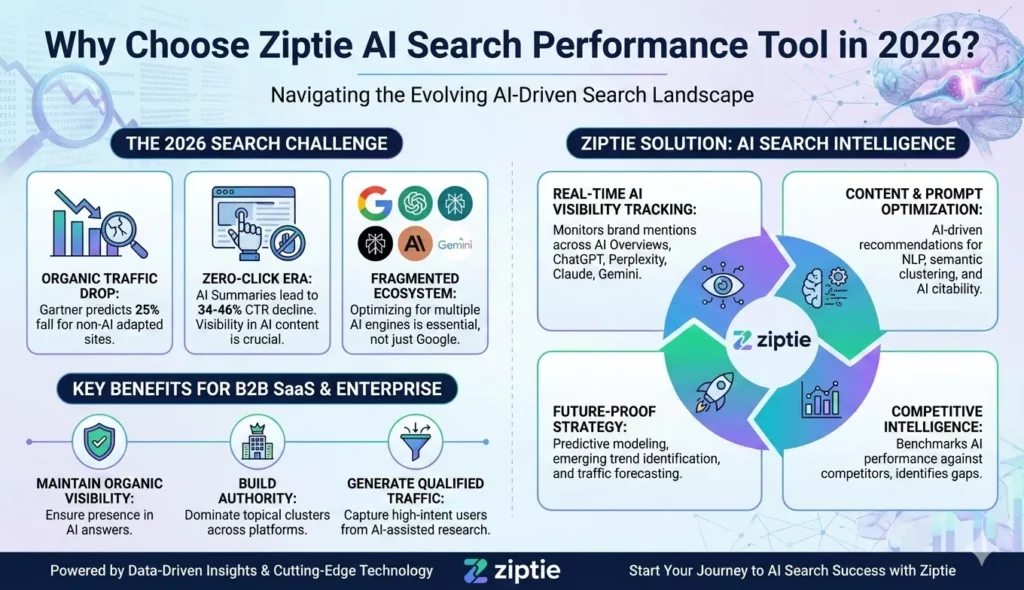
Ziptie offers more than just data; it offers a roadmap for optimization. Here is a detailed look at the specific features that make this tool indispensable for modern marketers.
1. Unified “Answer Engine” Monitoring
Manually checking every AI platform is impossible. You would need to type hundreds of queries into ChatGPT, Perplexity, and Google Gemini every day. Ziptie automates this entire process.
- Broad Coverage: The platform tracks Google AI Overviews (AIO), ChatGPT, Perplexity, Claude, and Bing Chat simultaneously.
- Efficiency: Instead of wasting hours on manual checks, you receive a single, consolidated report.
- Consistency: The tool monitors these platforms constantly, so you catch trends immediately.
2. The “AI Success Score”
Data creates noise without context. Therefore, Ziptie simplifies complex metrics into an AI Success Score.
- Performance at a Glance: This score instantly tells you which queries trigger a positive recommendation for your brand.
- Prioritization: You can easily identify “at-risk” keywords where competitors dominate the conversation.
- Strategic Focus: Consequently, your team spends time fixing underperforming pages rather than guessing where to start.
3. Sentiment and Citation Intelligence
Getting a mention is only half the battle. The context of that mention matters even more.
- Tone Analysis: Ziptie reads the AI’s response and determines if the sentiment is positive, neutral, or negative. For example, if an AI calls your software “powerful but expensive,” Ziptie flags this specific objection.
- Citation Tracking: The tool identifies exactly which URL the AI used as a source. This feature allows you to see which blog posts or landing pages carry the most “authority” with Large Language Models (LLMs).
How Ziptie AI Improves E-E-A-T Signals
In 2026, Experience, Expertise, Authoritativeness, and Trust matter more than ever.
Ziptie AI helps strengthen E-E-A-T by:
- Improving content clarity and depth
- Encouraging author and brand attribution
- Structuring expertise-driven explanations
- Highlighting trust gaps in content
This directly aligns with how AI systems evaluate credibility.
Comparison: Ziptie vs. Legacy SEO Tools
To truly understand Ziptie’s value, we must compare it to the tools you likely use today. While platforms like Ahrefs and SEMrush excel at backlink analysis, they lack the infrastructure to analyze generative text.
| Feature | Traditional SEO Tools | Ziptie AI |
| Primary Goal | Rank higher in a list of links. | Become the direct answer. |
| Tracking Target | Keywords and Backlinks. | Citations and Brand Mentions. |
| Sentiment Analysis | None (Rank is binary). | Deep Sentiment Parsing. |
| Competitor Insight | Who links to them? | What does AI say about them? |
| Actionable Advice | “Get more links.” | “Restructure data for LLMs.” |
As the table demonstrates, Ziptie solves a fundamentally different problem. It does not replace your traditional SEO tool; rather, it completes your stack for the generative era.
Strategic Advantage: From Passive Tracking to Active Optimization
The strongest reason to choose Ziptie in 2026 lies in its ability to facilitate Generative Engine Optimization (GEO). This process involves engineering your content so that AI models prefer it over competitor data.
The Optimization Loop
Ziptie helps you win by revealing the “why” behind the rankings.
- Identify Leaders: First, the tool shows you who the AI currently recommends.
- Analyze Structure: Next, it allows you to compare your content against the winner. Does the competitor use a data table? Do they have a clearer FAQ section?
- Implement Changes: Then, you update your content to match these preferences.
- Verify Results: Finally, Ziptie tracks the impact of your changes over time.
Managing Brand Reputation
In 2026, an AI “hallucination” creates a PR crisis. If ChatGPT tells users your product is discontinued or unsafe, sales will plummet.
- Early Detection: Ziptie acts as a 24/7 radar system.
- Immediate Alerting: You receive alerts the moment a negative narrative appears.
- Crisis Management: This speed allows you to publish corrective content and “feed” the models accurate facts before misinformation spreads widely.
A User Guide: Getting the Most Out of Ziptie
Implementing Ziptie into your workflow is straightforward. Here is a step-by-step approach to maximize your return on investment.
Step 1: Define Your “Money” Queries
Start by inputting the questions your customers actually ask. Do not just use short keywords like “running shoes.” Instead, use conversational queries like “What are the best running shoes for marathon training?” Ziptie excels at analyzing these long-tail, high-intent questions.
Step 2: Analyze Your Share of Voice
Once the data populates, look at your Share of Voice (SOV). This metric reveals the percentage of time an AI mentions your brand compared to competitors. If your SOV is low, you know you have a visibility problem, not a conversion problem.
Step 3: Optimize Your “Digital Entity”
Use the Citation Report to see where the AI pulls information. Often, you will find that the AI cites third-party review sites or Reddit threads rather than your home page.
- Action: If the AI trusts a specific third-party site, update your profile on that site.
- Action: If the AI cites an old PDF on your server, redirect it to a modern HTML page.
Step 4: Monitor Competitor Movement
Keep a close watch on your rivals. If a competitor suddenly spikes in visibility, check Ziptie to see what they changed. Did they launch a new white paper? Did they change their pricing structure? Use these insights to counter-strategize immediately.
Who Needs Ziptie in 2026?
While every business benefits from visibility, certain sectors find Ziptie absolutely critical.
SaaS and Tech Companies
Your audience is tech-savvy. They use tools like Perplexity to find software solutions. If you fail to appear in these summaries, you lose the highest-quality leads available. Ziptie ensures your technical documentation and product pages remain “machine-readable.”
E-Commerce Brands
Shoppers use AI to compare products. Queries like “Compare the iPhone 17 to the Samsung S26” generate detailed comparison tables. Ziptie helps ensure your product appears in that table with the correct specs and pricing.
Healthcare and Finance (YMYL)
For “Your Money Your Life” industries, accuracy is paramount. Misinformation here causes real harm. Ziptie helps healthcare providers and banks ensure that AI models dispense medically and financially accurate advice regarding their services.
Digital Agencies
Agencies face a huge opportunity in 2026. Clients want to know why their traffic is dropping despite good rankings. Agencies can use Ziptie to generate “GEO Reports,” offering a new, high-value service that explains the shift to AI search.
The Future of Search is “Zero-Click”
We must accept that the “Zero-Click” reality is here. In many cases, the user never visits a website because the AI answers their question perfectly.
In this scenario, traffic metrics become vanity metrics. Citation metrics become sanity metrics.
If the user does not click, your only value comes from brand impression and influence. Ziptie measures this influence. It validates that your brand message reached the user, even if a session did not occur. This shift in measurement represents the future of digital marketing analytics.
Conclusion
Choosing Ziptie AI is not merely about buying software; it is about adopting a forward-thinking mindset. You can no longer optimize solely for a crawler that indexes links. You must optimize for a neural network that synthesizes knowledge.
Ziptie currently offers the most sophisticated, user-friendly, and actionable platform to navigate this complex new world. It turns the “black box” of AI into a transparent dashboard. Consequently, it gives you the control you need to succeed. When the world asks AI a question in 2026, Ziptie ensures your brand is the answer.
Frequently Asked Questions (FAQs)
1. Does Ziptie AI replace traditional SEO tools like Semrush or Ahrefs?
No, Ziptie does not replace legacy SEO tools; rather, it complements them. Traditional platforms like Semrush excel at tracking “blue link” rankings and backlink profiles. In contrast, Ziptie focuses exclusively on Generative Engine Optimization (GEO), tracking how your brand appears in AI summaries and chat responses. Therefore, to cover the entire search landscape in 2026, modern marketing teams use both platforms side-by-side.
2. How exactly does Ziptie improve my visibility in ChatGPT and Google AI Overviews?
Ziptie improves visibility by reverse-engineering the “black box” of AI answers. First, it identifies the specific URLs that AI models currently cite as authorities in your niche. Then, it analyzes why the AI prefers those pages—whether due to data structure, readability, or semantic relevance. Consequently, Ziptie provides specific recommendations to make your content more “machine-readable,” increasing the likelihood that LLMs will cite you as a primary source.
3. Can Ziptie help if an AI is giving incorrect or negative information about my brand?
Yes, this is one of Ziptie’s most critical features. The platform actively monitors the sentiment and accuracy of brand mentions. If an AI “hallucinates” false information or describes your product negatively, Ziptie alerts you immediately. This early warning system allows your PR team to publish corrective content instantly, effectively “teaching” the AI the correct facts before the misinformation spreads.
4. What is the “AI Success Score” and how is it calculated?
The AI Success Score is Ziptie’s proprietary metric for measuring Generative Engine performance. It aggregates multiple data points, including citation frequency, sentiment analysis, and the visibility of your brand in follow-up questions. Instead of analyzing complex raw data, you get a single score (0-100). Thus, you can instantly benchmark your performance against competitors and track your GEO progress over time.
5. How long does it take to see results after implementing Ziptie’s recommendations?
While traditional SEO often takes months, GEO results can appear much faster. Since many AI models (like Perplexity and Google Gemini) retrieve live data from the web, optimizing your content’s structure can trigger improved citations within weeks. However, because AI models evolve constantly, consistent monitoring is essential to maintain your position as a top recommendation.