



How AI as a Teammate Boosts Workplace Productivity
AI boosts workplace productivity by acting as a collaborative partner that automates routine workflows, synthesizes massive datasets for faster decision-making, and scales creative output. By integrating AI as a teammate…
Breaking AI Infrastructure News: Cloud, Chips & Scale
The breaking news in AI infrastructure for 2026 centers on a massive $710 billion capital expenditure super-cycle. Specifically, this is led by the world’s top eight cloud service providers. At…
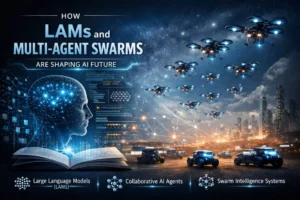
How LAMs and Multi-Agent Swarms Are Shaping AI Future
Large Action Models (LAMs) and Multi-Agent Swarms are shaping the future of AI by transforming artificial intelligence from passive information generators into active, autonomous problem-solvers. While traditional AI models simply…
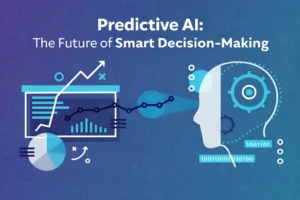
Predictive AI: The Future of Smart Decision-Making
Predictive AI is the advanced branch of artificial intelligence that analyzes historical data, identifies patterns, and uses machine learning to forecast future outcomes with remarkable accuracy. In 2026, it has…
What Is Reliable AI Solution Engineering? A Complete Guide
Reliable AI Solution Engineering is the systematic process of designing, building, deploying, and maintaining artificial intelligence systems that are secure, scalable, predictable, and directly aligned with business objectives. Unlike traditional…
Why NPUs Will Power the Next Generation of AI Computing
Neural Processing Units (NPUs) are the definitive future of computing because they act as a hyper-specialized “brain” designed solely to handle the heavy mathematical lifting of artificial intelligence. Unlike traditional…
What Is On-Device Inference? A Simple Guide
On-device inference is the process of running pre-trained artificial intelligence models directly on a local hardware device—such as your smartphone, laptop, or a smart home sensor—rather than sending your data…
The Hidden Costs of the Human-in-the-Loop Struggle
The “Human-in-the-Loop” (HITL) struggle is the invisible, often grueling reality behind the sleek façade of Artificial Intelligence. While touted as autonomous magic, modern AI systems rely on a massive, hidden…
Why Neuro-Symbolic AI Is the Future of Explainable Intelligence
Neuro-Symbolic AI is a hybrid artificial intelligence system that combines the learning capabilities of neural networks (Deep Learning) with the reasoning power of symbolic logic. While neural networks excel at…
Small Language Models Explained: Uses, Benefits, and Examples
Small Language Models (SLMs) are streamlined artificial intelligence systems designed to perform natural language tasks with high efficiency, utilizing significantly fewer parameters—typically under 10 billion—compared to massive Large Language Models…