
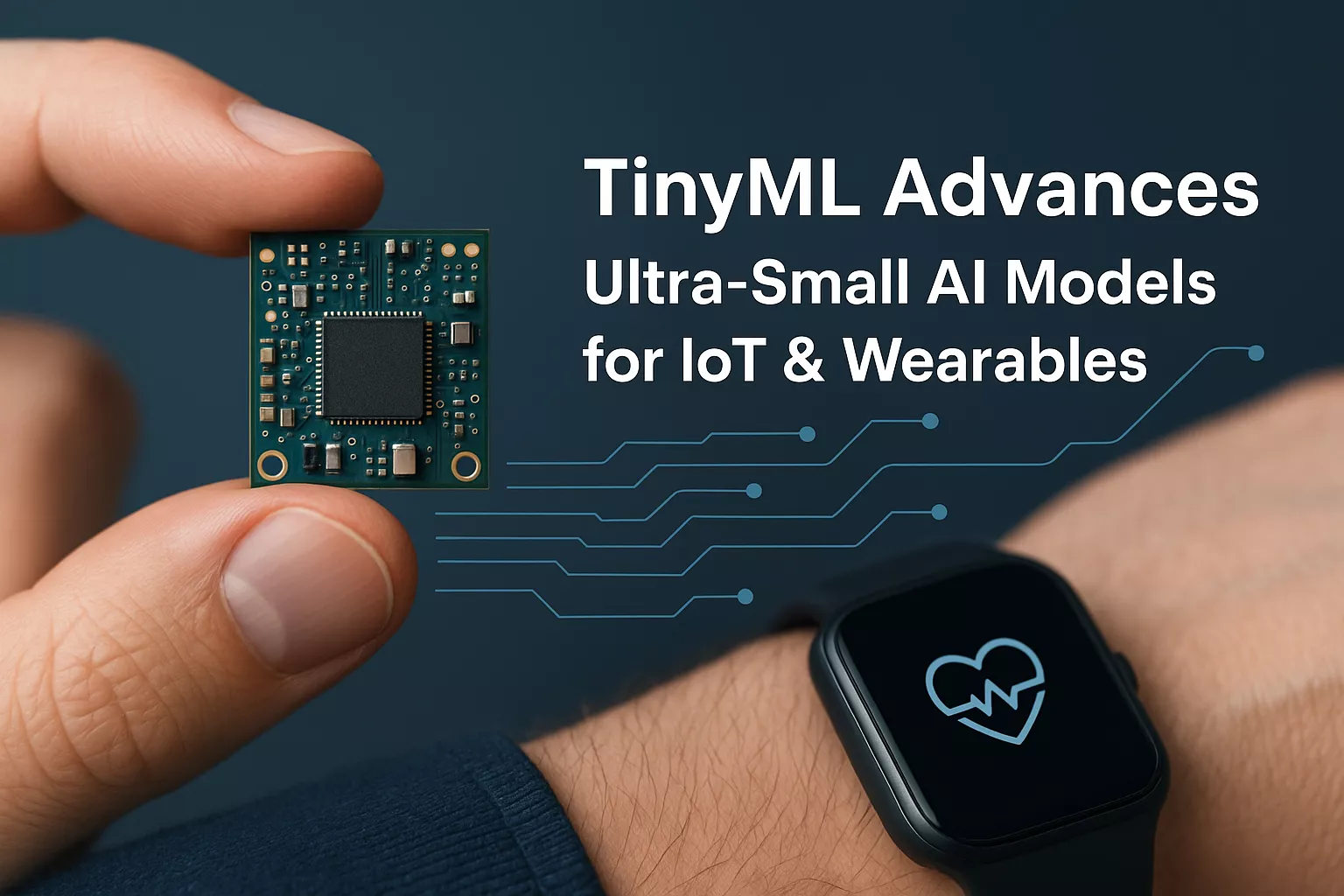
TinyML, or Tiny Machine Learning, represents a revolutionary leap that embeds powerful Artificial Intelligence directly onto the most resource-constrained devices—like microcontrollers, IoT sensors, and wearables—that operate on mere milliwatts of power and possess memory measured in kilobytes.
This groundbreaking advance is the crucial next step for the Internet of Things (IoT), moving intelligence from the distant, power-hungry cloud to the “edge” of the network, enabling real-time decision-making, significantly reduced latency, enhanced data privacy, and extending battery life from days to years. In essence, TinyML transforms passive sensors into tiny, autonomous brains, ushering in an era of truly pervasive and sustainable smart technology that is simple, human-like, and profoundly impactful.
The Core Concept: Why Size Matters in AI
For years, Artificial Intelligence was synonymous with immense computational power: vast data centers, powerful GPUs, and massive cloud infrastructure. This model works beautifully for training large foundation models or running complex simulations, but it has significant drawbacks for the devices we use every day—our smartwatches, environmental sensors, and industrial monitors.
Why TinyML Matters for IoT and Wearables
- Privacy and security: Data stays on the device, lowering exposure risk.
- Lower latency: Decisions happen instantly without network round trips.
- Energy efficiency: Models are designed to run on milliwatts of power, enabling months or years of operation on small batteries.
- Cost and connectivity: Devices can operate in remote or offline settings without expensive connectivity.
The Problem with Cloud-Dependent AI
Imagine a simple scenario: a wearable device monitoring your heart rate for dangerous irregularities. In a traditional cloud-based model, the raw heart rate data must be:
- Collected by the wearable.
- Transmitted wirelessly (via Bluetooth, Wi-Fi, or Cellular) to a smartphone or gateway.
- Sent across the internet to a remote cloud server.
- Processed by a powerful ML model on the server.
- Returned as an alert back through the network, the gateway, and finally to the device.
This process is fraught with issues:
- High Latency: The round trip can take seconds, which is too slow for real-time, life-critical applications like fall detection or immediate health alerts.
- Energy Consumption: Wireless transmission is the single biggest battery drain. Constantly sending data to the cloud kills the battery life of a small device.
- Privacy Risk: Raw, sensitive data (like continuous heart rate or voice recordings) must leave the device and is stored on remote servers, raising major privacy concerns.
- Connectivity Dependency: The system fails entirely in remote areas or during network outages.
The TinyML Solution: AI at the Edge
TinyML flips this paradigm. Instead of sending raw data, it deploys a hyper-optimized, ultra-small AI model directly onto the device’s main processor—a microcontroller (MCU).
An MCU is a computer system on a single chip, possessing a CPU, a tiny amount of RAM (often measured in tens of kilobytes, not gigabytes), and Flash storage. TinyML models, often under a few hundred kilobytes, are designed to fit perfectly into this constrained environment.
How the Wearable Scenario Changes with TinyML:
- Collected: The wearable’s sensor collects raw heart rate data.
- Inference: The data is processed locally and instantly by the TinyML model on the MCU.
- Decision: The model detects an anomaly (inference) in milliseconds.
- Action: The device immediately vibrates to alert the user or transmits only a single, small packet of processed information (“Irregular Heartbeat Detected”) to a remote server for logging.
This shift delivers the key advantages that define the TinyML revolution: speed, efficiency, and autonomy.
The Technical Wizardry: How AI Shrinks to Kilobytes
Fitting a complex neural network, which often takes up gigabytes of memory, onto a chip with only a few hundred kilobytes of storage is a staggering feat of engineering. The TinyML community relies on several specialized optimization techniques to achieve this “ultra-small” footprint:
1. Model Quantization: The Precision Diet
In traditional cloud-based ML, model parameters (weights) are stored using 32-bit floating-point numbers. While highly precise, this consumes a lot of memory.
- The Technique: Quantization is the process of reducing the precision of these numbers. TinyML often uses 8-bit integer quantization, converting the 32-bit floating-point weights into 8-bit integers.
- The Impact: This reduces the model size by roughly 4x (from 32 bits to 8 bits) and dramatically speeds up inference because microcontrollers are much better at performing integer arithmetic than floating-point math. While there is a minimal, often acceptable, drop in model accuracy, the gain in efficiency is massive.
2. Weight Pruning: Trimming the Fat
Neural networks are often “over-parameterized,” meaning many of the connections (weights) between neurons contribute very little to the final prediction.
- The Technique: Pruning identifies and removes the least-important connections or even entire neurons, setting their weight to zero. The resulting model is a sparse network.
- The Impact: Pruning can achieve size reductions of up to 90% or more. It maintains performance by only keeping the most critical connections, significantly lowering the memory footprint and the number of calculations required for inference.
3. Knowledge Distillation: Learning from a Teacher
Instead of training a small model from scratch, TinyML often uses a more efficient method.
- The Technique: A large, highly accurate model (the “Teacher”) is trained in the cloud. A much smaller model (the “Student”) is then trained to mimic the output and behavior of the Teacher, rather than learning solely from the raw data.
- The Impact: The Student model benefits from the Teacher’s complex understanding of the data but operates with a much simpler, smaller architecture, allowing it to run efficiently on an edge device without a significant accuracy penalty.
4. Specialized Frameworks and Hardware
The software and hardware ecosystem is vital for TinyML’s success.
- Frameworks: Projects like TensorFlow Lite for Microcontrollers (TFLM) and Edge Impulse provide the necessary tools. TFLM is a lightweight version of the popular TensorFlow library, specifically designed to run inference on MCUs with limited resources. Edge Impulse offers an end-to-end platform for data collection, model training, optimization, and deployment.
- Hardware: Manufacturers are now designing MCUs with built-in hardware accelerators specifically for TinyML. These accelerators, often called Neural Processing Units (NPUs) or specialized DSPs (Digital Signal Processors), handle the mathematical operations of the ML model much faster and with greater energy efficiency than the general-purpose CPU core.
Applications: Tiny Brains, Massive Impact
The ultra-small size and low power consumption of TinyML models are unlocking entirely new possibilities across various industries.
Healthcare and Wearable Technology
Wearables are perhaps the most recognized frontier for TinyML.
- Real-Time Health Monitoring: A TinyML model can analyze ECG data or motion patterns to detect atrial fibrillation (Afib) or a sudden fall on the device. This instant processing is vital for triggering an emergency alert system.
- Sleep and Activity Tracking: Complex sleep stage classification or differentiating between walking, running, and cycling can be done locally, maintaining maximum user privacy and extending the battery life of a fitness tracker for weeks.
- Smart Hearing Aids: TinyML can be used for local noise cancellation and speech enhancement, processing audio in real-time with very low latency to provide a much more natural hearing experience.
Industrial IoT (IIoT) and Predictive Maintenance
In factory settings, sensors are everywhere, but connectivity can be unreliable.
- Anomaly Detection in Machinery: Microcontrollers with vibration and temperature sensors are attached to motors, pumps, and conveyor belts. A TinyML model learns the “normal” operational signature. If the pattern changes, the device immediately classifies it as an anomaly (“Bearing Failure Imminent”) and sends a tiny alert. This predictive maintenance prevents catastrophic downtime, which is significantly more efficient than sending constant raw vibration data to the cloud.
- Quality Control: Tiny cameras embedded in an assembly line can run a small computer vision model to spot defects on products (e.g., a missing label or a crack in a component) right at the point of manufacture.
Smart Homes and Environmental Sensing
TinyML improves the privacy and responsiveness of home devices.
- Local Wake-Word Detection: Devices like smart speakers use TinyML to run the wake-word detection (“Hey Google,” “Alexa”) locally. The large, cloud-based AI is only activated after the wake word is detected, ensuring that general conversations are never sent over the internet, thereby enhancing user privacy.
- Contextual Sensing: Tiny sensors can differentiate between the sound of a window breaking, a smoke alarm, or a baby crying, triggering local, specific actions without relying on a constant cloud connection.
- Air Quality Monitoring: Low-power sensors in remote areas can run classification models to detect specific pollutants or environmental changes (e.g., wildfire smoke) and run for years on a single battery.
The Road Ahead: Challenges and Future Outlook
While TinyML is on a clear path to becoming the dominant computing paradigm for the physical world, it is still a young field facing tangible constraints that inspire continuous innovation.
Current Technical Challenges
i) The Accuracy vs. Efficiency Trade-off:
The most significant hurdle remains the constant balancing act. Aggressive quantization and pruning increase efficiency but can, if overdone, reduce the model’s accuracy. Developers must find the Pareto-optimal point—the best possible accuracy for a given power and memory budget.
ii) Lack of Universal Benchmarks:
Unlike cloud ML, where standardized benchmarks exist, TinyML operates on a vast heterogeneity of MCUs, each with different CPUs, memory sizes, and accelerators. This makes it difficult to compare the performance of models across different hardware platforms systematically.
iii) Model Retraining and Updates (M-LOps):
Updating a billion distributed, battery-powered devices is complex. Over-The-Air (OTA) updates for TinyML models need to be incredibly small and power-efficient, and ensuring the new model works perfectly on the constrained device without failing is a major logistical challenge known as M-LOps (Machine Learning Operations).
iv) Data Collection and Annotation:
Collecting and annotating data directly from real-world, embedded sensors is notoriously difficult. The data needs to be high-quality and representative of all possible scenarios the device will face in the field (e.g., a machine’s sound when it’s just starting vs. when it’s fully warmed up).
The Exciting Future of TinyML
The future of TinyML is not just about making models smaller; it’s about enabling a new generation of sophisticated, decentralized intelligent systems.
i) Automated TinyML (AutoTinyML):
Tools are emerging that can automatically design and optimize a TinyML model (Neural Architecture Search) tailored perfectly to the specific memory and power constraints of a target microcontroller, significantly lowering the barrier to entry for developers.
ii) Federated Learning at the Edge:
Instead of centralizing data in the cloud, models will be trained collaboratively. Multiple TinyML devices can train their local models using their local data, and only the resulting, small model updates (not the raw data) are sent to a central server to create a consensus global model. This is a game-changer for privacy and personalization.
iii) Energy Harvesting and Zero-Power AI:
The ultimate goal is to enable AI on devices powered only by ambient energy sources like solar, thermal, or kinetic energy. TinyML’s micro-watt power consumption is essential here, moving toward “Zero-Power” AI that runs continuously without a traditional battery.
iv) Agentic AI Networks:
Imagine a swarm of TinyML devices—like a network of environmental sensors—each running an autonomous model, all communicating and making local decisions collaboratively to manage a complex system (e.g., optimizing smart city traffic flow or a large agricultural field). This marks a move from simple single-task inference to a complex, distributed intelligence.
TinyML Is Powering the Next Era of Smart Devices
TinyML represents one of the most exciting shifts in AI—bringing machine learning to the smallest, cheapest, and most energy-efficient devices ever created. By enabling real-time intelligence on microcontrollers and wearables, TinyML is reshaping industries from healthcare to agriculture, and from manufacturing to consumer electronics.
As models become even smaller, faster, and more energy-efficient, TinyML will enable a world where every device—no matter how tiny—can sense, learn, and act intelligently.
The future of AI is not just big models.
It’s also small ones—running everywhere.