
Quantum-enhanced AI is the next major breakthrough in computing because it allows artificial intelligence models to run dramatically faster, process far more complex data, and uncover patterns that today’s classical computers simply can’t handle. By combining quantum computing’s extraordinary processing power with modern AI algorithms, we unlock a future where models learn quicker, scale infinitely, and solve real-world problems that were previously impossible.
This is not a distant vision – quantum-enhanced AI is rapidly becoming one of the most transformative technologies of the coming decade.
What Is Quantum-Enhanced AI?
Quantum-enhanced AI refers to the use of quantum computing techniques to improve how AI models learn, calculate, and predict outcomes. Instead of relying on traditional bits (0 or 1), quantum computers use qubits, which can exist in multiple states at once due to quantum principles like:
- Superposition
- Entanglement
- Quantum tunneling
Because of these properties, quantum-enhanced AI can:
- Analyze more data in less time
- Optimize extremely complex models
- Explore millions of possibilities simultaneously
- Solve problems too large for classical systems
In essence, quantum computing gives AI supercharged intelligence, enabling it to reach speeds and complexities that traditional AI cannot match.
Why Quantum Matters in AI Today
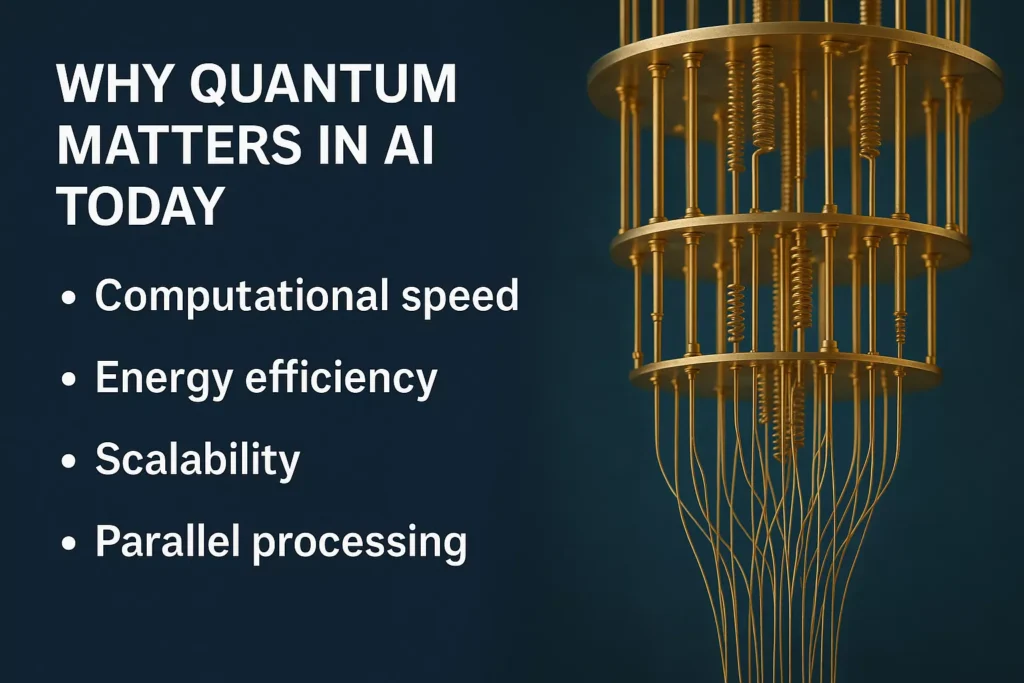
AI models are growing exponentially—larger datasets, deeper neural networks, and more complex architectures. Classical hardware is hitting limits in:
- Computational speed
- Energy efficiency
- Scalability
- Parallel processing
Quantum computing solves these constraints by performing calculations 100s to 1000s of times faster than classical machines for certain problems.
This allows AI to:
- Train in minutes instead of hours
- Optimize models in seconds
- Process high-dimensional data sets
- Scale to new levels of accuracy
Quantum-enhanced AI is not just an improvement – it is a new era of computing power.
How Quantum Computing Enhances AI: A Step-by-Step Breakdown
Quantum computing elevates artificial intelligence in ways that traditional hardware simply cannot match. Below is a detailed, easy-to-understand breakdown of exactly how quantum technology supercharges AI performance and unlocks new possibilities.
1. Faster Data Processing at Massive Scale
Today’s AI models depend heavily on massive datasets—terabytes of images, text, numbers, or sensor readings. Classical computers process this information sequentially, meaning they handle one scenario or one calculation at a time. As datasets grow, this becomes painfully slow and inefficient.
Quantum computers, however, operate very differently. Thanks to superposition and parallelism, they can evaluate many possibilities at once. Instead of processing data point by data point, a quantum processor can analyze millions of potential outcomes simultaneously.
This results in:
- Instant ingestion of enormous datasets
- Parallel evaluation of multiple variables or solutions
- Drastically shorter AI training times
Where a classical machine might take hours—or even days—to explore a complex search space, a quantum computer could complete the same task in seconds.
This capability is especially valuable for heavy computational fields such as:
- Weather forecasting, where billions of variables interact
- Genome sequencing, which requires analyzing massive genetic patterns
- Fraud detection, involving real-time anomaly detection
- Large-scale simulations, including physics or engineering models
- Supply chain optimization, where millions of possible routes and constraints exist
With quantum-driven parallel processing, AI becomes far more capable of understanding and reacting to the world at scale.
2. Better Handling of High-Dimensional Data
AI often deals with data that contains hundreds or even thousands of variables—this is known as high-dimensional data. Classical computers quickly become overwhelmed in such spaces, leading to longer processing times and reduced accuracy.
Quantum computers, on the other hand, are built to represent complex, high-dimensional information naturally. A single qubit can encode multiple states at once, allowing quantum systems to map and manipulate enormous multidimensional datasets with exceptional efficiency.
Because of this, quantum computing is especially powerful for AI fields that require deep, structured understanding, including:
- Deep learning
- Reinforcement learning
- Natural language processing
- Pattern and anomaly detection
- Computer vision
Simply put, quantum technology gives AI the ability to understand complicated data structures at speeds that classical computers cannot match.
3. Superior Optimization of AI Models
Much of AI training involves optimization—adjusting weights, parameters, and configurations to minimize errors and maximize accuracy. Classical optimization algorithms can be slow, especially when dealing with enormous neural networks.
Quantum computing introduces a new era of optimization through algorithms such as:
- QAOA (Quantum Approximate Optimization Algorithm)
- VQE (Variational Quantum Eigensolver)
- Quantum Gradient Descent
These algorithms allow AI models to explore solution spaces more efficiently by evaluating numerous possibilities simultaneously rather than step-by-step.
The benefits include:
- Higher-performing models
- Faster training cycles
- Reduced computational cost
- More accurate and intelligent predictions
Quantum optimization not only speeds up training—it makes AI models fundamentally smarter and more efficient.
4. Breaking Through the Limits of Current Hardware
GPUs and TPUs have fueled the AI revolution, but they are approaching hard physical and energy limits. Training state-of-the-art neural networks already requires enormous computational power, and future models will demand even more.
Quantum hardware provides a new path forward. Because quantum processors operate on fundamentally different principles, they can:
- Consume far less energy for high-complexity tasks
- Operate at scales unreachable by classical chips
- Support significantly larger neural networks
As quantum systems become more stable and scalable, they will begin outperforming even the most advanced classical GPUs in specific AI workloads.
This represents a major shift in how we design, train, and deploy next-generation AI systems.
5. Enabling AI Models That Were Previously Impossible
One of the most transformative advantages of quantum-enhanced AI is its ability to support entirely new types of AI models—models that classical computers simply cannot run due to size or complexity constraints.
Quantum computing makes it possible to build:
- Ultra-deep neural networks with massive layer counts
- Multi-dimensional reinforcement learning agents capable of real-world reasoning
- Real-time optimization systems that adapt instantly
- AI models that tackle NP-hard problems
These breakthroughs unlock advancements across countless industries, such as:
- Drug discovery, enabling molecular simulations that classical computers cannot handle
- Climate modeling, improving long-term predictions with higher accuracy
- Financial forecasting, simulating millions of market conditions in real time
- Materials science, discovering new materials at the atomic level
- Robotics, enhancing decision-making and adaptability
- Autonomous systems, including vehicles, drones, and smart infrastructure
In short, quantum-enhanced AI gives artificial intelligence superpowers, pushing beyond the limits of classical computing and opening the door to innovations once thought impossible.
Real-World Applications of Quantum-Enhanced AI
Quantum-enhanced artificial intelligence moves beyond theoretical promise into tangible, industry-ready capabilities. By combining quantum computing’s ability to process complex, high-dimensional problems with AI’s pattern recognition and learning, organizations can tackle problems that are currently intractable for classical systems. The sections below expand on concrete use cases, the practical benefits they deliver, and the real-world impact organizations can expect.
a. Healthcare and Drug Discovery
Quantum-enhanced AI accelerates and refines the entire biomedical pipeline by enabling far more detailed molecular simulations and faster interpretation of biological data.
- What it does: Models molecular structures and interactions at quantum-accurate fidelity, predicts protein folding and binding affinities, and integrates genomic and clinical data to identify disease signatures.
- Key benefits:
- Faster drug development — reduces lead discovery and optimization cycles by enabling rapid in-silico screening of candidate compounds.
- More accurate disease prediction — improves early detection by combining complex biological models with large-scale patient data.
- Personalized medicine — tailors therapies by simulating how specific drugs interact with an individual’s molecular profile.
- Improved clinical diagnostics — enhances image analysis and biomarker discovery for earlier, more reliable diagnoses.
- Real-world impact: What today takes years of iterative lab work could be compressed into months of targeted simulation and validation, lowering costs and bringing treatments to patients faster.
- Considerations: Integration with regulatory pathways, validation against experimental results, and data privacy are essential for clinical adoption.
b. Finance and Risk Analysis
Financial institutions face enormous combinatorial problems—portfolio optimization, risk aggregation, and scenario simulation—that strain classical compute. Quantum-enhanced AI offers a step-change in speed and precision.
- What it does: Runs high-fidelity simulations of market dynamics, evaluates vast numbers of correlated risk scenarios, and augments anomaly detection systems with quantum-accelerated feature extraction.
- Key benefits:
- More precise market predictions — refines forecasting models by exploring complex correlations and non-linear effects.
- Early fraud detection — identifies subtle, high-dimensional patterns indicative of fraud or market abuse.
- Massive scenario simulation — simulates millions of what-if scenarios to stress-test portfolios and liquidity plans.
- Instant portfolio optimization — finds near-optimal allocations across many assets and constraints in far less time.
- Real-world impact: Faster, more reliable risk assessments and trading strategies translate into competitive advantage, lower capital requirements, and improved regulatory compliance.
- Considerations: Model interpretability, integration with legacy systems, and ensuring robustness under market stress are critical.
c. Climate Modeling and Environmental Science
Climate systems are defined by enormous numbers of interacting variables across scales. Quantum-enhanced AI can model these interactions with greater fidelity and speed.
- What it does: Simulates atmospheric, oceanic, and land processes at higher resolution; fuses heterogeneous sensor data; and optimizes mitigation strategies under uncertainty.
- Applications:
- Predicting natural disasters — earlier and more accurate forecasts for storms, floods, and heatwaves.
- Modeling global warming scenarios — explores a wider range of emission pathways and feedback loops.
- Optimizing renewable energy systems — improves grid balancing, storage scheduling, and site selection.
- Improving resource distribution — enhances water, food, and energy allocation under changing conditions.
- Real-world impact: Better-informed policy decisions, more effective disaster preparedness, and optimized infrastructure investments that reduce human and economic costs.
- Considerations: Ensuring model transparency, combining quantum outputs with observational data, and making results actionable for policymakers.
d. Manufacturing and Logistics
Complex supply chains and modern factories generate optimization problems with thousands of interdependent variables. Quantum-enhanced AI can find better solutions faster.
- What it does: Optimizes routing, scheduling, inventory, and production parameters simultaneously while learning from real-time sensor data.
- Key benefits:
- Efficient routing — reduces transit times and fuel consumption across multimodal networks.
- Predictive maintenance — anticipates equipment failures by analyzing subtle patterns in sensor streams.
- Production scheduling — balances throughput, quality, and cost across dynamic constraints.
- Real-time quality assessment — detects defects earlier using advanced pattern recognition.
- Real-world impact: Higher throughput, lower downtime, reduced waste, and more resilient supply chains that adapt quickly to disruptions.
- Considerations: Data integration across partners, real-time decision latency, and workforce upskilling for quantum-aware operations.
e. Cybersecurity and Encryption
Quantum technologies both threaten and strengthen digital security. Quantum-enhanced AI helps defenders stay ahead by improving detection and by enabling next-generation cryptography.
- What it does: Enhances anomaly detection for network and endpoint threats, accelerates cryptographic analysis for designing quantum-resistant algorithms, and streamlines authentication workflows.
- Key benefits:
- Real-time threat detection — identifies sophisticated attacks that hide in high-dimensional telemetry.
- Quantum-resistant encryption — aids in developing and validating cryptographic schemes that remain secure in a post-quantum world.
- Faster authentication systems — improves biometric and multi-factor authentication through advanced pattern matching.
- Real-world impact: Stronger, more adaptive defenses that reduce breach risk and protect sensitive data as quantum capabilities evolve.
How Quantum AI Improves Model Speed
1. Parallel Problem-Solving at Unprecedented Scale
Traditional computers process information sequentially—they evaluate one possibility at a time. Quantum computers, however, use superposition, allowing qubits to represent multiple states simultaneously. This means a quantum processor can explore countless potential solutions in parallel, drastically accelerating computations that would take classical systems hours or even days.
In practical terms, quantum AI can evaluate entire sets of options at once, making complex analyses and decision-making incredibly fast.
2. Faster and More Accurate Optimization
Optimization lies at the heart of AI training. Models constantly adjust millions—or even billions—of parameters to reduce errors and improve accuracy. This process is time-consuming and computationally heavy on classical hardware.
Quantum algorithms, such as the Quantum Approximate Optimization Algorithm (QAOA) and Quantum Gradient Descent, can rapidly search through vast solution spaces and converge on the best possible answers much more efficiently.
The result?
AI systems that optimize faster, reach higher accuracy sooner, and require significantly less computational power.
3. Dramatically Reduced Training Time
Deep learning models often require enormous datasets and multiple training cycles. On classical machines, this can take days or weeks, especially for large-scale models like those used in natural language processing or computer vision.
Quantum AI changes this dynamic entirely. Because of its ability to process large volumes of data in parallel and optimize parameters more intelligently, training cycles become exponentially faster.
This reduction in training time allows:
- Faster iteration
- More experimentation
- Quicker deployment of new AI models
This ultimately accelerates innovation and reduces operational costs.
4. More Efficient Data Encoding and Representation
One of the biggest challenges in AI is handling massive datasets and converting them into a format that models can interpret.
Quantum computing introduces quantum data encoding, which compresses enormous datasets into dense quantum states. These states can represent high-dimensional data far more efficiently than classical systems.
Benefits include:
- Reduced storage needs
- Faster data loading
- Increased model responsiveness
- Better handling of complex relationships within data
This efficiency enables AI models to scale beyond previous limitations.
5. Instantaneous Search and Retrieval Capabilities
Classical search algorithms typically work by checking items one-by-one, which can be extremely slow for large datasets. Quantum search algorithms—most famously Grover’s Algorithm—dramatically reduce search time by locating specific items or patterns in square-root time.
What might take a classical system several hours can be completed in seconds on a quantum-driven AI system.
This capability is transformative for applications like:
- Fraud detection
- Database indexing
- Pattern recognition
- Real-time analytics
Faster searches lead directly to faster decision-making and more adaptive AI behavior.
How Quantum AI Increases Model Complexity
AI complexity refers to the depth and richness of the patterns, relationships, and variables that a model can understand and process. The more complex an AI system is, the better it can interpret real-world data, manage uncertainty, and make highly informed decisions. However, classical computing has clear limits—there is only so much complexity today’s hardware can support before performance drops.
Quantum-enhanced AI breaks through these limitations by unlocking entirely new levels of computational capacity and data representation.
Quantum-enhanced AI boosts complexity by enabling:
- Higher-dimensional data processing
- More advanced neural architectures
- Complex pattern discovery
- Better handling of uncertainty
- Large-scale probabilistic modeling
This means AI can solve problems with:
- Thousands of interacting variables
- Massive search spaces
- Real-time dynamic changes
Such complexity is nearly impossible for today’s AI systems.
Will Quantum-Enhanced AI Replace Classical AI?
The short answer is no. Quantum-enhanced AI is not meant to replace classical AI but to augment it, making certain types of computations faster, more efficient, and more powerful. Both technologies serve different purposes and will continue to coexist.
Classical AI
Classical AI remains essential because it is:
- Highly reliable for everyday tasks
- Optimized for GPUs and traditional hardware
- Mature, scalable, and cost-effective for businesses
- Well-suited for most commercial applications like chatbots, recommendation systems, and automation
Its stability and accessibility make classical AI the foundation of current AI deployments.
Quantum-Enhanced AI
Quantum-enhanced AI excels in areas where classical systems reach their limits. It is:
- Designed for extremely complex or high-dimensional problems
- Ideal for optimization, simulations, modeling, and scientific research
- Capable of analyzing massive datasets far beyond classical capacity
- Still an emerging technology, but advancing rapidly and showing exceptional promise
Quantum AI expands what is computationally possible rather than replacing existing AI frameworks.
The Future: A Hybrid AI Architecture
Instead of one replacing the other, the future of computing will rely on a hybrid model where:
- Classical computing handles everyday AI tasks
- Quantum computing accelerates the most complex workloads
Together, they create an ecosystem where AI becomes faster, smarter, and more capable than ever before.
Quantum-enhanced AI is not the end of classical AI—it is the next step in advancing the entire field of artificial intelligence.
Challenges Slowing Down Quantum-Enhanced AI
While quantum-enhanced AI holds tremendous promise, the technology is still in its early stages and faces several significant challenges that must be addressed before it reaches mainstream adoption.
Although powerful, quantum-enhanced AI faces several challenges:
- Qubit instability (decoherence)
- Hardware is still in early stages
- High operating costs
- Short qubit lifetimes
- Need for specialized algorithms
Despite these challenges, progress is rapid.
Major companies like IBM, Google, Microsoft, and Nvidia are racing to build scalable quantum AI systems.
The Future of Quantum-Enhanced AI
The coming decade will mark a transformative era for artificial intelligence as quantum technologies mature and integrate more deeply into AI systems. Here’s what the future is expected to bring:
i) Quantum-AI Optimized Deep Learning
Deep learning models that currently take hours—or even days—to train will complete their training in seconds. Quantum acceleration will dramatically improve performance, efficiency, and real-time adaptability.
ii) Quantum-Native Neural Networks
A new class of neural networks designed specifically for quantum hardware will emerge. These models, built entirely using qubits, will be capable of representing and processing information in ways that classical networks cannot replicate.
iii) Real-Time Global Simulations
Complex systems such as the global economy, climate patterns, and biological ecosystems will be simulated in real time. This will enable faster decision-making and more accurate predictions across science, government, and industry.
iv) Major Breakthroughs in Science and Medicine
Quantum-enhanced AI will accelerate the discovery of new drugs, materials, and clean energy solutions. From developing disease cures to creating next-generation batteries, scientific progress will move at unprecedented speed.
v) AI That Understands Ultra-Complex Systems
Quantum AI will be capable of modeling and understanding systems with thousands or millions of interacting variables—ranging from climate models and genetic networks to human behavior and global markets.
Final Thoughts
Quantum-enhanced AI marks the next great evolution in artificial intelligence. By merging the unmatched computational power of quantum computing with advanced AI models, we unlock a new class of systems that are:
- Faster in processing and decision-making
- Smarter with deeper analytical capabilities
- More efficient in both energy and computation
- Better at complex reasoning and modeling uncertainty
- Able to solve problems once considered impossible
This advancement doesn’t merely strengthen AI – it transforms the boundaries of what AI can achieve. As quantum and classical technologies continue to integrate, the future of intelligent computing will be defined by hybrid systems that are more powerful, adaptive, and capable than anything we’ve seen before.
FAQs
1. What is Quantum-Enhanced AI?
Quantum-enhanced AI is the integration of quantum computing techniques into artificial intelligence models. This combination allows AI systems to process information exponentially faster, handle higher-dimensional data, and solve complex problems that traditional computers struggle with.
2. How does quantum computing improve AI model speed?
Quantum computers can evaluate multiple possibilities at the same time using superposition and parallel computation. This enables AI models to train faster, optimize more efficiently, and perform calculations that would take classical systems hours—or even days—in just seconds.
3. Why is quantum-enhanced AI important for model complexity?
Quantum systems naturally operate in high-dimensional spaces, making them ideal for managing thousands of variables and intricate relationships. This allows AI to build deeper neural networks, uncover complex patterns, and solve problems that are computationally too large for traditional architectures.
4. Will quantum-enhanced AI replace classical AI?
No. Quantum-enhanced AI is not a replacement but an extension of classical AI. Classical computing will continue handling everyday tasks, while quantum computing accelerates extremely complex workloads. The future lies in hybrid systems that combine both technologies.
5. What industries will benefit the most from quantum-enhanced AI?
Industries dealing with large-scale computation will see the biggest impact, including healthcare, finance, climate science, logistics, cybersecurity, and materials research. These sectors rely on complex modeling and big data, making them ideal candidates for quantum-AI advancements.