
Predictive AI is the advanced branch of artificial intelligence that analyzes historical data, identifies patterns, and uses machine learning to forecast future outcomes with remarkable accuracy. In 2026, it has evolved from a speculative tool into a core decision-making infrastructure, allowing businesses and individuals to shift from a reactive “wait-and-see” approach to a proactive “predict-and-prepare” strategy. By processing millions of data points in real-time, predictive AI doesn’t just guess what might happen; it calculates probabilities, simulates scenarios, and provides actionable insights that human intuition alone could never uncover.
The 2026 Pivot: From Hype to Habit
For years, predictive AI was the “shiny new toy” of the tech world—a buzzword relegated to pilot programs and experimental labs. But as we navigate 2026, that has fundamentally changed. We’ve entered the era of “Hard Hat AI,”where the technology has moved from the boardroom slide deck to the front lines of every industry.
The shift is driven by a simple reality: the world has become too complex for manual decision-making. Whether it’s a global supply chain disruption or a sudden shift in consumer sentiment, the variables are too numerous for a human with a spreadsheet to manage. Predictive AI acts as a “decision-making partner,” quietly operating in the background to filter out the noise and highlight what actually matters.
Defining the Horizon: What is Predictive AI?
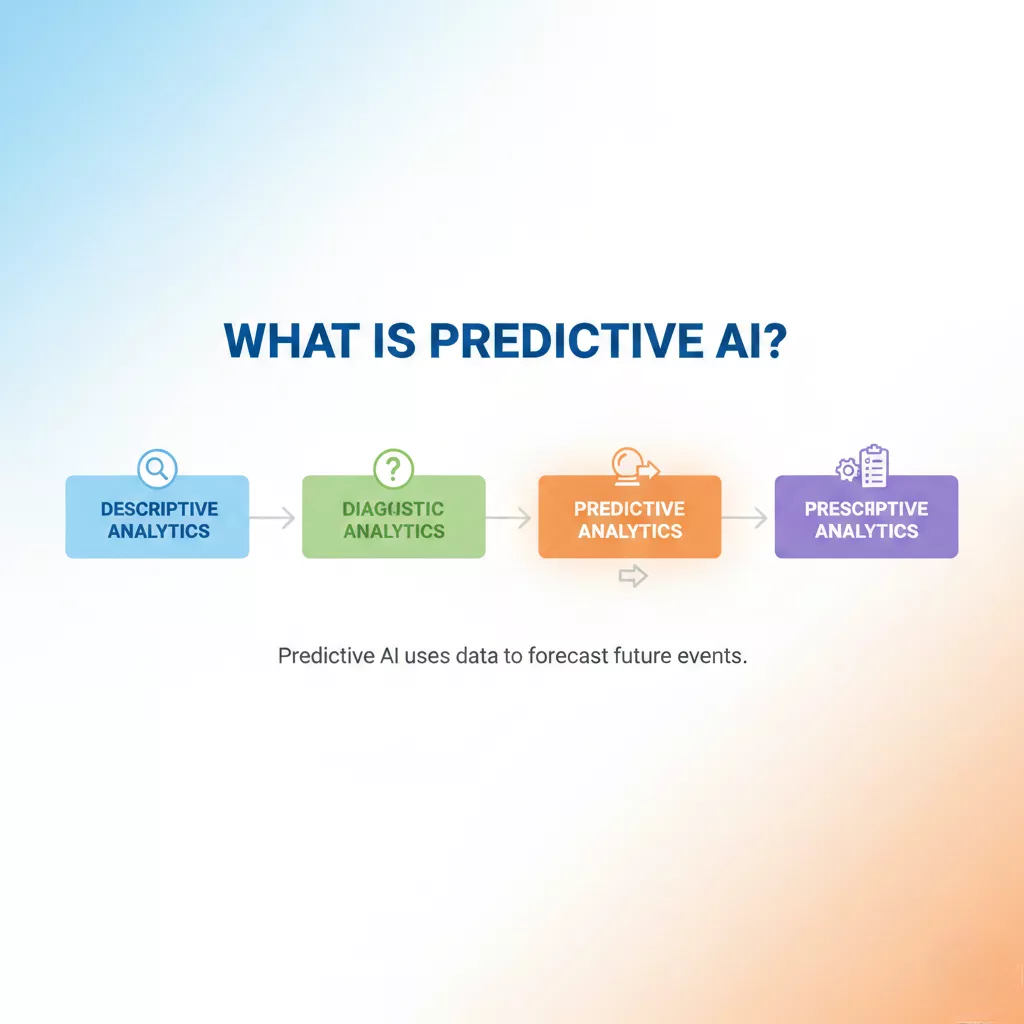
To understand where we are going, we have to understand what this technology actually is. In the world of data science, we often talk about the “Analytics Ladder.”
- Descriptive Analytics: What happened? (Looking at last month’s sales).
- Diagnostic Analytics: Why did it happen? (Realizing a competitor’s sale hurt your numbers).
- Predictive Analytics: What will happen? (Forecasting that sales will dip next week due to a predicted cold front).
- Prescriptive Analytics: How can we make it happen? (Automatically launching a “winter warm-up” promotion to offset the dip).
Predictive AI is the bridge between understanding the past and controlling the future. It uses a blend of statistical algorithms and machine learning techniques—such as neural networks and regression models—to find relationships in data that are invisible to the naked eye.
The 2026 Difference: The LLM Integration
What makes predictive AI in 2026 unique is its integration with Large Language Models (LLMs). We are no longer just looking at structured data (numbers in a table). We are now analyzing unstructured data—customer reviews, news reports, social media moods, and even internal emails. This allows the AI to understand context and emotion, predicting not just what a customer will buy, but why they feel like buying it.
How Predictive AI “Thinks”: The Mechanics
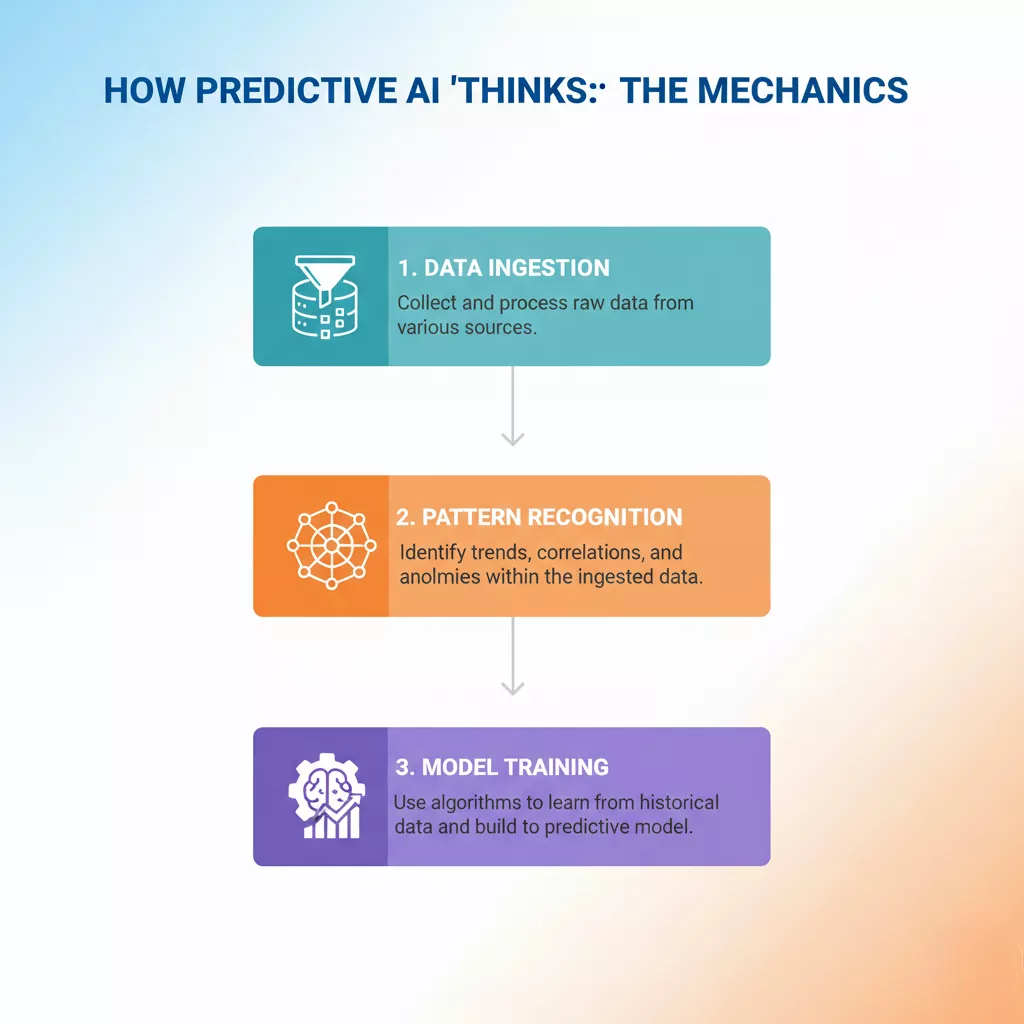
If you peek under the hood of a 2026 predictive model, you won’t just find code; you’ll find a sophisticated feedback loop.
- Data Ingestion: The system pulls in data from diverse sources—IoT sensors, CRM systems, public weather data, and real-time market feeds.
- Pattern Recognition: The AI identifies correlations. For example, it might notice that whenever the price of a specific raw material in Brazil rises, demand for a specific consumer good in Germany drops three weeks later.
- Model Training: Using a process called Reinforcement Learning, the model “practices” making predictions on historical data, correcting itself whenever it gets an answer wrong.
- Inference & Action: Once live, the model provides a probability score (e.g., “There is an 84% chance of a stockout by Friday”).
For those who enjoy the technical side, a simplified version of a predictive model’s probability function might look like this:
P(Y∣X)=1+eβ0+β1Xeβ0+β1X
Where P(Y∣X) is the probability of an event happening given a set of inputs. In 2026, these models are calculating millions of these variables simultaneously in milliseconds.
Industry Deep Dives: Predictive AI in Action
1. Healthcare: The End of “Reactive” Medicine
In 2026, healthcare has seen the most dramatic shift. We’ve moved from “sick care” (treating you once you’re ill) to “preventative care” (keeping you well).
- Early Diagnosis: Predictive models now analyze medical imaging and genetic data to spot signs of chronic diseases like Alzheimer’s or Type 2 Diabetes years before symptoms appear.
- Hospital Operations: Systems like “Ambient Notes” have reached 85% adoption, predicting patient surges in emergency rooms and automatically adjusting nurse staffing levels to prevent burnout.
2. Finance: The Rise of the AI Co-Pilot
Finance has always been about risk, but predictive AI has turned risk management into a science of precision.
- FP&A (Financial Planning & Analysis): 69% of CFOs now report that AI is integral to their strategy. Instead of monthly reports, they have “live dashboards” that predict cash flow fluctuations based on global economic shifts.
- Fraud Detection: In 2026, fraud detection is no longer about flagging a transaction after it happens. AI predicts the likelihood of a hack or a fraudulent withdrawal based on subtle “micro-signals” in user behavior, stopping the crime before it occurs.
3. Retail: Hyper-Personalization 2.0
The days of “Customers who bought this also bought…” are over.
- Sentiment & Mood: Retail AI in 2026 uses emotional data. If a user is browsing quickly and clicking aggressively, the AI detects “frustration” and might offer a “Need help?” chat or a discount to keep them on the site.
- Inventory Resilience: Predictive AI has solved the “overstock vs. stockout” dilemma. By analyzing weather, social media trends, and shipping delays, retailers can predict demand for a product with 95% accuracy weeks in advance.
The Statistics: Mapping the Growth
The numbers behind predictive AI in 2026 are staggering. The technology isn’t just growing; it’s colonizing the global economy.
Table: Predictive AI Market & Adoption Stats (2025-2026)
| Metric | 2025 (Actual) | 2026 (Projected/Current) | Growth Rate (YoY) |
| Global AI Market Size | $390.91 Billion | $475.20 Billion | ~21.6% |
| Predictive Analytics Segment | $18.24 Billion | $24.10 Billion | ~32.1% |
| Enterprise Adoption Rate | 42% | 58.9% | +16.9% |
| Documentation Time Reduction | 30% | 53% | +23% |
| Global AI Infrastructure Spending | $1.2 Trillion | $2.02 Trillion | ~68% |
Note: North America remains the leader in revenue share (35.5%), but the Asia-Pacific region is the fastest-growing market, driven by massive investments in India and China.
The Rise of Agentic AI: The Decision-Maker Partner
The biggest breakthrough of 2026 is the transition from Assistive AI to Agentic AI.
- Assistive AI (The Past): You ask the AI to write a report based on data.
- Agentic AI (The Present): The AI notices a supply chain delay, identifies three alternative suppliers, calculates the cost-benefit of each, and presents you with the best option—or even executes the order if it falls within your pre-set budget.
These “autonomous agents” are becoming digital employees. They don’t just provide a chart; they provide a recommendation backed by a “rationale.” This has led to the rise of Explainable AI (XAI). In 2026, if an AI tells a bank to deny a loan, it must be able to explain exactly why in human terms. The “Black Box” is being opened.
The Ethics and the Trust Gap
It’s not all sunshine and perfect forecasts. As we rely more on predictive AI, new challenges have emerged.
- Model Drift: The world changes fast. If a model was trained on 2023 data, it might fail in 2026. Companies now have to invest in “Continuous Monitoring” to ensure their AI hasn’t become “outdated” or biased.
- Privacy vs. Prediction: To predict your behavior, AI needs data. In 2026, the tension between personalized services and data privacy is at an all-time high.
- The “Human-in-the-Loop” Necessity: While AI is great at patterns, it struggles with “Black Swan” events—unpredictable anomalies like a sudden political shift. Human judgment remains the final “kill switch” for high-stakes decisions.
Barriers to Adoption: Why Isn’t Everyone Using It?
Despite the growth, many small and medium enterprises (SMEs) struggle.
- Data Silos: AI is only as good as the data it eats. If a company’s sales data is in one system and its marketing data is in another, the AI can’t see the full picture.
- Talent Shortage: There is a massive demand for “AI Translators”—people who understand both the business needs and the technical limits of the models.
- The “Hype Hangover”: Some companies spent millions in 2024 on “GenAI” without a clear ROI and are now cautious about investing in predictive tools.
The Road Ahead: 2027 and Beyond
As we look toward the end of the decade, predictive AI will become even more “invisible.” It will be embedded in our glasses, our cars, and our kitchen appliances. We won’t say we’re using “Predictive AI”; we’ll just say we’re making “smart decisions.”
We are moving toward “Anticipatory Design,” where our needs are met before we even express them. Your fridge will order milk before you run out; your car will suggest a different route because it predicts a traffic jam will form in 10 minutes; your doctor will call you because your wearable predicted a heart arrhythmia that hasn’t happened yet.
Conclusion
Predictive AI is no longer a luxury for the “Magnificent Seven” tech giants; it is the fundamental utility of the modern world. By turning the “unknown” into the “calculable,” it empowers us to build more resilient businesses, more efficient healthcare systems, and more personalized lives.
However, the future of smart decision-making isn’t just about better algorithms—it’s about better partnership. The winners of 2026 are those who know when to trust the machine’s prediction and when to rely on human empathy and intuition. The future isn’t AI replacing humans; it’s humans becoming “super-deciders” with AI by their side.
Frequently Asked Questions (FAQs)
1. Is Predictive AI the same as “General AI” or “Superintelligence”?
No. Predictive AI is a form of “Narrow AI.” While it is incredibly sophisticated at analyzing data and forecasting specific outcomes, it does not possess consciousness, emotions, or the ability to perform tasks outside its training data. It is a highly specialized tool, not a sentient being.
2. Can Predictive AI actually predict the “Black Swan” events?
Partially. Predictive AI thrives on patterns. Unusual, unprecedented events (like a sudden global pandemic or a freak geological event) are difficult for AI to predict because there is no historical precedent. However, modern 2026 models are better at “Anomaly Detection”—flagging when things start to look weird, which can give humans an earlier warning than traditional methods.
3. How do Small Language Models (SLMs) change predictive analytics?
In the past, you needed massive data centers to run powerful AI. In 2026, SLMs allow us to run “mini-predictive” models on a smartphone or a factory-floor sensor. This means your privacy is protected (data stays on your device) and decisions happen instantly without needing an internet connection.
4. Does using Predictive AI mean my data is no longer private?
Not necessarily. In 2026, “Privacy-Preserving Machine Learning” (PPML) and “Federated Learning” allow models to learn from your data without ever seeing the raw, personal details. The AI learns the patterns of your behavior without knowing your identity.
5. Will Predictive AI replace middle management?
It won’t replace managers, but it will fundamentally change their job. Instead of spending 80% of their time collecting and analyzing reports, 2026 managers spend their time on “strategic interpretation.” The AI provides the “what,” and the human provides the “so what?” and “how do we handle the people involved?”