
Large Action Models (LAMs) and Multi-Agent Swarms are shaping the future of AI by transforming artificial intelligence from passive information generators into active, autonomous problem-solvers. While traditional AI models simply answer questions or generate text, LAMs possess the capability to directly execute complex digital actions—such as navigating user interfaces, clicking buttons, triggering APIs, and completing online transactions—without continuous human intervention. Simultaneously, Multi-Agent Swarms involve coordinated networks of specialized AI agents collaborating in real-time. These swarms divide complex enterprise tasks among themselves, critique each other’s work, and collectively drive toward a unified goal. Together, LAMs and Multi-Agent Systems (MAS) represent the critical leap into “Agentic AI,” creating highly automated ecosystems that dramatically boost productivity, minimize operational costs, and autonomously manage end-to-end workflows across software development, healthcare, finance, and industrial automation.
In this comprehensive guide, we will explore exactly how these advanced systems operate, delve into the latest 2026 market statistics, and break down why the shift toward Agentic AI is considered the most significant technological leap since the dawn of the internet.
The Paradigm Shift: From Generative AI to Agentic AI
To understand the future of AI, we must first contextualize its past. Generative AI 1.0, characterized by Large Language Models (LLMs) like early iterations of ChatGPT and Claude, fundamentally changed how we create content, write code, and brainstorm ideas. However, LLMs are fundamentally constrained by their “read-only” nature. They are reactive brains trapped in a digital jar; they can explain how to deploy a web server, but they cannot log into your cloud account and deploy it for you.
The industry quickly realized that reasoning and content generation were only half the battle. The true value of AI lies in execution. This realization sparked the shift toward Agentic AI—artificial intelligence systems equipped with agency.
Agentic AI does not wait for a human to micromanage every prompt. Instead, given a high-level goal (e.g., “Research the top 5 competitors in our market and update the CRM with their pricing models”), an agentic system will autonomously break the goal down into sub-tasks, execute the necessary web searches, scrape the data, format it, securely log into the CRM, and input the data. This transition shifts the human role from “operator” to “supervisor.”
Decoding Large Action Models (LAMs): The “Doers” of the AI World
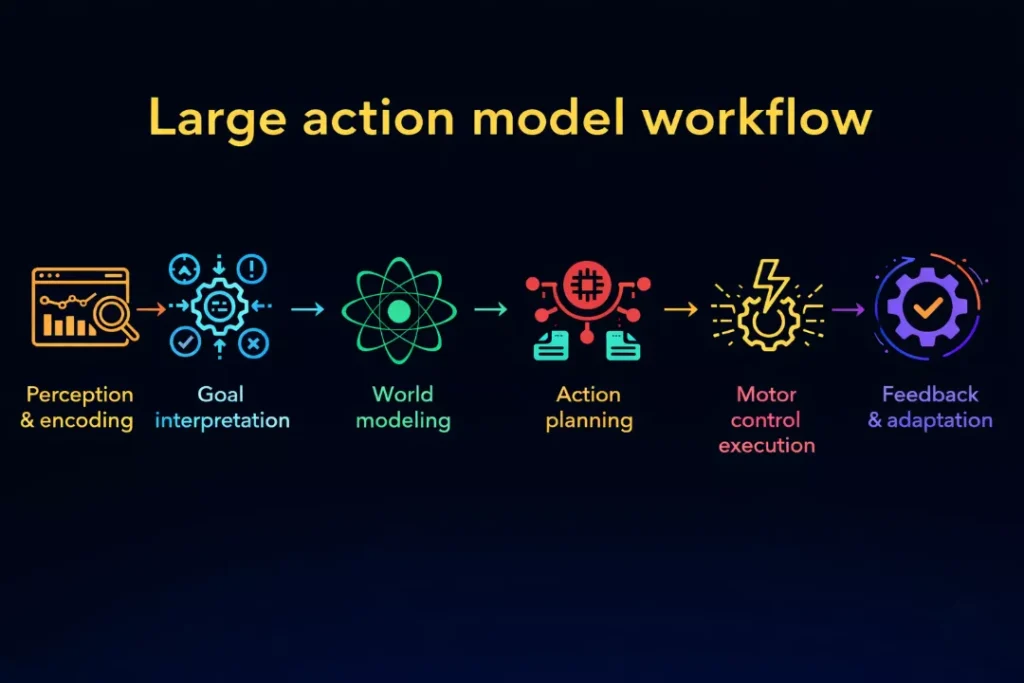
Large Action Models (LAMs) are the engines driving individual agentic capabilities. Unlike LLMs that map text to text, LAMs are trained to map human intent directly to executable actions within digital environments.
How LAMs Operate
LAMs achieve this by understanding the visual and structural components of a user interface (UI) or the programmatic logic of an Application Programming Interface (API). A well-trained LAM can look at a web page, identify the search bar, the dropdown menu, and the “Submit” button, and interact with them exactly as a human would using a mouse and keyboard.
The decision-making process of a Large Action Model is highly complex and is often formalized through Reinforcement Learning frameworks, such as a Markov Decision Process (MDP). The model seeks to maximize a cumulative reward by taking the correct sequence of actions. The policy $\pi_{\theta}(a_t | s_t, c_t)$ defines the probability of the model taking a specific action $a_t$ at time $t$, given the current state of the application $s_t$ and the user’s overarching context or prompt $c_t$.
The LAM’s objective during training is to maximize the expected return:
$$J(\theta) = \mathbb{E}_{\pi_{\theta}} \left[ \sum_{t=0}^{T} \gamma^t r(s_t, a_t) \right]$$
where $\gamma$ is the discount factor (determining the importance of future rewards) and $r(s_t, a_t)$ is the reward function evaluating the success of the action (e.g., successfully clicking the correct button yields a positive reward).
Core Capabilities of LAMs
- Procedural Memory and UI Navigation: LAMs can learn workflows by watching humans perform them, building a “procedural memory.” They can then replicate these workflows across dynamically changing interfaces.
- Multi-Modal Perception: Modern LAMs process text, code, and visual inputs simultaneously, allowing them to “see” a screen to understand where to click.
- Autonomous Task Execution: LAMs can auto-fill complex spreadsheets, manage cross-platform financial transactions, or book travel itineraries across multiple unlinked websites.
Multi-Agent Swarms: The Power of Collaborative Intelligence
If a LAM is a highly skilled digital employee, a Multi-Agent Swarm (or Multi-Agent System – MAS) is an entire digital corporation operating at lightspeed.
A single AI agent, no matter how advanced, can suffer from context window limitations, “hallucinations” (making up false information), or get stuck in logic loops. Multi-Agent Swarms solve this by decentralizing the workload. By connecting multiple specialized AI agents, the system becomes highly fault-tolerant, scalable, and capable of profound logical reasoning.
The Architecture of a Swarm
In a typical Multi-Agent Swarm, agents are assigned distinct roles, mimicking a human corporate structure:
- The Orchestrator (Manager) Agent: Receives the human user’s prompt, breaks the massive task into smaller sub-tasks, and delegates them to worker agents based on their specific capabilities.
- Worker (Specialist) Agents: Execute specific tasks. For instance, in a software development swarm, one agent writes the backend code, another designs the frontend UI, and a third sets up the database schema.
- The Critic (QA) Agent: Reviews the output generated by the worker agents. If the code written by the backend agent contains a bug, the Critic agent flags it and sends it back for revision, entirely autonomously.
This collaborative approach drastically reduces the error rate of AI systems. When agents debate, verify, and cross-reference each other’s work, the final output is significantly more robust and accurate than what any single model could produce.
The Synergy: When LAMs Meet Multi-Agent Swarms
The true future of AI takes shape when Large Action Models are integrated into Multi-Agent Swarms. This creates an ecosystem where specialized agents don’t just talk to each other—they physically do things across disparate software environments.
Imagine an enterprise supply chain swarm triggered by a delay at a manufacturing plant.
- The Monitoring Agent detects the delay via IoT sensors.
- It alerts the Orchestrator Agent, which tasks a LAM-powered Logistics Agent to log into the shipping company’s portal and reroute available trucks.
- Simultaneously, a LAM-powered Procurement Agent navigates supplier websites to order emergency backup materials.
- Finally, a Communications Agent drafts and emails an update to stakeholders.
This entire, highly complex, multi-system workflow occurs in seconds, without a single human click.
Recent Statistics: The Explosive Growth of Agentic AI (2025–2026)
The transition from theoretical research to enterprise deployment of LAMs and Multi-Agent Swarms has catalyzed a massive economic boom. According to recent 2026 market data from firms like Fortune Business Insights, BCC Research, and Dimension Market Research, the AI agent space is currently the fastest-growing sector in the technology industry.
The global Agentic AI market was valued at $7.29 billion in 2025 and is projected to reach $9.14 billion in 2026. However, the long-term forecast is staggering: the market is expected to skyrocket to over $139 billion to $184 billion by 2033/2034, growing at a phenomenal Compound Annual Growth Rate (CAGR) of over 40% to 49%.
Global AI Agent Market Size & Projections (2025 – 2034)
| Metric / Year | 2025 Valuation | 2026 Projection | 2030 Projection | 2034 Projection | Estimated CAGR |
| Overall Agentic AI Market | ~$7.6 Billion | ~$9.3 Billion | ~$48 – $54 Billion | ~$139 – $184 Billion | 40.5% – 49.6% |
| Multi-Agent Systems (MAS) | ~$6.3 Billion | ~$8.5 Billion | ~$32 Billion | ~$184.8 Billion | 45.5% |
| Enterprise AI Agents | ~$5.09 Billion | ~$6.4 Billion | ~$25 Billion | N/A | 22.3% |
(Note: Data aggregated from multiple 2025/2026 market intelligence reports including Fortune Business Insights, Grand View Research, and Mordor Intelligence).
Enterprise adoption is moving at unprecedented speeds. Organizations realize that avoiding Agentic AI will result in an insurmountable competitive disadvantage. In 2026, an overwhelming 96% of organizations utilizing AI reported plans to actively expand their agentic AI usage.
Agentic AI Enterprise Adoption Metrics (2026)
| Adoption Metric | Percentage / Statistic | Implication for Enterprises |
| Current AI Agent Adoption | 79% | The vast majority of organizations have moved past LLMs into active agent deployment. |
| Planned Expansion | 96% | Near-universal confidence in the ROI of multi-agent and LAM systems. |
| Budget Allocation | 43% | Nearly half of companies allocate over 50% of their total AI budget strictly to agentic systems. |
| Executive Buy-In | 88% | C-suite leaders are actively driving budget increases specifically for autonomous capabilities. |
| Full Implementation Success | 34% | Despite high investment, deploying complex multi-agent swarms remains challenging, highlighting a skills gap. |
These statistics reveal a clear reality: The hype has materialized into aggressive, well-funded corporate strategy. The focus has entirely shifted from “Can AI write an email?” to “Can AI run a department?”
Industry-Specific Transformations Driven by LAMs and Swarms
The integration of LAMs and Multi-Agent Swarms is not an abstract concept; it is currently overhauling major industries from the ground up.
1. Healthcare and Life Sciences
In the medical field, AI swarms are reducing the crushing administrative burden on clinical staff. LAM-powered agents can autonomously navigate disparate Electronic Health Record (EHR) systems, cross-reference patient histories, process complex insurance claims, and automatically schedule follow-up appointments. Multi-agent systems are also being deployed in pharmaceutical research, where a swarm of agents can simulate molecular interactions, critique each other’s findings, and accelerate the drug discovery pipeline by years.
2. Software Development and IT Operations
The software engineering paradigm has shifted from AI as a “copilot” to AI as an autonomous “developer swarm.” Modern agentic IDEs utilize swarms where agents take on the roles of Architect, Coder, Tester, and DevOps Engineer. A LAM can write the code, push it to a repository, test it against edge cases, spin up a secure cloud environment via AWS or Azure APIs, and deploy the application live—all while a human engineer oversees the dashboard.
3. Financial Services and Banking
In finance, Multi-Agent Swarms act as elite auditing and trading teams. A swarm can monitor global news feeds in real time, analyze market sentiment, and trigger a LAM to autonomously execute high-frequency algorithmic trades across multiple brokerage interfaces. Furthermore, in compliance and risk management, agent swarms continuously audit millions of transactions, flagging anomalies for fraud prevention with a level of vigilance no human team could maintain.
4. Manufacturing and Supply Chain Automation
Industrial sectors are utilizing “Edge AI” swarms to power smart factories. Swarms of robotic agents coordinate on factory floors to assemble products, while software-based LAMs monitor inventory levels in the background. If stock runs low, the LAM autonomously interacts with a supplier’s ERP system to reorder components, optimizing the supply chain in real-time without human delays.
Overcoming the Challenges of Autonomous AI
Despite the revolutionary potential of LAMs and Multi-Agent Swarms, the path to full autonomy is fraught with significant technical and ethical challenges.
1. Security Risks and “Agentic” Attack Surfaces
When you give AI the power to execute actions, you fundamentally alter the cybersecurity landscape. An LLM that hallucinates a bad answer is annoying; a LAM that hallucinates and autonomously deletes a production database, or wires company funds to the wrong vendor, is catastrophic. Securing agentic workflows requires strict “human-in-the-loop” safeguards for high-stakes actions, alongside robust identity and access management (IAM) specifically designed for non-human identities.
2. The Explainability Crisis (The “Black Box”)
As Multi-Agent Swarms debate and execute complex workflows, tracking why the swarm made a specific decision becomes incredibly difficult. In regulated industries like finance and healthcare, decision-tracing and explainability are legally mandated. Developing transparent agent logs that map the exact reasoning path of the swarm remains a major hurdle.
3. Infrastructure and Compute Costs
Running a single LLM query is relatively cheap. Running a swarm of 10 specialized agents that continuously query each other, evaluate responses, and render UI environments to execute actions consumes immense computational power. The sheer GPU utilization required for at-scale MAS deployments currently limits broad accessibility, creating a bottleneck for smaller enterprises.
4. Lack of Standardization
The current market is highly fragmented. Agents built on Salesforce’s Agentforce struggle to communicate organically with Microsoft’s autonomous frameworks or custom open-source swarms. The absence of universal communication protocols for AI agents risks creating siloed ecosystems and heavy vendor lock-in.
Conclusion
The evolution from Large Language Models to Large Action Models and Multi-Agent Swarms marks the true maturation of artificial intelligence. We are moving from an era where we ask computers for information, to an era where we simply delegate outcomes. By combining the autonomous physical/digital execution capabilities of LAMs with the decentralized, collaborative reasoning power of Multi-Agent Swarms, organizations are unlocking unprecedented levels of scale and efficiency.
While challenges regarding cybersecurity, compute costs, and safety guardrails remain pressing, the 2026 market statistics make one thing undeniably clear: Agentic AI is not a fleeting trend. It is the new foundational infrastructure of the modern digital economy. Organizations that successfully harness the power of these AI swarms will redefine productivity, while those that hesitate will find themselves competing against highly optimized, autonomous digital workforces.
Would you like me to dive deeper into how you can start building or integrating a small-scale Multi-Agent Swarm for your specific business use case?