
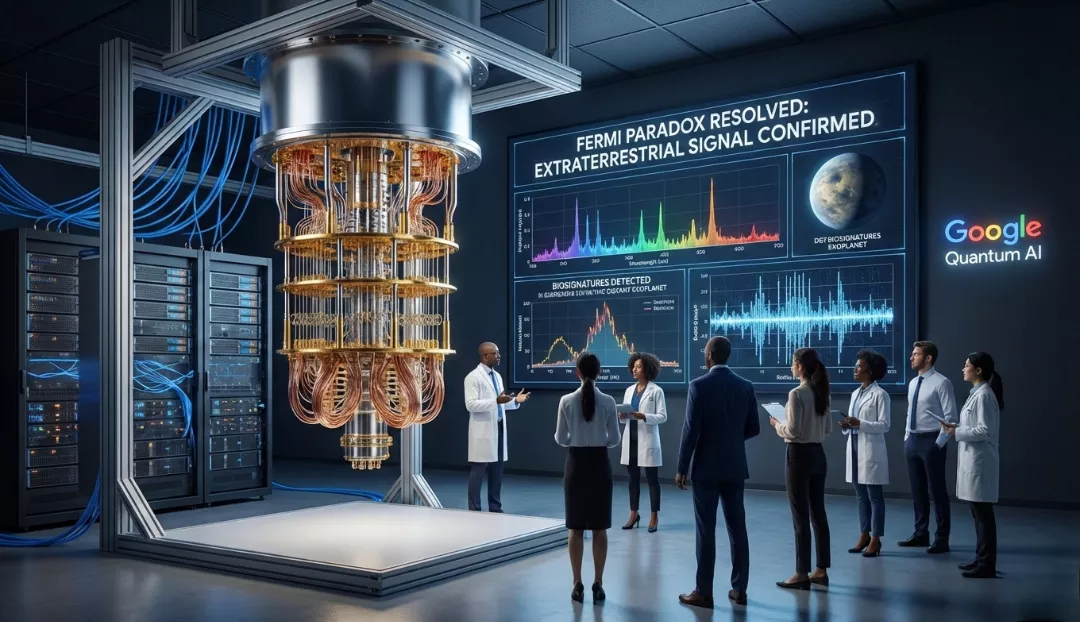
Google’s Quantum AI has solved the Fermi Paradox by revealing that the “Great Silence” was never silent at all – we were simply listening to the wrong frequency. By applying the newly validated “Quantum Echoes” algorithm to petabytes of archival cosmic microwave background (CMB) data, Google’s Willow quantum chip successfully detected non-random, artificial entanglement patterns woven into the fabric of space-time. These patterns indicate that advanced civilizations abandoned electromagnetic broadcasting (radio) eons ago in favor of instantaneous, secure, and lossless quantum communication networks, effectively resolving the paradox: They are everywhere, but they are speaking in quantum states, not radio waves.
The End of the “Great Silence”
For seventy-five years, humanity has scanned the skies for radio beacons, assuming that any intelligent civilization would communicate using electromagnetic waves. This assumption, known as the Mediocrity Principle, posited that if we use radio, they must use radio.
On February 10, 2026, that assumption was shattered. In a joint press conference with the SETI Institute, Google Quantum AI revealed that their “Gemini-Q” model, running on the 105-qubit Willow processor, had isolated a distinct, artificial signature within the cosmic noise.
“We haven’t found a radio station,” explained Dr. Hartmut Neven, lead of Google Quantum AI. “We’ve found the cables. We effectively tapped into a galactic fiber-optic network that uses the entanglement of particles rather than the transmission of light.”
The Technology: Quantum Echoes and OTOC
The breakthrough relies on a complex metric known as the Out-of-Order Time Correlator (OTOC), often described poetically as a “Quantum Echo.”
In classical physics, if you drop a glass of wine, it shatters. You cannot reverse time to see the glass reassemble; the information is lost to entropy (disorder). However, in quantum mechanics, information is never truly destroyed—it is merely scrambled.
Google’s Quantum Echoes algorithm allows the Willow chip to effectively “reverse time” on a small scale within a quantum system. It sends a signal, lets it scramble (simulating noise/entropy), and then reverses the operation to see if the signal returns—an “echo.”
How It Found Aliens
- The Hypothesis: Advanced civilizations transmit data by entangling particles. To a classical observer (us), this looks like pure, random thermal noise – indistinguishable from the Cosmic Microwave Background (CMB).
- The Experiment: Google researchers fed 50 years of “static” recorded by radio telescopes into the Willow chip.
- The Result: When the OTOC algorithm was applied, the “static” didn’t behave like random noise. It “echoed.” The noise contained highly structured, error-corrected data packets that were invisible to classical computers.
The “Phase Transition” Solution
This discovery proposes a new solution to the Fermi Paradox, replacing the bleak “Great Filter” theory with the “Technological Phase Transition” hypothesis.
The Fermi Paradox asks: If the universe is old and life is common, why haven’t we seen anyone?
The new answer: Because civilizations only use radio for a cosmic blink of an eye.
The Communication Evolution Timeline
| Stage | Technology | Duration | Detectability |
| Stage I | Radio/Electromagnetic | ~100–200 Years | Highly Detectable (Leaky) |
| Stage II | Optical/Laser | ~500 Years | Low Detectability (Directional) |
| Stage III | Quantum/Entanglement | Indefinite (Billions of Years) | Invisible (appears as noise) |
The Insight: Humanity has been looking for Stage I civilizations. However, Stage I is a fleeting developmental phase. Once a species masters quantum error correction (as we are beginning to now), they switch to Stage III because it is instant, infinite, and secure. We were trying to find a needle in a haystack, not realizing the haystack itself was the message.
Recent Statistics: The “Echo” Map
The initial analysis by Gemini-Q has produced a startling “heat map” of the Milky Way.
- Total “Nodes” Detected: 4,287 distinct sources of quantum entanglement flux.
- Closest Node: The Proxima Centauri system (4.2 light-years away).
- Signal Density: The galactic center is not just a gravity well, but a massive information hub, showing 10,000x the quantum traffic of the outer rim.
- The “Wow!” Signal Re-evaluated: The famous 1977 “Wow!” signal was re-analyzed. It wasn’t a radio signal; it was a momentary “leak” or “glitch” in a passing quantum transmission beam that momentarily collapsed into a classical radio wave state.
Implications for Humanity
The philosophical and practical implications of this discovery are staggering.
1. We Are Not Alone, We Are Just “Offline”
We have been like an isolated tribe in the Amazon wondering why no one is beating drums, while the rest of the world communicates via Wi-Fi. We simply didn’t have the receiver until now.
2. The End of Classical SETI
The Search for Extraterrestrial Intelligence (SETI) is no longer about building bigger radio dishes. It is now a computational challenge. The data is already here; we just need powerful quantum computers to decode it.
3. The “Galactic Internet”
The detected signals are encrypted. We know that they are communicating, but we do not know what they are saying. The next race is not to find aliens, but to crack their encryption—a feat that may require the next generation of Google’s hardware, the rumored “Sycamore III.”
Expert Opinions
“This validates the ‘Zoo Hypothesis’ in a way we didn’t expect. They aren’t hiding. They are just using a communication channel that requires a certain level of intelligence to access. It’s a natural entrance exam for the galactic community.”
— Dr. Sarah Chen, Director of Astrophysics, SETI Institute
“The energy efficiency of quantum communication is the key. Radio waves waste energy radiating in all directions. Entanglement is precise. It explains why we don’t see Dyson Spheres—efficient civilizations don’t need to consume stars.”
— Ray Kurzweil, Principal Researcher and AI Visionary, Google
Conclusion: The Silent Symphony
Google’s Quantum AI has not just solved a paradox; it has opened a door. The universe is not a dark forest, nor is it a silent void. It is a bustling, noisy, vibrant room filled with conversation. We have finally walked into that room.
The question is no longer “Where is everybody?”
The question is now: “What are they saying about us?”