
Countries like the United States, China, the European Union, the United Kingdom, Japan, South Korea, and the UAE are currently investing the most heavily in next-generation AI infrastructure, including supercomputers, AI data centers, semiconductor manufacturing, advanced research labs, and national AI policies. These nations are leading the global AI race by pouring billions into chips, cloud compute, national AI strategies, and cutting-edge model development.
A New Era of AI Competition
The global AI race has become one of the most transformative competitions of the 21st century. Nations are no longer competing only in military strength or economic output—they are competing in compute power, data access, semiconductor innovation, AI research, and scalable digital infrastructure.
The world now understands a simple truth:
The country that leads in AI infrastructure will lead in global innovation, economic growth, and geopolitical influence.
From billion-dollar AI cloud hubs to national supercomputer programs, governments worldwide are racing to build the digital backbone needed for next-gen AI models—models that can reason, plan, analyze, and perform autonomous tasks at scale.
This article breaks down which countries are investing the most in AI, how they are building AI infrastructure, and what it means for global competitiveness.
Why AI Infrastructure Matters More Than Ever
AI infrastructure has become the backbone of modern digital progress. Just as roads, electricity, and the internet powered earlier generations of innovation, AI infrastructure now powers the systems that will shape the future of economies, governments, and global competitiveness.
At its core, AI infrastructure refers to the highly advanced technological environment required to build, train, deploy, and scale artificial intelligence. This includes:
- Supercomputers and high-performance computing (HPC) labs that handle massive training workloads and complex simulations.
- GPU-rich data centers capable of processing trillions of operations per second for next-gen models.
- Cloud-based AI platforms that offer scalable compute power to businesses, researchers, and government agencies.
- Semiconductor manufacturing and chip R&D, which determine how fast and efficient AI models can become.
- Research ecosystems including universities, innovation labs, and AI development hubs.
- 5G/6G networks and ultra-fast connectivity, essential for real-time AI, IoT, and autonomous systems.
- Quantum computing and emerging computing architectures that will eventually redefine what AI can achieve.
Without this deep infrastructure foundation, countries lose the ability to:
- Train cutting-edge AI models capable of reasoning, planning, and advanced decision-making.
- Scale AI across industries—from healthcare and banking to transportation and manufacturing.
- Build national-level AI services, such as smart governance, digital identity systems, and automated public services.
- Support AI research talent that drives breakthrough innovation.
- Develop autonomous robotics, drones, and intelligent machines that require continuous, powerful compute resources.
- Remain competitive in the global economy, where AI now determines productivity and technological leadership.
This is why AI infrastructure is no longer just a technology investment – it is a strategic national asset. Just as countries once protected oil reserves or safeguarded nuclear capabilities, governments today treat AI compute, chips, and research networks as critical components of national power.
Nations that build strong AI infrastructure now will shape the economic and geopolitical landscape for decades to come.
The Top Countries Leading the AI Infrastructure Race
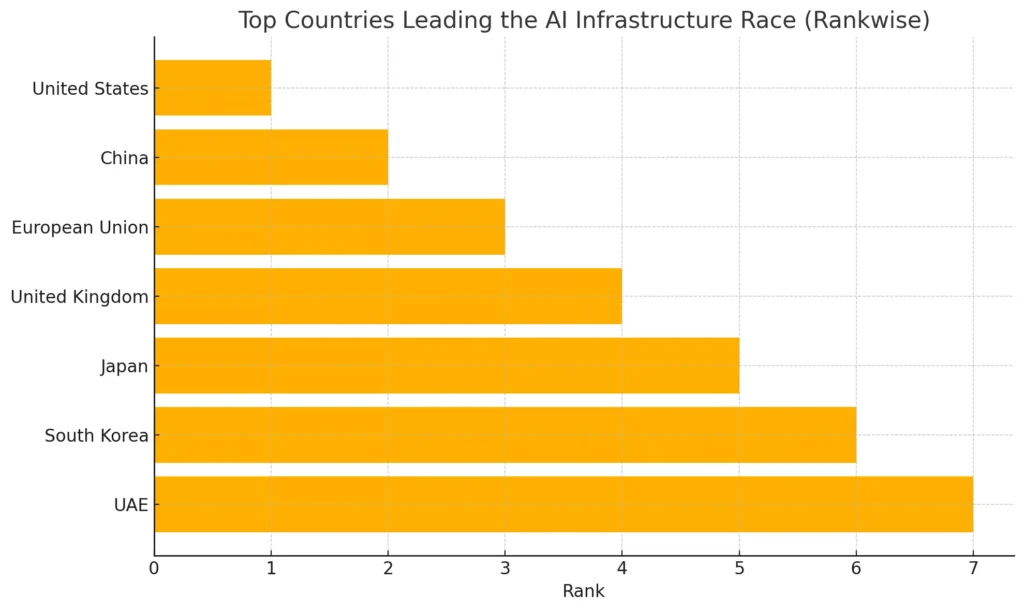
The global AI race is shaped by massive national investments in compute power, semiconductor manufacturing, research ecosystems, and cloud-scale AI platforms. Below is an in-depth look at the countries that are investing the most in next-generation AI infrastructure and rapidly shaping the future of global technology leadership.
1. United States – The Global AI Infrastructure Leader
The United States currently stands as the world’s strongest force in AI infrastructure, driven by a powerful combination of research excellence, private-sector investment, and advanced semiconductor innovation.
Where the U.S. Dominates
The U.S. leads the world in:
- AI-focused supercomputing power
- Private-sector investment into AI startups and labs
- Advanced chip architecture and manufacturing
- World-class AI research universities
- Major Big Tech AI labs, including OpenAI, Google, Meta, NVIDIA, Microsoft, and Amazon
Key U.S. Investments
The country is investing tens of billions of dollars into:
- Large-scale cloud infrastructure and massive GPU clusters
- NVIDIA H100, H200, and B200 chip deployment at national scale
- OpenAI’s next-generation supercomputer built in partnership with Microsoft
- The CHIPS and Science Act, offering $52 billion for semiconductor production
- Department of Energy (DOE) supercomputers such as Frontier, Aurora, and El Capitan
Why the U.S. Leads
- A deep tech ecosystem built over decades
- The world’s strongest venture capital environment
- A large pool of highly skilled AI engineers and researchers
- Home to global chip leaders like NVIDIA, AMD, and Intel
The result: The United States remains the world’s undisputed AI powerhouse, shaping nearly every major advancement in the field.
2. China – The Fastest-Growing AI Powerhouse
China is scaling its AI infrastructure at an unprecedented speed, with the clear national goal of becoming the world’s leading AI power by 2030.
Key Investments
China is heavily investing in:
- Huge national AI cloud centers across multiple provinces
- The world’s largest number of supercomputers
- Government-driven AI research and development programs
- Rapidly growing domestic AI chip design companies
- Full-scale “AI City” projects with integrated smart infrastructure
- AI-driven robotics and manufacturing hubs
- Extensive funding for facial recognition, computer vision, and surveillance AI
China is also developing exascale supercomputers and investing aggressively in quantum computing, aiming to dominate both traditional and next-gen computing.
Challenges Facing China
- U.S. export restrictions on advanced semiconductors
- Limited access to cutting-edge GPUs needed for frontier model training
Despite these barriers, China continues to accelerate faster than any other nation, narrowing the gap with the U.S. year after year.
3. European Union – Responsible & Regulated AI Growth
The European Union is adopting a powerful, values-driven approach to AI infrastructure—combining huge investment in HPC with strict governance and ethical AI standards.
Key EU Investments
Major initiatives include:
- The EuroHPC program for next-generation supercomputers
- New AI-ready data centers in Germany, France, Finland, and the Netherlands
- Billions in funding through the Digital Europe Programme
- University-level AI grants and research accelerators
- A major push into semiconductor manufacturing through ASML and partners
Why the EU Stands Out
- Leadership in AI regulation and responsible AI development
- A strong emphasis on trusted and transparent AI systems
- High investment in 6G, next-gen connectivity, and sovereign cloud infrastructure
The EU’s strength lies in its structured governance, shared research networks, and unified long-term digital strategy, making it a global model for ethical AI development.
4. United Kingdom – Europe’s AI Research Powerhouse
The United Kingdom is rapidly establishing itself as a global epicenter of AI research, innovation, and safety oversight.
Major Investments
The UK government and private sector are building:
- The National AI Research Resource (NIRR)
- One of the world’s largest AI supercomputers, Isambard-AI, running on tens of thousands of NVIDIA GPUs
- The AI Safety Institute, the first government-led lab focused on frontier model evaluation
- Strong funding programs supporting deep-tech and AI startups, including companies like DeepMind and Stability AI
Areas of Leadership
The UK excels in:
- AI safety and regulation
- Large-scale model development
- Computational biology and biotech + AI
- Robotics, automation, and autonomous decision systems
With its academic excellence and strong innovation ecosystem, the UK remains a top-three global AI research hub, alongside the U.S. and China.
5. Japan – AI for Robotics, Manufacturing & Engineering Excellence
Japan continues to invest heavily in AI infrastructure focused on robotics, automation, and precision engineering—areas where the country already holds global leadership.
Key Investment Areas
Japan’s AI focus spans:
- Advanced robotics
- Smart manufacturing and automated factories
- Public transportation and autonomous mobility systems
- Healthcare robots and automation
- High-end semiconductor research and chip collaboration
Major Projects
- The Fugaku Supercomputer, one of the world’s fastest systems
- A national program to boost next-generation chip manufacturing
- Joint semiconductor research with the U.S.
- Widespread implementation of AI-enabled smart factories
Japan stands out for its ability to combine hardware excellence with AI innovation, especially in robotics.
6. South Korea – A Global Hub for Chips and AI Innovation
South Korea’s explosive AI growth is driven largely by its dominance in semiconductor manufacturing, led by industry giants Samsung and SK Hynix.
Major Investments
South Korea is building:
- The world’s largest semiconductor mega-campus by 2042, valued at $220 billion
- Numerous AI data centers equipped with advanced GPU clusters
- A nationwide AI digital strategy aimed at 2030 transformation
- Advanced AI chip designs, including Samsung’s NPUs and Xclipse processors
Strengths
- Leadership in memory chip production
- Strong government–industry partnerships
- Exceptional engineering talent
With these strengths, South Korea is quickly becoming a global AI hardware and infrastructure powerhouse.
7. United Arab Emirates (UAE) – The Middle East’s AI Epicenter
The UAE stands out as the fastest-growing AI investor on a per-capita basis, backed by a bold national vision and unmatched government support.
Major Investments
The UAE is building:
- A long-term National AI Strategy 2031
- The world’s first Minister of Artificial Intelligence
- AI-integrated smart city projects in Dubai and Abu Dhabi
- Massive cloud and data center expansions
- A thriving ecosystem for open-source AI, including the Falcon LLM family
- Partnerships with leading AI labs worldwide
Why the UAE Is Rising Quickly
- Innovation-driven government policies
- Aggressive investment in emerging technologies
- Support for open-source models and local AI talent
- Strategic location bridging East and West
The UAE is evolving into the AI hub of the Middle East, attracting global researchers, companies, and investors.
What These Countries Are Building: Key AI Infrastructure Components
AI investment is far more than building computers or upgrading data centers. Nations leading the AI race are constructing a complete technological ecosystem, carefully designed to support the next generation of intelligent systems. This ecosystem includes everything from supercomputers and semiconductor fabs to smart cities and nationwide AI research hubs. Below is a detailed look at the core infrastructure components shaping global AI leadership.
i) Supercomputers for Large-Scale AI Training
One of the most important pillars of AI infrastructure is the development of supercomputers specifically optimized for AI workloads. These machines provide the massive computational power required to train the world’s most advanced models.
Modern AI supercomputers are built to:
- Train trillion-parameter AI models capable of reasoning, planning, and multimodal learning
- Run complex scientific simulations for climate modeling, drug discovery, and national research projects
- Support academic institutions and private organizations working on frontier AI
- Provide enterprise AI capabilities for businesses that need scalable compute
Some of the most notable AI-focused supercomputers include:
- Frontier (U.S.) – one of the most powerful AI-capable systems
- Aurora (U.S.) – built for exascale-level AI science
- Isambard-AI (UK) – a massive NVIDIA GPU-powered system
- Fugaku (Japan) – known for its speed and versatility
- Tianhe and Sunway supercomputers (China) – crucial to China’s national AI ambitions
These systems form the computational backbone of national AI development.
ii) AI Data Centers With Massive GPU and Accelerator Clusters
The rise of generative AI has created an enormous demand for GPU-rich data centers, as GPUs are the engines that power modern AI training and inference.
Countries are rapidly building and expanding data centers equipped with:
- NVIDIA H100, H200, and B200 GPU clusters
- Custom-made AI accelerators (such as Google TPU, Huawei Ascend, and AWS Trainium)
- Energy-efficient liquid cooling systems
- High-speed, AI-optimized networking fabrics that connect thousands of GPUs
These advanced data centers support:
- National AI cloud platforms
- Enterprise-level AI development
- Public-sector digital transformation
- Research and innovation ecosystems
- National-level AI initiatives, from digital citizenship to smart governance
As AI adoption grows, these GPU-dense data centers are becoming the new digital energy plants powering global economies.
iii) Semiconductor & Chip Manufacturing Capacity
No country can lead in AI without leadership in semiconductor manufacturing. AI performance is ultimately limited by the availability of powerful, efficient chips.
This is why nations are investing heavily in:
- Chip fabrication plants (fabs) for high-end chip production
- AI-specific accelerators designed to handle massive neural networks
- Memory manufacturing, crucial for running large AI workloads
- Next-generation lithography technologies, such as EUV
- Advanced chip design labs researching new architectures
The battle for semiconductor supremacy has become known as the global CHIPS war, with countries competing to secure supply chains, attract chipmakers, and reduce dependence on foreign producers.
The countries that dominate chip innovation will likely dominate AI for decades.
iv) National AI Research & Innovation Ecosystems
AI progress requires more than hardware—it requires people, institutions, and an innovation-friendly environment.
That’s why many nations are heavily funding:
- AI-focused universities and degree programs
- Government and public research labs
- Large language model development projects
- AI safety and alignment laboratories
- Robotics research centers and automation testbeds
- Quantum computing research programs
These ecosystems attract top researchers, drive breakthrough discoveries, and support both public and private innovation efforts.
In many countries, these research hubs have become the heart of national AI strategy, connecting academia, industry, and government into a unified innovation network.
v) Smart Cities, IoT Networks & Autonomous Infrastructure
Beyond labs and supercomputers, countries are actively integrating AI into everyday public infrastructure to create intelligent, connected societies.
AI is being woven into multiple sectors, including:
- Transportation: autonomous vehicles, traffic prediction, smart public transit
- Energy grids: real-time load balancing, predictive maintenance, smart metering
- Healthcare: AI-driven hospitals, medical imaging, telemedicine networks
- Public security: emergency response systems, threat detection, surveillance
- Agriculture: precision farming, automated monitoring, smart irrigation
- Urban planning: digital twins of cities, resource optimization, pollution tracking
This level of integration transforms cities into living AI ecosystems, creating safer, more efficient, and more sustainable environments.
As AI continues to advance, it will increasingly become the backbone of national operations, driving everything from energy management to public service automation.
What Drives Countries to Invest Heavily in AI?
The rush to build powerful AI infrastructure isn’t just a technology trend—it’s a strategic race that will determine which nations shape the future of the global economy. Countries are investing aggressively because AI has become a gateway to economic strength, national security, and long-term global influence. Here’s why governments around the world are pouring billions into AI.
A. Explosive Economic Growth Potential
AI is projected to add trillions of dollars to the global economy over the next decade. Nations that build strong AI foundations now can:
- Accelerate industrial automation
- Boost productivity across businesses
- Reduce operational costs
- Attract high-value tech companies
- Spur innovation in healthcare, finance, logistics, and retail
Simply put, AI is becoming the world’s most powerful economic engine, and no country wants to be left behind.
B. National Security and Defense Superiority
AI now plays a central role in defense systems and cybersecurity. Countries invest heavily in AI to:
- Strengthen cyber defense against sophisticated digital threats
- Develop autonomous drones and surveillance systems
- Enhance intelligence analysis and counter-terrorism
- Maintain military competitiveness
In modern warfare, data, algorithms, and compute power are becoming as important as traditional weapons. Nations see AI as a key pillar of future defense strategy.
C. Technological Leadership in the Next Industrial Revolution
AI is widely viewed as the driving force behind the fourth industrial revolution. Leading in AI technology means leading in:
- Robotics
- Advanced manufacturing
- Biotechnology
- Space exploration
- Autonomous systems
Countries want to control these breakthroughs rather than depend on foreign innovation. Whoever leads in AI sets the pace for the rest of the world.
D. Global Influence and Geopolitical Power
AI leadership translates into global authority. The nations that dominate AI will:
- Shape international standards and regulatory frameworks
- Influence cross-border technology policies
- Dictate trade terms in emerging tech sectors
- Become key hubs for global AI research and talent
Much like the “space race” of the 20th century, the AI race determines which countries become global decision-makers in the future.
E. Job Creation and Workforce Transformation
AI isn’t just about automation—it creates massive opportunities for new jobs and industries. Countries are investing in AI to:
- Expand roles in engineering, data science, robotics, and cloud computing
- Build new sectors such as autonomous mobility and smart manufacturing
- Upskill their workforce for the AI-driven economy
- Support startups and homegrown tech ecosystems
AI will reshape every field, and countries that invest early can create millions of high-paying jobs while preparing citizens for a rapidly changing job market.
The Global AI Race: Who Will Lead the Future?
The global AI race is transforming into a long-term competition between:
- U.S. dominance in AI research, chips, and Big Tech
- China’s rapid scaling and national strategies
- UK’s leadership in AI safety
- EU’s trusted AI framework and HPC focus
- Japan/Korea’s manufacturing + robotics integration
- UAE’s rapid infrastructure expansion
The future leader will be the nation that can combine:
- Compute power
- Semiconductors
- Research excellence
- AI-ready workforce
- Strong governance
- Scalable infrastructure
Right now, the U.S. leads, but China is rising fast, and other nations are building focused strengths that make the landscape more competitive than ever.
Conclusion: The AI Race Defines the Next Global Superpowers
The global AI race is redefining which nations will lead the world in technology, economy, and security. Countries investing heavily in supercomputers, chips, data centers, and research ecosystems are gaining a decisive advantage that extends far beyond innovation. These investments fuel economic growth, strengthen national security, attract top talent, and shape global policies. By building robust AI infrastructure, nations prepare their workforce for an AI-driven future and position themselves at the center of global decision-making. The countries leading this race today are the ones shaping the future of global power.
FAQs: Global AI Race & Next-Gen AI Infrastructure
1. Which country is leading the global AI race right now?
The United States currently leads due to its dominance in AI supercomputing, semiconductor innovation, top research labs, and massive private-sector investment from companies like Google, Microsoft, NVIDIA, and OpenAI.
2. Which countries are investing the fastest in next-gen AI infrastructure?
China, the United States, the European Union, South Korea, the UK, and the UAE are investing most aggressively in supercomputers, AI cloud systems, and semiconductor manufacturing.
3. Why are countries investing so heavily in AI infrastructure?
Nations invest in AI to boost economic growth, strengthen national security, attract global talent, stay competitive in innovation, and shape future geopolitical influence.
4. What types of infrastructure are needed for advanced AI development?
Key components include supercomputers, GPU-rich data centers, semiconductor fabs, research labs, national cloud platforms, 5G/6G networks, and smart city systems.
5. How does AI infrastructure impact national power?
Strong AI infrastructure improves economic productivity, enhances defense capabilities, enables global leadership in technology standards, and positions a country as a future global superpower.