
In 2026, Generative AI has evolved from a simple content creation tool into an ecosystem of “Agentic AI”—autonomous systems capable of planning, reasoning, and executing complex workflows with minimal human oversight. While 2024 was defined by the chatbot, 2026 is the era of the digital teammate, where models like GPT-6 and Claude 5 (hypothetically named successors) actively manage projects, debug code, and negotiate logic chains without constant prompting. Consequently, the defining characteristics of this new landscape are hyper-personalization via local Edge AI, multimodal fluidity for seamless real-time interaction, and a significant pivot toward Sovereign AI, where enterprises build domain-specific “Small Language Models” (SLMs) rather than relying exclusively on massive generalist giants.
The 2026 Generative AI Guide: Tools, Trends and Real-World Impact
It is January 2026. If you are reading this, you have likely noticed that the “AI hype” of yesteryear has quieted down. In its place, something far more potent has emerged: AI utility. The days of being amazed that a computer can write a poem are effectively over; today, we judge AI not by what it can say, but by what it can do.
The landscape has shifted dramatically. Specifically, we have moved from “Prompt Engineering” to “Agent Orchestration.” This shift is subtle but profound, effectively changing humans from operators into managers. This guide serves as your roadmap to this new reality—a comprehensive look at the tools, trends, and critical shifts defining Generative AI in 2026.
The Big Shift: From “Chatbots” to “Agentic Workflows”
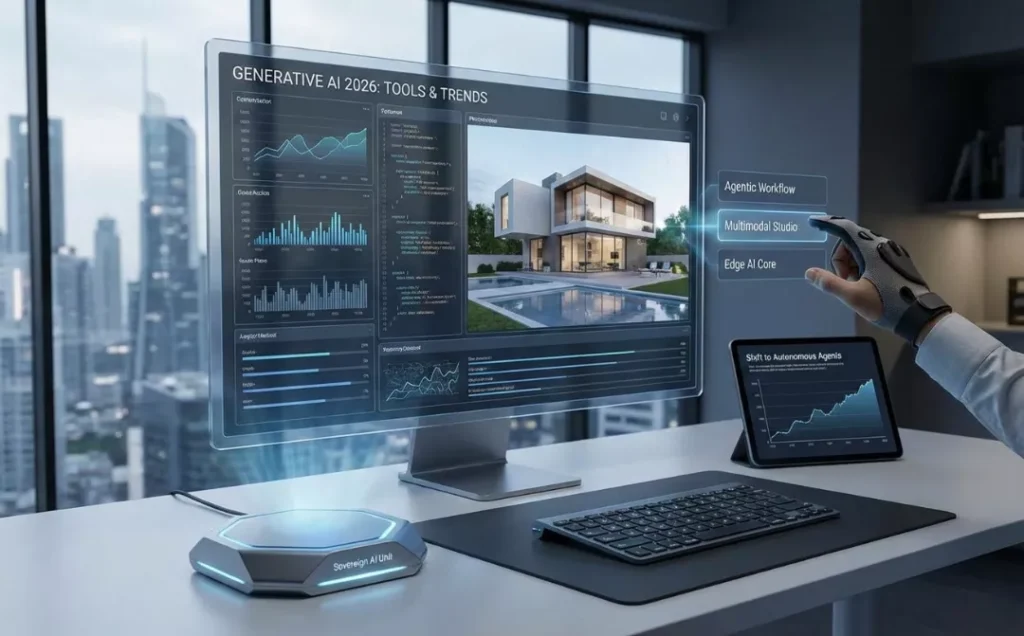
The most significant change in 2026 is the decline of the isolated chat window. The concept of merely “chatting” with an AI to accomplish a task now feels remarkably inefficient.
What is Agentic AI?
In 2024, if you wanted to plan a travel itinerary, you asked ChatGPT to “write an itinerary.” However, you still had to manually visit Expedia, book the flights, check your calendar, and email your family.
In contrast, Agentic AI in 2026 handles the execution. You simply state a goal: “Plan a business trip to Tokyo for the second week of March, keep flights under $1,500, and sync with the team’s availability.”
Subsequently, the Agent takes over:
- Reasons: First, it breaks down the goal into sub-tasks, such as checking your calendar and cross-referencing hotel preferences.
- Acts: Next, it accesses APIs (Application Programming Interfaces) to actively reserve seats and draft calendar invites.
- Verifies: Finally, it checks for conflicts before presenting you with a simple “Confirm” button.
Why It Matters Now
According to recent industry analysis, agentic capabilities now account for over 30% of enterprise software actions. We aren’t just generating text anymore; we are generating work. This evolution has led to the rise of “Action Transformers”—models specifically trained to navigate user interfaces (UIs) and software environments autonomously.
Top Trends Defining 2026
To understand where to invest your time and budget, you must first understand the three pillars supporting the 2026 AI ecosystem.
A. Small Language Models (SLMs) & Edge AI
The “bigger is better” era is pausing. While massive trillion-parameter models still exist in the cloud for heavy lifting, 2026 is undeniably the year of the SLM.
- Privacy First: Companies and individuals are tired of sending sensitive data to the cloud. Therefore, models like Llama-4-Edge (hypothetical) and Apple’s on-device intelligence run locally on your laptop or phone.
- Speed: Latency is effectively zero. Your AI assistant knows your local files, screen context, and biometric data without that information ever leaving your device.
- Cost: Furthermore, running a 7-billion parameter model on a local NPU (Neural Processing Unit) costs nothing compared to expensive API tokens.
B. Multimodal Fluidity
We have finally achieved “native” multimodality. Previously, models would transcribe audio to text, process the text, and then convert it back to audio, which introduced lag and lost emotional nuance.
- Native Understanding: Now, 2026 models “hear” audio and “see” video directly as tokens. Consequently, they understand the sarcasm in your voice or the clutter in your video background instantly.
- Video-to-Video: Moreover, real-time video generation is no longer a novelty; it is a standard communication tool. Marketing teams use text-to-video tools to generate daily social content that looks 99% photorealistic.
C. The “AI-Free” Movement & Regulation
With the proliferation of AI, a counter-trend has naturally emerged: the premium on human authenticity.
- Verification: “Proof of Personhood” has become a major security feature in 2026 social platforms.
- Hiring: Employers are increasingly using “AI-Free” skill assessments. They are less concerned with whether you can prompt, and more interested in whether you can think when the internet goes down. Indeed, “lazy thinking” caused by over-reliance on AI is the new skills gap.
The Essential Tool Stack of 2026
The market has consolidated significantly. Thousands of “wrapper” startups from 2024 have vanished, leaving behind robust, integrated platforms. Here is the breakdown of the essential tools you likely have on your dashboard today.
For The Knowledge Worker (Text & Logic)
- Advanced GPT / Claude Successors: The market leaders (OpenAI, Anthropic) have moved toward “Reasoning Engines.” These tools don’t just predict the next word; instead, they pause to “think” (using Chain of Thought verification) before answering complex legal or coding queries.
- Best for: Complex strategy, coding architecture, and legal analysis.
- Microsoft Copilot (OS Level): This tool is now deeply integrated into the OS. It doesn’t just sit in Word; rather, it watches your workflow across apps, suggesting file organizations and drafting replies based on context from meetings you didn’t even attend.
For The Creator (Visuals & Audio)
- Midjourney v7 & DALL-E 4: These have merged into “World Simulators.” You don’t just generate a static image; you generate a 3D environment or a consistent character that can be placed in multiple scenes without losing facial identity.
- Sora & Runway Gen-4: These represent the standard for video. Hollywood uses them for pre-visualization (previs), while YouTubers use them for B-roll. Fortunately, the cost has dropped significantly, making high-fidelity video generation accessible to solopreneurs.
- ElevenLabs & Suno: Audio generation is now indistinguishable from reality. Voice cloning is a standard feature in most CRM (Customer Relationship Management) software, allowing sales agents to leave personalized voicemails at scale.
For The Developer (Coding & Engineering)
- Autonomous Dev Agents (e.g., Devin 2.0): Developers in 2026 don’t just use autocomplete; they employ “AI Junior Developers.” You assign a GitHub issue to the agent, and it subsequently scans the repo, writes the fix, creates the test case, and submits the Pull Request for your review.
- Legacy Code Translators: A massive industry has sprung up around using AI to translate ancient COBOL and Fortran banking systems into modern Python or Rust, automated by specialized models.
Industry Impact: A Day in the Life (2026 Edition)
To make this concrete, let’s look at how these tools impact specific roles right now.
The Marketing Manager
- 09:00 AM: Arrives at the office. The Agentic Dashboard has already scanned overnight social sentiment and proposes 3 campaign adjustments.
- 10:00 AM: The user approves Campaign B. Immediately, the Agent automatically generates 50 variations of ad copy and 10 video assets (using a brand-consistent LoRA model), then pushes them to Meta and TikTok ad managers.
- 02:00 PM: During the review meeting, the AI analyzes ROI in real-time, predicting which ads will fatigue by Friday.
The Software Engineer
- 09:00 AM: There is no stand-up meeting. Instead, statuses were auto-summarized by the repo-watcher bot.
- 11:00 AM: The engineer sketches a system architecture on a whiteboard and takes a photo. The Multimodal AI instantly converts the sketch into Terraform infrastructure code and a React frontend boilerplate.
- 03:00 PM: Consequently, the engineer focuses purely on the complex logic of a payment gateway, leaving the boilerplate and unit tests to the AI pair programmer.
The Healthcare Professional
- Patient Intake: The doctor wears a smart lapel pin (Edge AI). It records the consult, separates medical data from small talk, and auto-populates the Electronic Health Record (EHR) with ICD-11 codes.
- Diagnosis Support: Simultaneously, the AI flags a potential drug interaction based on a paper published yesterday, which the model ingested overnight.
Comparative Analysis: 2024 vs. 2026
| Feature | The Landscape in 2024 | The Reality in 2026 |
| Primary Interaction | Chatbox / Prompting | Voice / Agent Delegation |
| Model Size | Massive LLMs (Cloud-only focus) | Hybrid: Cloud Giants + Edge SLMs |
| Video Generation | Glitchy, short clips (2-4s) | High-def, consistent physics, long-form |
| Coding | Autocomplete suggestions | Autonomous debugging & refactoring |
| Personalization | Custom Instructions (limited) | Deep Memory (Recalls years of context) |
| Regulation | “Wild West” / Early drafts | Strict “Watermarking” & Liability Laws |
How to choose the right tool (decision checklist)
- Task fit: content generation vs. data analysis vs. design.
- Data sensitivity: prefer on-prem or private-cloud models for confidential data.
- Cost vs. scale: estimate API usage and compute costs before committing.
- Integration needs: check connectors for your CMS, CRM, or codebase.
- Governance: ensure audit logs and human-in-the-loop controls.
Challenges & The Dark Side
It would be irresponsible to paint 2026 as a utopia. The integration of GenAI has brought distinct friction points that must be addressed:
- The “Dead Internet” Theory Realized: An estimated 40-50% of web content is now AI-generated. As a result, finding “human” forums has become a premium service.
- Data Poisoning: Because models are training on AI-generated data (Model Collapse), developers are aggressively hunting for “pure” pre-2023 human data. This makes old books and archives incredibly valuable.
- Power Consumption: The “Yotta-scale” computing centers required to train these models are straining energy grids. Thus, sustainable AI is the #1 topic at CES 2026.
- Job Displacement: While new roles appeared (e.g., Agent Ethics Compliance Officer), entry-level digital jobs in copywriting and basic coding have shrunk significantly. This forces juniors to upskill faster than ever before.
How to Stay Relevant in 2026
If you feel behind, do not panic. The skills required today are less technical and more managerial.
- Master the “Managerial Prompt”: Stop asking AI to write a sentence. Instead, start asking AI to execute a plan. Learn to define constraints, success metrics, and review checkpoints.
- Audit Your Workflow: Identify where you are transferring data manually (e.g., copying from email to Excel). An Agent can likely do that now.
- Humanity as a Premium: Finally, cultivate skills AI cannot fake—empathy, high-stakes negotiation, and physical world problem-solving. In a world of synthetic media, being “real” is your unique selling proposition.
Conclusion
Generative AI in 2026 is no longer a “trend”—it is the operating system of the modern world. We have graduated from the awe of creation to the utility of execution. The tools listed above are powerful, but they are merely engines; ultimately, you are the driver. The winners in 2026 aren’t the ones who use the most AI; they are the ones who use AI to amplify their uniquely human strategic vision.
Frequently Asked Questions (FAQs)
1. Will AI Agents replace my job in 2026?
Short Answer: No, but they will replace your tasks. Deep Dive: In 2026, AI is not replacing roles so much as it is “up-leveling” them. For example, a Junior Copywriter is now an “AI Content Editor,” responsible for guiding the tone and strategy of 50 AI-generated articles rather than writing one from scratch. The jobs most at risk are those purely focused on repetitive digital execution without strategic oversight.
2. What is the difference between a Chatbot and an AI Agent?
Short Answer: A chatbot talks; an agent acts. Deep Dive: A chatbot (like the 2023 version of ChatGPT) can tell you how to book a flight. An AI Agent (the 2026 standard) has permission to access your calendar, credit card, and the airline’s API to actually book the flight for you. This ability to execute multi-step workflows autonomously is the defining leap of 2026.
3. Do I still need to learn coding in 2026?
Short Answer: Yes, but the focus has shifted from “Syntax” to “Systems.” Deep Dive: You no longer need to memorize boilerplate code (AI does that instantly). However, you strictly need to understand System Architecture, Logic Flow, and Security. If you cannot read code to verify what the AI wrote, you cannot act as the “Manager,” leaving you vulnerable to bugs and security hallucinations.
4. Why is “Edge AI” suddenly so popular?
Short Answer: Privacy and Speed. Deep Dive: As models became efficient enough to run on laptops and phones (NPU chips), users realized they didn’t need to send sensitive financial or health data to the cloud. Edge AI processes data locally on your device, meaning your secrets never leave your hardware, and the AI works even without an internet connection.
5. How can I tell if a video is AI-generated?
Short Answer: Look for “Temporal Inconsistencies” and Watermarks. Deep Dive: While 2026 video models are hyper-realistic, they still struggle with complex object permanence over long clips (e.g., a watch disappearing and reappearing). Additionally, 2026 regulations now mandate invisible “C2PA” cryptographic watermarks on synthetic content, which browser plugins can automatically detect to warn you of “Non-Human Origin.”