

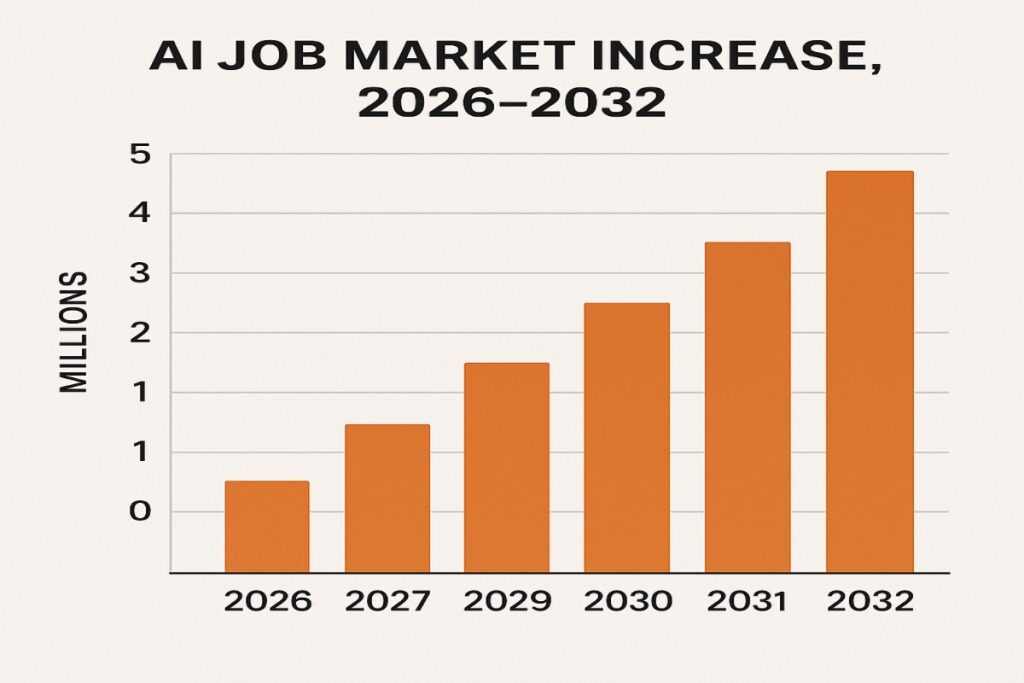
Entry-level AI jobs are increasing faster than ever because next-generation AI technologies have created entirely new roles that beginners can start without advanced coding or technical degrees. These roles involve training AI, reviewing AI-generated content, managing AI workflows, and supporting automation systems—making it easier than ever for fresh graduates and career switchers to enter the AI industry with confidence.
The AI Job Boom Has Opened the Door for Beginners
Artificial Intelligence used to be dominated by researchers, programmers, and data scientists. But today, AI tools have become powerful and user-friendly enough that businesses now need people who can use, guide, train, and improve AI systems.
This shift has unlocked a wide range of entry-level opportunities that do not require:
- Deep machine learning knowledge
- Advanced mathematics
- 5–10 years of experience
- A full computer science background
Instead, companies are looking for candidates who understand AI tools, can think logically, communicate clearly, and adapt quickly. This means anyone—with the right skills and willingness to learn—can build a strong career in AI, even without technical expertise.
What Makes an AI Job “Entry-Level”?
Entry-level AI positions are specifically designed for individuals who are new to the field and ready to develop foundational skills. These roles do not require deep technical expertise; instead, they offer beginner-friendly responsibilities and clear pathways for growth within the AI industry. Below are the key characteristics that define an entry-level AI job.
1. Requires Only Basic Foundational Knowledge
Candidates are not expected to have advanced skills in programming, machine learning, or data science. A basic understanding of digital tools, the ability to follow instructions, and familiarity with AI platforms (such as ChatGPT or Gemini) are typically sufficient to begin.
2. Provides Structured On-the-Job Training
Organizations hiring for entry-level AI roles offer comprehensive training to help newcomers understand their tasks. This may include learning how to review AI outputs, tag and prepare datasets, test chatbots, or refine prompts. Training ensures that employees build confidence while acquiring practical, hands-on experience.
3. Focuses on Supporting AI Systems Rather Than Building Them
Entry-level roles do not involve designing or developing AI algorithms. Instead, responsibilities revolve around assisting AI systems—monitoring outputs, correcting errors, organizing data, and improving overall performance. The focus is on operational support, not technical model creation.
4. Open to Fresh Graduates and Career Switchers
These jobs are accessible to individuals from diverse academic and professional backgrounds. Whether you are a recent graduate or transitioning from another field, entry-level AI positions welcome candidates who demonstrate curiosity, adaptability, and a willingness to learn.
5. Prioritizes Soft Skills Over Technical Expertise
Competencies such as critical thinking, communication, attention to detail, and problem-solving are highly valued. These qualities enable individuals to evaluate AI outputs effectively, understand user intent, refine prompts, and ensure quality results.
Entry-Level AI Roles as a Foundation for Future Growth
These positions serve as a solid starting point for advancing into more specialized AI careers. With experience, professionals can progress into roles such as AI analyst, prompt engineer, AI product associate, automation specialist, or AI safety reviewer. Entry-level roles establish the essential skills needed for long-term success in the evolving AI landscape.
Why Next-Gen AI Technology Is Creating New Career Paths
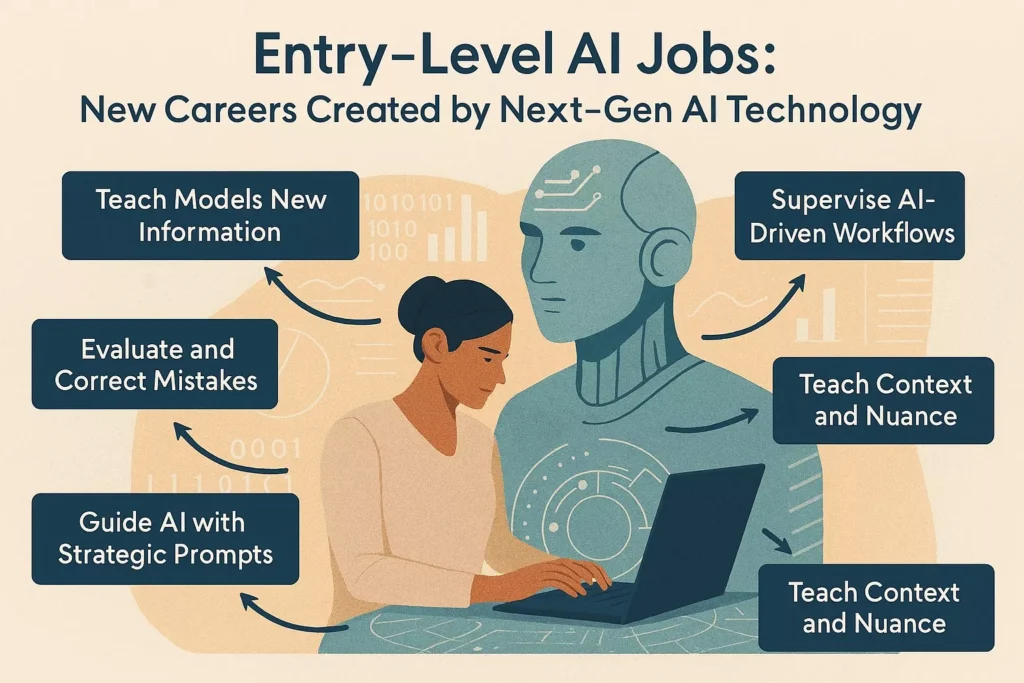
The latest generation of AI—large language models and multimodal systems—has shifted the balance between machines and people. These models are astonishingly capable, yet they still depend on human judgment, creativity, and care to be useful in the real world. That dependence is creating entirely new roles and career paths, many of them accessible to beginners who bring curiosity and practical skills rather than advanced degrees.
Teach models new information
- What this looks like: People create examples, write explanations, and correct model outputs so systems learn how to behave in specific contexts.
- Why it matters: Models don’t automatically know domain-specific facts, company policies, or up-to-date events—humans supply the curated, high-quality inputs that shape model behavior.
Evaluate and correct mistakes
- What this looks like: Humans review AI outputs, flag hallucinations or factual errors, and refine responses until they meet quality standards.
- Why it matters: Even powerful models produce plausible-sounding but incorrect answers; human reviewers are essential to catch and fix those failures before they reach users.
Guide AI with strategic prompts
- What this looks like: Skilled prompt designers craft instructions that steer models toward accurate, relevant, and useful results.
- Why it matters: The same model can produce wildly different outcomes depending on how it’s asked—good prompts turn raw capability into reliable performance.
Supervise AI-driven workflows
- What this looks like: People monitor automated pipelines, intervene when processes break, and ensure systems follow safety and compliance rules.
- Why it matters: Automation scales work but also amplifies mistakes; human oversight keeps systems safe, auditable, and aligned with organizational goals.
Teach context and nuance
- What this looks like: Humans train models to understand cultural norms, tone, and emotional subtleties so outputs are appropriate for different audiences.
- Why it matters: Language and meaning depend on context; human judgment helps AI communicate with sensitivity and relevance across cultures and situations.
The career impact
These human-centered needs have produced a wave of new, beginner-friendly roles that didn’t exist a few years ago—data labelers, model evaluators, prompt engineers, AI content reviewers, and workflow supervisors, to name a few. Many of these positions emphasize judgment, communication, and process skills over deep technical expertise, making them accessible entry points into the AI ecosystem.
Quick ways to get started
- Build practical experience: Try small projects with public AI tools and document what you learned.
- Showcase transferable skills: Highlight attention to detail, writing, domain knowledge, or quality-control experience on your resume.
- Learn the language of prompts and evaluation: Practice crafting prompts and writing clear feedback that improves model outputs.
Next‑gen AI is not replacing people so much as reshaping work—creating roles where human strengths like context, ethics, and creativity are more valuable than ever.
Top Entry-Level AI Jobs (No Experience or Coding Required)
1. Junior AI Prompt Engineer
A Junior AI Prompt Engineer helps craft the instructions that AI models use to generate accurate, meaningful results. This role sits at the intersection of creativity and logic.
Key Responsibilities:
- Writing structured prompts for AI tasks such as content creation, research assistance, data sorting, report generation, and more.
- Experimenting with wording, tone, and structure to see how AI responds, then choosing the best-performing style.
- Building prompt libraries that teams across the company can reuse for efficiency and consistency.
- Testing AI outputs to identify errors, inconsistencies, or irrelevant responses, then improving the prompts.
- Supporting cross-functional teams (marketing, sales, HR, customer support) by helping them integrate AI tools into their workflows.
Why This Role Is Great for Beginners:
It’s perfect for individuals who enjoy writing, analyzing patterns, solving problems, and thinking creatively. No coding required—only strong communication skills and curiosity.
2. AI Data Annotator / Labeling Specialist
AI models depend on high-quality labeled data to learn correctly. Data annotators play a critical role in shaping how AI understands the world.
Key Responsibilities:
- Tagging and labeling text, images, videos, or audio files to help AI identify what each example represents.
- Identifying objects, emotions, activities, and environmental details across different types of data.
- Correcting AI-generated labels to improve accuracy and reinforce the right patterns.
- Preparing datasets for cutting-edge industries such as autonomous vehicles, medical diagnostics, robotics, and security systems.
Why This Role Is Great for Beginners:
It requires patience and attention to detail rather than technical knowledge. Anyone comfortable with digital tools can excel.
3. AI Content Reviewer / AI Output Quality Analyst
As companies increasingly use AI to generate content, humans are needed to ensure quality, accuracy, and brand consistency.
Key Responsibilities:
- Reviewing AI-generated text to assess accuracy, clarity, and relevance.
- Editing tone, grammar, flow, and structure to make content more professional or aligned with brand guidelines.
- Checking for factual correctness and removing misleading or incorrect information.
- Spotting hallucinations—cases where AI generates false or fabricated details.
- Refining prompts and feedback loops to help the AI improve.
Why This Role Is Great for Beginners:
Ideal for writers, editors, content creators, and communicators who want to build an AI-focused career.
4. AI Chatbot Trainer
AI chatbots require regular improvements to sound natural, helpful, and context-aware. Trainers help refine how the chatbot handles real conversations.
Key Responsibilities:
- Creating sample dialogues and scenarios the chatbot might encounter.
- Reviewing chatbot responses to identify mistakes or incorrect interpretations.
- Tagging user intent to ensure the bot understands the purpose of each question.
- Refining conversation flows for better customer support or onboarding experiences.
- Testing chatbot performance across various situations and documenting improvements needed.
Why This Role Is Great for Beginners:
Perfect for individuals with customer service, communication, or problem-solving experience.
5. AI Research Assistant (Entry-Level)
This role supports AI research teams by handling operational tasks that help speed up development and experimentation.
Key Responsibilities:
- Summarizing lengthy AI research papers into simple insights for internal use.
- Organizing and preparing datasets for model testing and training.
- Running basic model tests and recording performance results.
- Comparing multiple AI tools and documenting findings.
- Maintaining reports, documentation, and knowledge bases for the research team.
Why This Role Is Great for Beginners:
Perfect for analytical thinkers, students, and curious learners who want early exposure to AI research without needing technical expertise.
6. AI Operations Assistant (AI Ops)
AI Operations teams ensure that AI tools, automations, and systems function properly around the clock. Entry-level assistants help monitor and support these workflows.
Key Responsibilities:
- Monitoring AI processes and dashboards to detect performance issues or errors.
- Reporting system problems so engineers can take corrective actions.
- Reviewing metrics and usage data to ensure AI tools run smoothly.
- Coordinating with engineering, product, and support teams to maintain optimal system performance.
- Documenting day-to-day operational tasks for internal tracking.
Why This Role Is Great for Beginners:
It provides a deep look into how AI systems function behind the scenes, making it valuable for future technical growth.
7. AI Social Media Assistant
AI tools now play a major role in content creation and audience engagement. Social media assistants use AI to speed up and enhance brand communication.
Key Responsibilities:
- Using AI tools to create captions, hashtags, visuals, ideas, and video scripts.
- Managing posting schedules and maintaining an organized content calendar.
- Analyzing AI-generated insights to understand audience behavior and campaign performance.
- Assisting with engagement strategies, such as optimizing content for reach and conversions.
Why This Role Is Great for Beginners:
Ideal for people interested in marketing, branding, content creation, and social media strategy.
8. AI Copywriting Assistant
AI simplifies writing, but human oversight ensures quality, personality, and accuracy. AI copywriting assistants enhance and refine AI-generated content.
Key Responsibilities:
- Editing blogs, product descriptions, ads, emails, and social posts created by AI.
- Improving clarity and structure to make content more readable and engaging.
- Creating outlines to guide AI tools in writing high-quality content.
- Ensuring SEO optimization, keyword placement, and brand messaging.
- Using AI tools to speed up content production while maintaining quality.
Why This Role Is Great for Beginners:
Perfect for aspiring writers or marketers who want to transition into AI-driven content work.
9. AI Testing & Validation Intern
AI systems must be tested thoroughly to ensure they behave safely, correctly, and reliably. This role focuses on quality control and model evaluation.
Key Responsibilities:
- Testing AI responses based on specific guidelines and safety rules.
- Identifying harmful, biased, or inappropriate outputs.
- Running benchmark tests to evaluate how the model performs across tasks.
- Documenting problems, inconsistencies, and improvement suggestions.
- Working with AI developers to refine output quality.
Why This Role Is Great for Beginners:
An excellent starting point for those interested in AI ethics, AI safety, or regulatory work—fields expected to grow rapidly.
10. AI Automation Associate
AI automation tools such as Zapier, Make.com, and AI agent platforms require human setup and management.
Key Responsibilities:
- Designing and maintaining simple automation workflows to streamline business operations.
- Connecting various software tools using automation platforms.
- Using AI to reduce repetitive manual tasks across teams like marketing, HR, or operations.
- Troubleshooting workflow issues and optimizing performance.
- Documenting automations to help teams understand processes.
Why This Role Is Great for Beginners:
Ideal for individuals who enjoy problem-solving, efficiency, and technology—even without coding experience.
Entry-Level AI Jobs That Require Basic Technical Skills
For beginners who are willing to learn light technical skills, the following roles offer excellent growth opportunities. They provide hands-on exposure to AI processes while keeping the technical barrier low. Even basic knowledge of tools like Excel, Python, or dashboards is enough to get started. These roles are ideal for individuals who want to blend technical skills with real AI applications.
1. Junior Data Analyst (AI-Assisted)
AI-powered analytics tools have simplified the traditional data analyst role. Today, even beginners can perform complex analysis with AI assistance, making this one of the fastest-growing entry-level opportunities.
What You Will Do:
- Clean and organize datasets using AI tools that automate repetitive steps like formatting, filtering, and error detection.
- Build dashboards and visualizations in tools like Power BI, Tableau, or Google Looker, guided by AI-generated suggestions.
- Interpret insights provided by AI models to support business decisions in areas such as sales, marketing, finance, and operations.
- Maintain regular reports and track important data trends to help companies understand performance over time.
Why It’s Beginner-Friendly:
Foundational skills in Excel or spreadsheets are enough to start. AI handles tasks like data cleaning and chart recommendations, allowing beginners to focus on understanding insights rather than complicated technical steps.
2. MLOps Intern (Machine Learning Operations)
MLOps manages the end-to-end lifecycle of AI models—from development and deployment to maintenance. As an intern, you support senior engineers and learn how real AI models operate in production environments.
What You Will Do:
- Monitor deployed AI models to ensure they are running efficiently and delivering accurate results.
- Log and track model performance metrics, documenting anomalies such as accuracy drops or slow response times.
- Troubleshoot minor technical issues by following predefined procedures or escalating them to senior engineers.
- Document workflows, updates, and system changes to keep the team aligned and maintain clear operational records.
- Assist ML engineers by preparing basic datasets, reviewing logs, or helping with monitoring tools.
Why It’s Beginner-Friendly:
You learn how AI systems work behind the scenes without needing to build models yourself. This role offers a strong foundation for future careers in AI infrastructure, cloud computing, or DevOps.
3. AI Product Assistant
AI product teams need support managing feature development, user research, and product performance. An AI Product Assistant helps bridge the gap between AI technology and user needs.
What You Will Do:
- Gather and organize user feedback to help the product team understand what features users enjoy or struggle with.
- Test new AI features and provide clear reports on bugs, usability issues, or areas for improvement.
- Prepare documentation such as feature guides, release notes, FAQs, and internal knowledge bases.
- Assist in product launches by coordinating tasks, preparing content, and ensuring teams have the resources they need.
- Understand basic UX workflows and collaborate with designers to ensure AI-powered features feel intuitive and user-friendly.
Why It’s Beginner-Friendly:
You don’t need technical expertise—just strong communication skills, organization, and an interest in understanding how AI products evolve.
4. Python Automation Assistant
Python remains one of the simplest and most widely used languages for automation. With basic Python knowledge and AI-assisted coding tools, beginners can easily take on valuable tasks.
What You Will Do:
- Write basic automation scripts to streamline tasks like data extraction, file organization, and formatting.
- Automate routine operations within teams, reducing manual work and increasing productivity.
- Support simple data-processing tasks, such as reading files, filtering information, or generating reports.
- Use AI-assisted code suggestions to fix errors, write functions, or generate boilerplate code quickly.
Why It’s Beginner-Friendly:
You only need very lightweight Python skills. Modern AI coding assistants help bridge knowledge gaps, making this role an ideal starting point for anyone interested in technical AI positions.
Industries Hiring Entry-Level AI Talent
i) Healthcare – medical data labeling, imaging support:
Healthcare organizations rely heavily on AI to analyze scans, manage patient data, and assist with diagnostics. Entry-level workers help label medical images, organize clinical datasets, support AI-driven diagnostic tools, and ensure the accuracy of automated health reports. This improves overall patient outcomes and speeds up medical decision-making.
ii) Finance – fraud detection assistance, data review:
Banks and financial institutions use AI to monitor transactions, flag suspicious activities, and analyze customer patterns. Beginners in this field support fraud detection processes, validate AI-generated alerts, review financial data, and help maintain compliance systems that keep transactions secure and transparent.
iii) Retail & E-commerce – AI product tagging, content review:
Online stores depend on AI to categorize products, manage large inventories, personalize recommendations, and review massive amounts of content. Entry-level roles include tagging product images, checking AI-generated descriptions, optimizing listings, and improving search accuracy to enhance customer experience.
iv) Education – AI tutoring support, content creation:
The education sector uses AI for personalized learning, automated study materials, and intelligent tutoring systems. Beginners help create academic content, review AI-generated explanations, support adaptive learning tools, and build training datasets that improve the effectiveness of AI-driven educational platforms.
v) Marketing – AI-generated content supervision:
Marketing teams increasingly use AI for advertising, social media content, copywriting, and audience insights. Entry-level talent supports these efforts by reviewing AI-generated campaigns, refining messaging, ensuring brand consistency, and using AI analytics to measure performance and engagement.
vi) Manufacturing – AI operations and automation:
Factories now utilize AI for quality control, equipment monitoring, predictive maintenance, and production optimization. Entry-level workers help oversee AI systems, annotate industrial data, identify workflow errors, and support automation tools that improve efficiency and reduce downtime in manufacturing environments.
vii) Logistics – route and inventory AI assistants:
Logistics and supply chain companies depend on AI for route planning, demand forecasting, warehouse automation, and shipment tracking. Beginners assist with reviewing AI-generated schedules, managing inventory data, supporting automated sorting systems, and ensuring operations run smoothly.
Skills Needed for Entry-Level AI Jobs
You do not need advanced mathematics, coding expertise, or a technical degree to start a career in AI. Instead, entry-level AI roles rely on practical abilities and foundational skills that most people can develop quickly. These skills help you work effectively with AI tools, evaluate outputs, solve problems, and support automated systems.
Core Skills
- Clear communication
The ability to communicate ideas clearly—both in writing and speaking—is essential. Many tasks involve reviewing AI outputs, refining prompts, or explaining results to team members. - Analytical thinking
Entry-level AI roles often require evaluating patterns, identifying errors, or interpreting AI-generated insights. Strong analytical thinking helps you make sense of data and AI behavior. - Problem-solving
AI systems may produce unexpected results or need human correction. Being able to troubleshoot issues, refine prompts, or improve workflows is a major advantage. - Creativity
Many AI tasks, such as prompt engineering or content improvement, require creative thinking. Creativity helps you generate better ideas, improve AI responses, and design user-friendly solutions. - Basic digital literacy
Comfort with computers, productivity tools, and online platforms is essential. Most entry-level AI roles involve navigating dashboards, using AI interfaces, and managing digital files.
Helpful Add-Ons
- Simple Python knowledge
Even a basic understanding of Python can help you automate small tasks, manipulate data, or collaborate with technical teams. You don’t need to be an expert—just know the fundamentals. - Prompt-writing skills
Learning how to write clear, structured prompts enables you to guide AI tools effectively. This skill enhances accuracy, consistency, and overall output quality. - Understanding common AI tools
Familiarity with platforms such as ChatGPT, Bard, Claude, or AI-powered content tools helps you adapt quickly to workplace requirements. - Familiarity with spreadsheets
Skills in Excel or Google Sheets help with data organization, reports, labeling, and analysis—common tasks in entry-level AI work. - Basic knowledge of automation workflows
Knowing how tools like Zapier, Make.com, or AI agents function gives you an edge when helping teams automate repetitive tasks.
Entry-Level AI Salary Expectations
AI salaries are among the highest in the beginner job market.
USA Salary Ranges:
- AI Data Annotator: $25K–$45K
- AI Output Reviewer: $30K–$55K
- Junior Prompt Engineer: $40K–$75K
- AI Ops Assistant: $40K–$65K
- AI Research Assistant: $35K–$60K
India Salary Ranges:
- ₹3.5L to ₹10L depending on role and company
Your salary grows rapidly as you gain experience.
How to Begin an AI Career with Zero Experience
Starting a career in AI may seem intimidating, but today’s tools and learning resources make it easier than ever—even if you are a complete beginner. With the right approach, you can build confidence, gain practical skills, and enter the AI job market in just a few weeks. Here’s a clear, beginner-friendly roadmap to get started:
Step 1: Learn AI Tools
Begin by familiarizing yourself with popular AI platforms. These tools are the backbone of most entry-level AI jobs.
- ChatGPT, Claude, and Gemini for writing prompts, analyzing data, and generating insights
- AI automation tools like Zapier, Make.com, or Notion AI to streamline workflows
- Image and video AI tools such as Midjourney or Runway (optional but useful)
Spending even a few hours a week exploring these tools will significantly boost your confidence and understanding of how AI behaves.
Step 2: Build Simple Projects
You don’t need complex coding projects to impress employers. Start small with practical, beginner-friendly creations that demonstrate your understanding of AI usage.
Great examples include:
- A prompt library showing how you solved different tasks using structured prompts
- An AI-powered resume generator built using simple automation workflows
- A mini blog website where all content is AI-assisted
- AI-driven summaries, reports, or templates for different industries
These projects prove that you can use AI creatively and effectively—exactly what employers want.
Step 3: Create a Small Portfolio
A portfolio helps you stand out, even without experience. It shows what you can do, not just what you claim to know.
Your portfolio may include:
- Prompt experiments (before-and-after outputs, detailed explanations)
- Data annotation samples showing how you labeled images, text, or videos
- AI-assisted content such as blogs, social posts, reports, or presentations
- Simple automation workflows for tasks like email sorting or data cleanup
Even 4–6 solid examples are enough to get noticed.
Step 4: Take Beginner-Friendly AI Courses
Formal education isn’t required, but online courses help structure your learning. Many platforms offer free or affordable options.
Recommended platforms:
- Coursera – AI foundations, data analysis, automation
- Google AI – introductions to machine learning and responsible AI
- Udemy – beginner-friendly AI and prompt engineering courses
- YouTube – free tutorials on AI tools, automation, and workflows
You can complete multiple courses in just a few weeks and add them to your resume or LinkedIn profile.
Step 5: Apply for Entry-Level AI Jobs
Once you’ve built some skills and assembled your portfolio, start applying for beginner-friendly AI roles. Employers often look for curiosity, adaptability, and hands-on familiarity with AI—not formal degrees.
Search for job titles such as:
- AI Assistant
- Prompt Tester
- Data Labeler / Data Annotator
- AI Content Reviewer
- AI Operations Support
- AI Research Assistant (Entry-Level)
Start applying widely—many companies offer remote or hybrid AI roles suitable for beginners.
Future of Entry-Level AI Jobs
This decade will bring new beginner roles such as:
- AI Safety Reviewer
- AI Agent Supervisor
- AI Personalization Assistant
- AI Workflow Designer
- Synthetic Data Assistant
AI is creating more jobs than it replaces—and beginners will benefit the most.
Conclusion: The Future Workforce Needs AI Beginners
Entry-level AI jobs prove that Artificial Intelligence is not eliminating careers—it is creating fresh opportunities for millions worldwide. With the rise of next-gen AI tools, anyone can enter the field with the right mindset, basic skills, and willingness to learn. Whether you’re a student, job seeker, or career switcher, AI now offers a fast-growing, high-income, future-ready career path.
FAQs
1. Why are entry‑level AI jobs growing so quickly?
Answer: The rapid adoption of next‑gen models across industries has created demand for roles that bridge human judgment and automated systems. Companies need people to curate training examples, evaluate outputs, and maintain safe workflows—work that scales with AI deployment and doesn’t always require advanced technical degrees.
2. What kinds of entry‑level roles are available?
Answer: Common roles include data annotators/labelers, model evaluators/content reviewers, prompt specialists, AI workflow operators, and quality assurance associates. Many of these positions emphasize process discipline, domain knowledge, and communication skills over heavy coding, making them accessible to fresh graduates and career switchers.
3. What skills make a candidate stand out for these roles?
Answer: Employers prioritize attention to detail, critical thinking, clear written feedback, and the ability to follow and improve evaluation rubrics. Familiarity with popular AI tools, basic data handling (spreadsheets, simple tagging), and examples of prompt experimentation or small projects help candidates demonstrate readiness.
4. How do entry‑level AI jobs lead to higher‑level careers?
Answer: These roles provide hands‑on exposure to real datasets, model failure modes, and product constraints. Over time you can move into prompt engineering, ML operations, data engineering, or junior data scientist tracks by adding technical skills (Python, SQL, ML fundamentals) and demonstrating impact through process improvements or tooling contributions. The typical path is learn → document → optimize → specialize.
5. What should I include on my resume or portfolio?
Answer: Highlight practical examples: short projects using public AI tools, documented prompt experiments, quality‑control or annotation work, and any domain expertise (healthcare, finance, legal) that improves data quality. Emphasize soft skills—clear feedback samples, teamwork, and process improvements—because they’re often the deciding factor for hiring managers.