
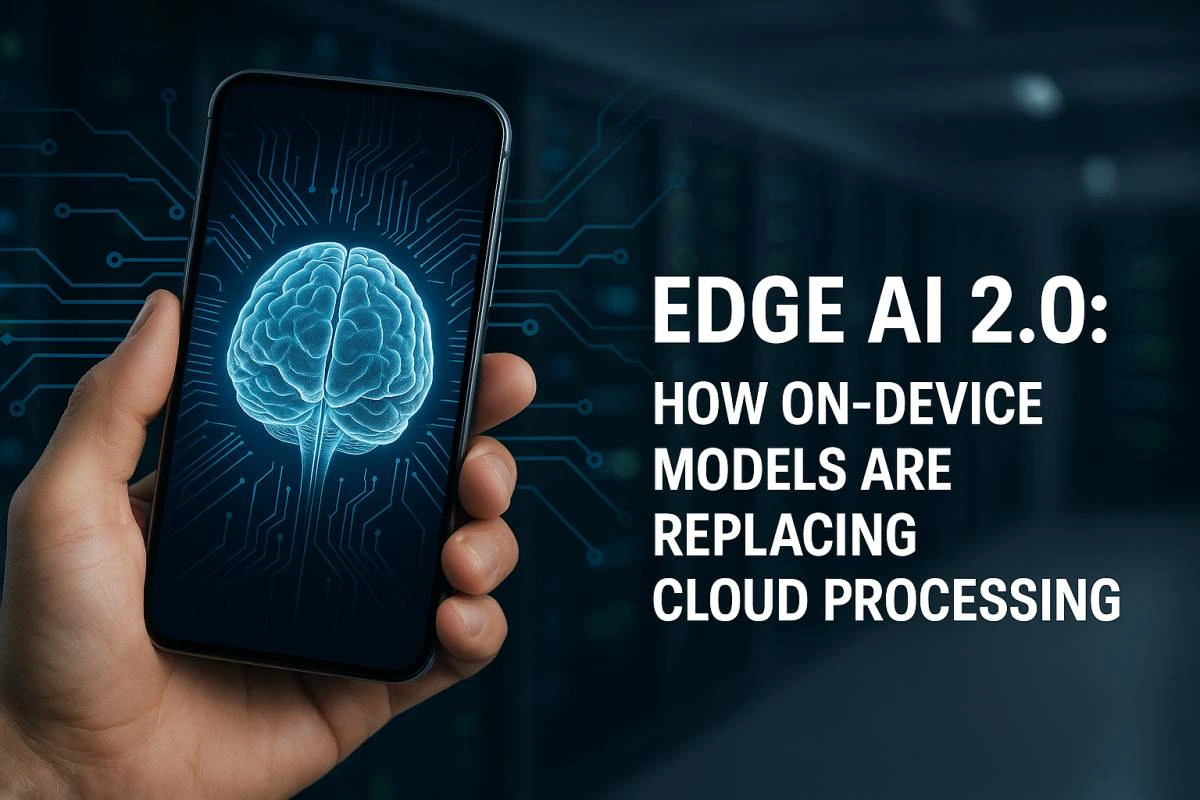
Edge AI 2.0 is the next evolution of artificial intelligence where models run directly on devices—smartphones, IoT sensors, wearables, and industrial machines—rather than relying on constant cloud connectivity. This shift replaces traditional cloud processing with on-device intelligence, enabling faster responses, greater privacy, reduced bandwidth costs, and more reliable performance. In simple terms, Edge AI 2.0 means your device itself is becoming smart enough to process AI tasks locally, without always sending data to distant servers.
What is Edge AI 2.0?
- Definition: Edge AI 2.0 refers to the deployment of advanced AI models directly on edge devices, powered by optimized hardware and software frameworks.
- Difference from Edge AI 1.0: Earlier edge AI was limited to lightweight tasks (like keyword detection or basic image recognition). Edge AI 2.0 introduces more complex models—natural language processing, computer vision, predictive analytics—running locally.
- Core Idea: Instead of depending on the cloud for every computation, devices now handle AI workloads themselves.
Why Cloud Processing Is Being Replaced
1. Latency Reduction
- Cloud AI requires sending data to remote servers, waiting for processing, and receiving results.
- Edge AI 2.0 eliminates this round trip, offering real-time responses.
- Example: Autonomous vehicles cannot afford delays; they need instant decision-making.
2. Privacy and Security
- Sensitive data (health records, facial recognition, financial transactions) no longer needs to leave the device.
- On-device processing reduces risks of breaches and compliance issues.
3. Bandwidth Efficiency
- Constant cloud communication consumes bandwidth and costs.
- Edge AI reduces unnecessary data transfers, saving resources.
4. Reliability in Offline Environments
- Devices can function even without internet connectivity.
- Example: Smart farming sensors in rural areas can analyze soil conditions without cloud dependency.
The Technology Behind Edge AI 2.0
Hardware Innovations
- AI Chips: Specialized processors like Google’s TPU, Apple’s Neural Engine, and Qualcomm’s AI cores.
- Energy Efficiency: Chips designed for low power consumption, enabling AI in wearables and IoT devices.
- Miniaturization: Smaller, faster, and cheaper hardware makes edge deployment scalable.
Software Advancements
- Model Compression: Techniques like quantization and pruning reduce model size without losing accuracy.
- Federated Learning: Devices train models collaboratively without sharing raw data.
- On-Device Frameworks: TensorFlow Lite, Core ML, and PyTorch Mobile optimize AI for edge hardware.
Why Edge AI 2.0 Matters Today
The world needs faster and more private AI systems. Cloud computing has limitations:
- It depends on internet connectivity
- It introduces latency
- It raises privacy concerns
- It provokes high cloud costs
- It requires huge energy consumption
Edge AI 2.0 solves all of these.
Modern Users Expect Instant Intelligence
Today’s apps—from mobile assistants to real-time translation—demand near-instant performance. Waiting even one second impacts user experience.
Security & Privacy Are Under Pressure
Sending personal voice, images, health metrics, or location to the cloud raises risks. On-device AI avoids unnecessary data exposure.
Scalability Matters
For companies deploying millions of devices, cloud AI is expensive. On-device inference reduces recurring cloud bills dramatically.
Edge AI 2.0 is not just a convenience—it’s the solution to the limitations of cloud-based AI.
Real-World Applications of Edge AI 2.0
Healthcare
- Wearables detecting heart irregularities in real time.
- Smart diagnostic tools analyzing medical images locally.
Automotive
- Self-driving cars making split-second decisions.
- Predictive maintenance for vehicles.
Smart Homes
- Voice assistants processing commands locally.
- Security cameras analyzing footage without cloud uploads.
Industrial IoT
- Machines predicting failures before breakdowns.
- Sensors monitoring production lines with instant feedback.
Retail
- Smart checkout systems recognizing products instantly.
- Personalized recommendations on-device.
Benefits for Businesses and Consumers
- Speed: Instant AI responses improve user experience.
- Cost Savings: Reduced cloud dependency lowers operational expenses.
- Scalability: Millions of devices can run AI without overwhelming cloud servers.
- Trust: Enhanced privacy builds consumer confidence.
Challenges of Edge AI 2.0
- Hardware Limitations: Not all devices can handle large models.
- Model Updates: Keeping on-device models up to date is complex.
- Interoperability: Different devices and ecosystems may struggle to integrate.
- Security Risks: While data stays local, devices themselves can be hacked.
Future of Edge AI 2.0
- Integration with 5G: Faster networks will complement edge AI, enabling hybrid models.
- AI-Powered Chips Everywhere: From refrigerators to drones, AI chips will become standard.
- Decentralized Intelligence: Devices will collaborate without central servers.
- Sustainability: Reduced cloud reliance lowers energy consumption globally.
Comparison: Cloud AI vs Edge AI 2.0
| Feature | Cloud AI | Edge AI 2.0 |
|---|---|---|
| Latency | High (depends on network) | Ultra-low (local processing) |
| Privacy | Data leaves device | Data stays on device |
| Bandwidth | Heavy usage | Minimal usage |
| Reliability | Needs internet | Works offline |
| Scalability | Limited by server capacity | Distributed across devices |
Human-Centric Impact
Edge AI 2.0 is not just a technical upgrade—it’s a human-centered revolution. By keeping intelligence closer to the user:
- Patients get faster diagnoses.
- Drivers get safer vehicles.
- Consumers get more personalized experiences.
- Workers get smarter tools that reduce errors.
This shift makes AI more accessible, trustworthy, and practical in everyday life.
Conclusion
Edge AI 2.0 is transforming the way artificial intelligence operates. By moving intelligence from the cloud to the device, it delivers speed, privacy, efficiency, and reliability. As hardware and software continue to evolve, Edge AI 2.0 will become the backbone of smart living, powering everything from healthcare to industry. The future of AI is not far away—it’s already in your pocket, on your wrist, and in your home.
Frequently Asked Questions (FAQs)
1. What is Edge AI 2.0?
Edge AI 2.0 refers to the deployment of advanced artificial intelligence models directly on devices like smartphones, sensors, and wearables. Unlike traditional AI that relies on cloud servers, Edge AI 2.0 processes data locally, enabling faster, more private, and more efficient operations.
2. How is Edge AI 2.0 different from traditional cloud AI?
Traditional cloud AI sends data to remote servers for processing, which can introduce latency and privacy risks. Edge AI 2.0 processes data on-device, reducing delays, improving security, and minimizing bandwidth usage.
3. What are the benefits of Edge AI 2.0?
- Real-time decision-making
- Enhanced privacy and data security
- Lower bandwidth and cloud costs
- Offline functionality
- Scalability across millions of devices
4. What types of devices use Edge AI 2.0?
Edge AI 2.0 is used in:
- Smartphones
- Smartwatches and wearables
- IoT sensors
- Autonomous vehicles
- Industrial robots
- Smart home devices
5. What are some real-world examples of Edge AI 2.0?
- Apple’s Face ID and Siri processing on-device
- Tesla’s Autopilot making real-time driving decisions
- Smart cameras analyzing footage locally
- Wearables detecting heart irregularities instantly