
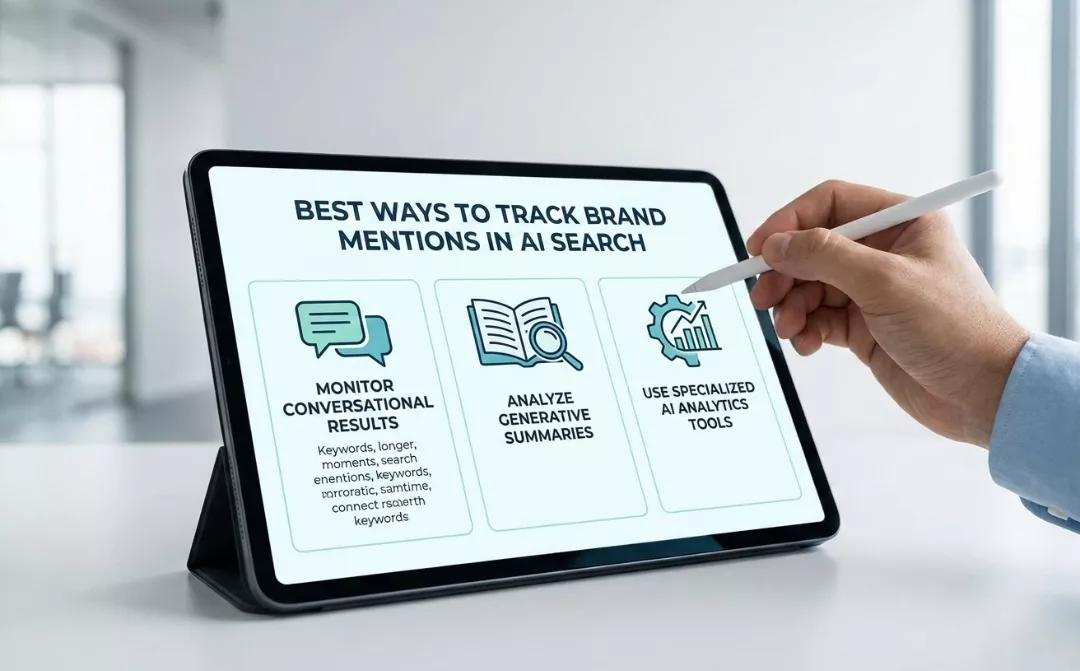
Tracking brand mentions in AI search in 2026 requires shifting from traditional SEO metrics to Generative Engine Optimization (GEO) and monitoring your “Share of Model” (SOM). Unlike traditional search engines that list links, AI platforms like ChatGPT, Google AI Overviews, and Perplexity synthesize answers; therefore, tracking involves using specialized AI visibility tools (such as Otterly.ai, Siftly, or Semrush’s AI Toolkit) to measure how often your brand is cited as a source or recommended in direct answers. Effective tracking now necessitates a dual approach: leveraging automated software to monitor mention frequency across Large Language Models (LLMs) and performing manual “prompt engineering” audits to understand the sentiment and context in which your brand appears for high-intent queries.
The Great Shift: Why “Googling It” Isn’t What It Used To Be
Welcome to 2026. The days of fighting for the “featured snippet” or obsessing over rank #1 on a page of blue links are fading. Today, when a user asks, “What is the best CRM for a mid-sized fintech company?” they aren’t clicking through ten different blogs. They are getting a single, comprehensive, synthesized answer from an AI.
If your brand isn’t in that answer, you don’t exist.
This shift has birthed a new discipline: Generative Engine Optimization (GEO). The goal is no longer just traffic; it is inclusion. You are fighting for a place in the neural pathways of the world’s most powerful AI models. But before you can optimize for this, you have to measure it. And that is where things get tricky. Traditional rank trackers are blind to the dynamic, conversational nature of AI.
This guide will walk you through exactly how to track your brand’s heartbeat in the age of AI, from the cutting-edge tools you need to the manual audits that reveal what the algorithms truly think of you.
The New North Star: Share of Model (SOM)
In the old world, we tracked “Share of Voice” (SOV)—how much of the conversation you owned on social media or search ads. In 2026, the metric that matters is Share of Model (SOM).
What is Share of Model?
SOM measures the percentage of times an AI model mentions your brand in response to category-relevant prompts compared to your competitors.
For example, if you sell eco-friendly running shoes, and you run the prompt “Recommend the best sustainable running shoes for marathons” 100 times across different AI sessions:
- If your brand appears in the recommendation list 40 times, your SOM is 40%.
- If your competitor appears 80 times, they are dominating the model’s “headspace.”
Why SOM is harder to track than SEO rankings:
- Non-Deterministic Answers: AI models are creative. Ask the same question twice, and you might get slightly different wording.
- Personalization: AI agents now know the user’s history. A prompt from a CTO looks different than a prompt from a junior developer.
- No “Rankings”: You aren’t “Position 3.” You are either cited, recommended, or ignored.
Tracking approaches (what to use and why)
- AI‑visibility platforms — scan LLM answer outputs, show where you’re cited, and recommend content fixes.
- SERP + AI snippet monitoring — track both classic search and AI overviews to capture cross‑channel mentions.
- Structured data & Knowledge Graph optimization — ensure your facts are machine‑readable so LLMs cite you accurately.
- Social listening + news feeds — LLMs often pull from recent articles; monitor those sources for upstream mentions.
- Human verification workflow — flag false or harmful mentions and escalate for PR/SEO fixes.
The 2026 Tool Stack: Automated AI Monitoring
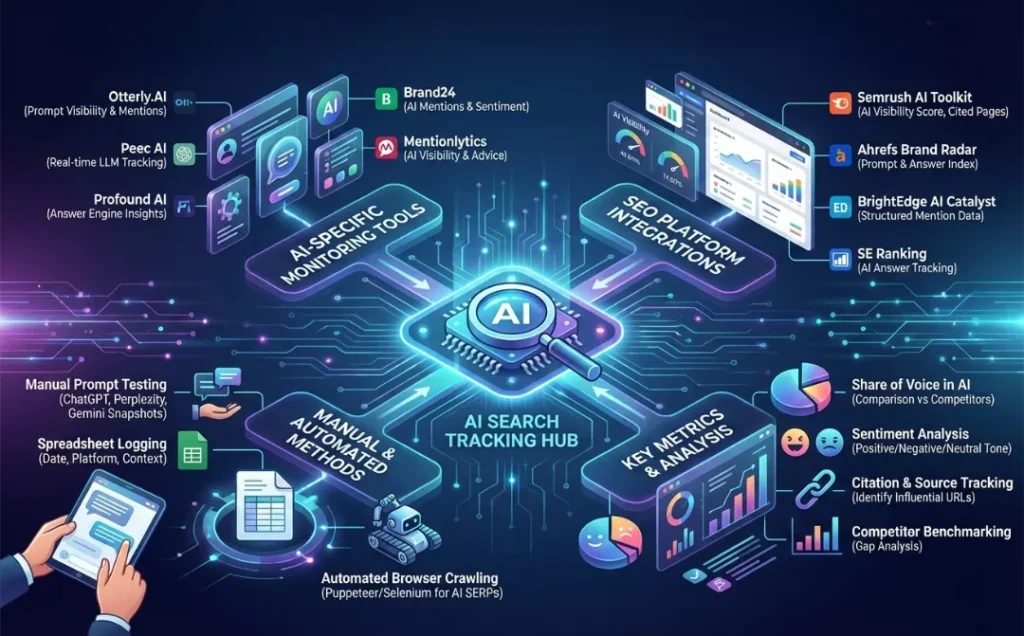
You cannot manually check ChatGPT 500 times a day. Fortunately, the software landscape has exploded with tools designed specifically for LLM monitoring. These platforms don’t just “crawl the web”; they “interrogate the models.”
Here is a breakdown of the top-tier tools dominating the market this year.
| Tool Name | Best Used For | Key Feature | 2026 Status |
| Otterly.ai | Multi-Model Tracking | Tracks visibility across ChatGPT, Perplexity, Claude, and Gemini simultaneously. | Market Leader for pure GEO tracking. High accuracy in citation detection. |
| Siftly | Strategic Insight | excellent for “Source Analysis”—tells you which websites the AI read to learn about you. | Essential for PR teams to know where to pitch guest posts. |
| Semrush AI Toolkit | Integrated SEO/GEO | Blends traditional keyword volume with AI “Sentiment Analysis.” | Best for teams who want to keep SEO and GEO data in one dashboard. |
| Brand24 AI | Reputation & Sentiment | Focuses heavily on how the AI describes you (positive vs. negative bias). | rigorous “hallucination detection” to alert you if AI lies about your product. |
| Perplexity Enterprise | Direct Source Data | First-party data from Perplexity on how often your brand is cited in their answers. | The “Google Search Console” of the AI answer engine world. |
Pro Tip: Don’t just subscribe to one. Most successful enterprise teams in 2026 use a combination—typically Otterly.ai for the raw numbers and Brand24 to monitor the sentiment of those mentions.
Manual Tracking: The “Prompt Matrix” Method
While tools give you data at scale, they often miss the nuance. To truly understand your position, you need to perform manual audits using a Prompt Matrix. This involves simulating the user journey by feeding specific categories of prompts into the major AI engines (ChatGPT, Claude, Google Gemini).
Create a spreadsheet and track your brand’s performance against these three specific prompt types:
1. The Informational Prompt (The “What is” Phase)
- The User’s Intent: They are learning about a problem.
- The Prompt: “How do I lower my cloud storage costs?”
- The Goal: Does the AI mention your brand as a solution or a concept?
- Scoring: 1 point if mentioned, 0 if not.
2. The Comparative Prompt (The “Versus” Phase)
- The User’s Intent: They are narrowing down options.
- The Prompt: “Compare [Your Brand] vs. [Competitor A] vs. [Competitor B].”
- The Goal: Look for “Argument framing.” Does the AI list your unique selling proposition (USP) correctly? Or does it hallucinate features you don’t have?
- Critical Check: Does the AI recommend a “winner”? If so, why? (This often reveals which review sites the AI trusts most).
3. The Transactional Prompt (The “Best for” Phase)
- The User’s Intent: They are ready to buy.
- The Prompt: “I need a CRM for a real estate agency with a budget of $500/month. What should I buy?”
- The Goal: This is the “money prompt.” Being the #1 recommendation here is worth 100x more than a blog visit.
- Metric: Recommendation Rate. How often are you the first name dropped?
Optimizing for Inclusion: How to influence the Tracking
Once you are tracking your SOM, you will inevitably ask: “How do I improve it?”
In 2026, you cannot just “buy links.” You have to optimize your Brand Entity. AI models rely on a “Knowledge Graph”—a web of interconnected facts. If the AI is not mentioning you, it’s usually because it doesn’t understand you or doesn’t trust you.
1. The “Citation Ecosystem” Strategy
AI models don’t read the whole internet equally. They favor “High-Authority Nodes”—sites like Wikipedia, G2, Capterra, major news outlets (New York Times, Bloomberg), and niche authority blogs.
- The Fix: Use tools like Siftly to identify which sources the AI is citing for your competitors.
- The Action: If ChatGPT cites a specific review on “TechRadar” to recommend your competitor, your marketing goal is no longer “get any link.” It is “get a review on TechRadar.”
2. Structured Data is Your Translator
AI is smart, but it prefers data that is easy to digest.
- The Fix: Ensure your website uses extensive Schema Markup (Organization schema, Product schema, FAQ schema).
- The logic: When you explicitly tell the AI code “Price: $50” and “Rating: 4.8”, it is far more likely to accurate quote those specs in a comparison table than if it has to guess from a paragraph of text.
3. “Agentic Ready” Content
We are seeing the rise of Agentic Commerce—where AI agents buy products for users.
- The Fix: Create a specific section of your site (e.g.,
/ai-manifest) or specialized API documentation that explains your pricing and specs in pure JSON or rigid tables. - The Future: You aren’t just writing for humans anymore; you are writing for the bot that is researching on the human’s behalf.
The “Hallucination” Danger Zone
Tracking isn’t just about visibility; it’s about Brand Safety. One of the biggest risks in 2026 is an AI confidently stating something false about your brand.
- “Product X has been discontinued.” (When it hasn’t).
- “Company Y has a history of security breaches.” (Confusing you with a competitor).
How to track this:
Set up Negative Sentiment Alerts in your AI monitoring tools. If the “Truthfulness Score” of a mention drops, you need to intervene.
The Remedy: You cannot “email the manager of ChatGPT.” Instead, you must flood the “Citation Ecosystem” with corrective content. Publish a press release, update your Wikipedia, and get third-party validation that corrects the specific error. The AI will eventually “re-learn” the truth during its next retrieval cycle.
Conclusion: The Era of “Invisible” Influence
Tracking brand mentions in AI search is the most critical marketing adjustment of the decade. The “funnel” has collapsed. Users are no longer browsing; they are asking.
If you are not tracking your Share of Model, you are flying blind. You might have excellent SEO traffic to your blog, but if ChatGPT tells every high-intent buyer that your competitor is “more reliable,” your revenue will bleed out, and your analytics won’t show you why.
The winning formula for 2026 is clear:
- Monitor continuously with tools like Otterly or Siftly.
- Audit manually with persona-driven prompts.
- Optimize by feeding the “Citation Ecosystem” that feeds the AI.
The brands that win in 2026 won’t necessarily be the ones with the loudest ads, but the ones that the AI trusts enough to recommend when no one is watching.
Frequently Asked Questions (FAQs)
1. How is tracking “Share of Model” (SOM) different from traditional SEO ranking?
Traditional SEO is about position (e.g., “I am #1 on Google”). It is static and location-based. Share of Model (SOM) is about frequency and sentiment within a conversation. Since AI answers are generated dynamically for every user, you don’t “hold a spot.” Instead, SOM measures the probability of your brand being mentioned. If an AI is asked 100 times for a recommendation and it suggests you 40 times, your SOM is 40%. It is less about “where you rank” and more about “how often you are top-of-mind” for the algorithm.
2. Can I just pay ChatGPT or Google Gemini to mention my brand more?
Not directly in the organic results. In 2026, you cannot pay to alter the core training data or the organic “reasoning” of the model. However, “Sponsored Citations” do exist in tools like Perplexity and Google AI Overviews, which act like traditional ads (clearly labeled). But for the organic recommendation—the part where the user trusts the AI’s unbiased opinion—you cannot buy your way in. You have to earn it by having a strong presence in the “trusted sources” (like authoritative reviews and data-rich content) that the AI reads.
3. What should I do if an AI model is “hallucinating” or saying false things about my brand?
This is a critical reputation issue. You cannot “log in” to fix it. The best approach is a strategy called “Correction via Citation.” You must flood the authoritative web (your press section, Wikipedia, partner news sites, and review platforms) with the correct information. If the AI says your product costs $100 (and it actually costs $50), explicitly publish the correct price on high-authority pages using structured data. The next time the AI “scrapes” or “retrieves” live data to answer a user, it will correct itself based on this new, overwhelming evidence.
4. Is traditional SEO dead in 2026?
No, but its job has changed. Traditional SEO is now the “food” that feeds the AI. You still need a website, blogs, and technical SEO, not just for human clicks, but so the AI bots can read and understand you. If you stop doing SEO, the AI stops finding new data about you, and your “Share of Model” will eventually drop to zero. Think of SEO as the foundation; GEO (Generative Engine Optimization) is the house you build on top of it.
5. How often should I audit my brand’s visibility in AI search?
Because AI models update their “retrieval knowledge” frequently (sometimes daily), a monthly cadence is too slow.
- Automated Tracking: Use tools (like Otterly.ai or Brand24) to run daily checks for volume and sentiment.
- Manual Audits: Perform a deep-dive “Prompt Audit” (testing complex questions) bi-weekly or whenever you launch a major product or campaign. This ensures you catch any shifts in how the AI perceives your new messaging before it becomes permanent memory.