
If you’re looking for the best AI tools for data analysis in 2026, the seven platforms listed below are the fastest, smartest, and most accurate options available today. These tools help you analyze massive datasets in seconds, generate instant insights, automate reports, and predict future trends with far higher accuracy than traditional analytics tools. Whether you’re a business leader, analyst, or beginner, these are the top 7 AI tools you should use right now to unlock faster insights, reduce manual work, and make smarter data-driven decisions.
List of the Top 7 AI Tools for Data Analysis
The landscape of data analysis has changed dramatically. AI is no longer optional—it’s the backbone of analytics in every industry. From predictive modeling and automated visualization to anomaly detection and natural language querying, AI tools are making complex data simple, actionable, and instant.
Below are the seven standout AI tools dominating 2026.
1. Google Vertex AI – Best for Enterprise-Grade Predictive Analytics
Google Vertex AI has solidified its position as one of the most powerful enterprise AI platforms in 2026 thanks to its seamless integration with the Google Cloud ecosystem and its ability to handle large-scale predictive workloads. Vertex AI dramatically simplifies the entire machine learning lifecycle—from data import and preparation to model training, evaluation, deployment, and monitoring—within one unified interface.
Why It Stands Out
Vertex AI is widely recognized for reducing model development time by up to 60–70% through its automated pipelines and AutoML capabilities. Businesses no longer need large engineering teams to build advanced models. Instead, Vertex AI uses intelligent automation to train, tune, and optimize models at scale while ensuring enterprise-level consistency and reliability. Its strong integration with BigQuery allows organizations to run ML directly on top of massive datasets, enabling real-time analytics at an unprecedented speed.
Key Features
- End-to-end AI workflow automation for faster development cycles
- AutoML for simple drag-and-drop predictive model creation
- Enterprise-grade real-time analytics for anomaly detection and forecasting
- Native BigQuery integration for large-scale cloud analytics
- Multimodal ML support for text, image, tabular, IoT, and time-series data
Best For
Large corporations, data scientists, advanced ML teams, and organizations that require highly scalable predictive intelligence.
2. Microsoft Fabric + Copilot – Best for Business Intelligence & AI-Driven Decision Making
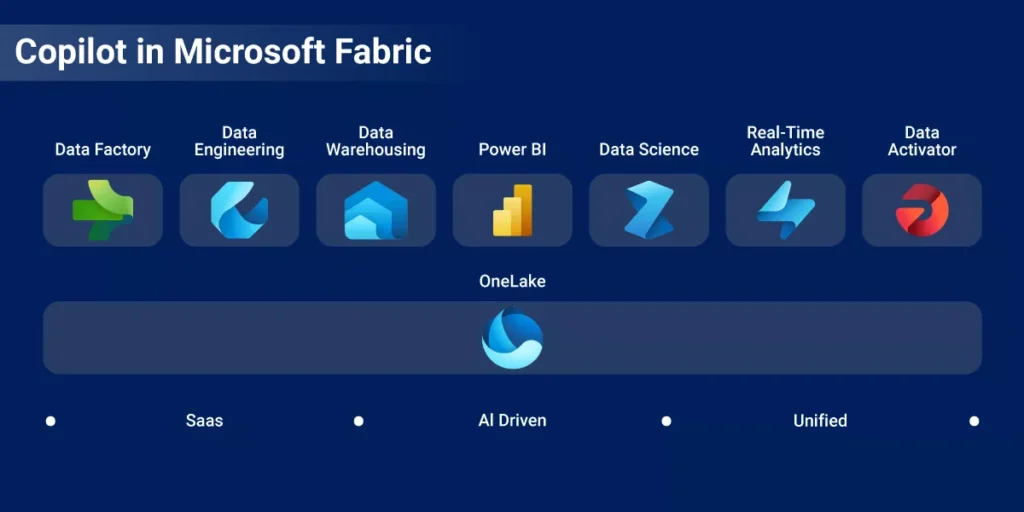
Microsoft Fabric paired with Copilot has become the most accessible yet powerful analytics system for businesses transitioning into AI-driven operations. Fabric unifies data engineering, business intelligence, machine learning, and real-time analytics—making it possible for teams to work on the same data foundation without data silos.
Why It Stands Out
Fabric’s real strength lies in its native integration with Copilot, Microsoft’s AI assistant. Copilot allows users to ask questions in natural language and instantly receive insights, summaries, data visualizations, and predictive suggestions. This democratizes analytics, enabling non-technical teams to perform deep analysis without writing any SQL, DAX, or Python. For organizations already using Power BI or Microsoft 365, Fabric provides a seamless upgrade into AI-powered analytics.
Key Features
- Natural-language querying for instant, code-free insights
- Auto-generated dashboards and executive summaries
- Real-time data pipelines for live operational intelligence
- Deep Power BI integration for advanced BI workflows
- Strong enterprise governance across the Microsoft ecosystem
Best For
Business analysts, mid-to-large enterprises, BI teams, and companies using Microsoft Office or Power BI/cloud infrastructure.
3. Tableau Pulse AI – Best for Automated Insights & Visual Analytics
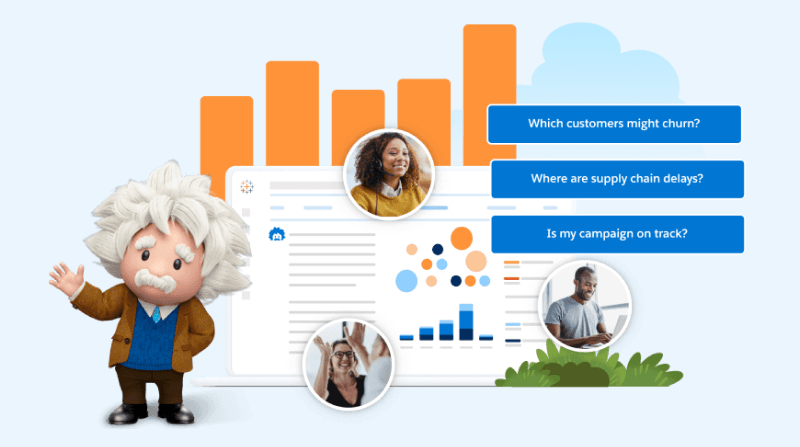
Tableau has long been the leader in data visualization, and with Tableau Pulse AI, the platform becomes even more intelligent and intuitive. Instead of relying solely on dashboards that require manual interaction, Pulse provides automated insights, personalized summaries, and conversational analysis—all powered by generative AI.
Why It Stands Out
Pulse helps users understand why metrics change by producing contextual insights, narrative explanations, and correlation analysis. This makes it extremely useful for executives or teams who need to interpret trends quickly without diving deeply into charts. It automatically monitors key metrics and sends alerts when unusual behavior or patterns are detected, helping organizations respond faster.
Key Features
- AI-generated narrative reports that explain trends and anomalies
- Automated metric monitoring and alerts
- Predictive insights to highlight future outcomes
- World-class visual analytics for deep interactive exploration
- Team collaboration workflows for easy data sharing
Best For
Marketing teams, financial analysts, BI teams, executives, and organizations focused heavily on storytelling and visual clarity.
4. Databricks AI + Lakehouse Best for Big Data & Advanced ML Pipelines
Databricks continues to dominate the world of large-scale data analytics and machine learning. Its Lakehouse architecture combines the flexibility of data lakes with the reliability of warehouses, making it an ideal choice for AI-powered enterprises.
Why It Stands Out
The Databricks Lakehouse allows massive datasets to be processed quickly, enabling real-time machine learning workflows and experimental modeling at scale. In 2026, Databricks AI builds on this foundation with generative AI capabilities, collaborative notebooks, and automated ML workflows that simplify even the most complex data engineering tasks.
Key Features
- Advanced generative AI tools for text and structured data
- Collaborative workspace for data engineering and data science teams
- Automated ETL, cleaning, and feature engineering
- Large-scale model training using GPU/TPU clusters
- Real-time data streaming and live analytics
Best For
Organizations working with massive datasets, data engineering teams, AI-first companies, machine learning engineers, and cloud-native enterprises.
5. Snowflake Cortex AI – Best for Cloud-First, Instant Data Intelligence
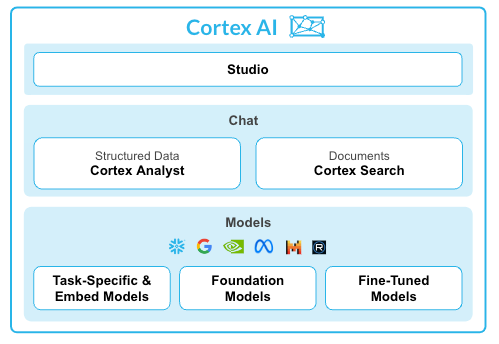
Snowflake Cortex AI extends Snowflake’s already powerful data warehouse with built-in AI features designed specifically for cloud-first businesses. The platform allows users to apply AI models directly to the data stored in Snowflake—no exporting, ETL, or external tools required.
Why It Stands Out
By keeping all AI operations inside the Snowflake ecosystem, Cortex AI delivers faster analytics, stronger governance, and smoother performance. It provides pretrained models for classification, summarization, sentiment analysis, forecasting, and more—making AI accessible to every analyst regardless of technical skill.
Key Features
- Natural-language analytics for easy, conversational data exploration
- Pretrained generative and predictive AI models
- Enterprise-level privacy and security governance
- Automated data categorization, cleaning, and entity extraction
- Extremely fast query performance using Snowflake’s architecture
Best For
Cloud data teams, SaaS companies, analysts, BI teams, and companies running their main analytics workflows in Snowflake.
6. IBM Watsonx – Best for Governance, Explainability & Regulated Industries

IBM Watsonx shines in sectors where trust, transparency, and regulatory compliance are non-negotiable. With industries facing stricter AI governance requirements in 2026, Watsonx has become the go-to solution for organizations needing full model visibility and accountability.
Why It Stands Out
Watsonx is specifically designed to provide explainable AI. It includes audit logs, bias detection tools, model transparency reports, and compliance monitoring to ensure that AI decisions are ethical, fair, and traceable. This is essential for healthcare, finance, government, and other regulated sectors where every prediction must be justified.
Key Features
- Explainable AI dashboards that clarify how models make decisions
- Bias and fairness detection tools
- Audit trails and compliance reporting
- Scalable NLP and machine learning models
- Industry-specific frameworks for security and ethics
Best For
Banks, government agencies, healthcare providers, insurance companies, and compliance-focused enterprises.
7. ChatGPT Enterprise + Advanced Analytics — Best for Natural-Language Data Exploration
ChatGPT Enterprise has evolved into one of the most intuitive analytics tools of 2026, enabling teams to explore data simply by asking questions in everyday language. With advanced analytics modules, the system can understand datasets, generate predictions, summarize reports, and visualize data without any coding.
Why It Stands Out
Unlike traditional BI tools that require dashboards and syntax-based queries, ChatGPT Enterprise turns data analysis into a conversational experience. Users can upload spreadsheets, databases, or documents and instantly receive charts, summaries, anomaly detection, and forecasts. This dramatically reduces time spent on manual reporting.
Key Features
- Conversational data analysis through natural-language questions
- Automated chart and table generation
- Predictive insights powered by advanced modeling
- Document, spreadsheet, and PDF analysis
- Integration with enterprise data sources like CRM and cloud storage
Best For
Executives, non-technical teams, marketers, sales teams, managers, and small businesses needing fast, simple analytics.
How AI Is Transforming Data Analysis in 2026 (Key Trends)
Data analysis in 2026 has evolved far beyond traditional dashboards, manual querying, and time-consuming reporting. AI has fundamentally reshaped how businesses interact with information, enabling faster insights, automated workflows, and decision-making that feels almost instantaneous. Compared to two years ago, today’s analytics landscape emphasizes speed, clarity, and autonomy—allowing both technical and non-technical teams to extract value from data effortlessly.
Below are the key AI-driven trends redefining data analysis in 2026.
A. Natural Language Querying (NLQ) Becomes Standard
Natural Language Querying has turned data analysis into a simple conversation. Instead of writing SQL queries or advanced scripts, users now type—or even speak—questions in everyday language such as:
- “Show revenue trends for the last 12 months.”
- “Which region had the highest churn last quarter?”
- “What factors contributed most to our sales decline?”
AI systems instantly respond with charts, summaries, predictions, and explanations. This has dramatically expanded access to analytics, allowing every employee—from executives to interns—to interact with data without relying on specialists. NLQ has eliminated the barrier between people and data, creating a more democratized and insight-driven workplace.
B. Predictive Insights Replace Static Reporting
Static dashboards that show “what happened” are no longer enough. In 2026, AI-powered analytics tools automatically forecast trends, detect risks, and highlight opportunities before humans even ask.
Modern AI systems can:
- Predict future customer behavior
- Anticipate revenue shifts
- Identify early warning signs of churn
- Highlight hidden correlations
These tools don’t just report the past—they explain why something happened and what is likely to happen next, allowing leaders to act proactively instead of reactively.
C. Automated Data Preparation Saves 60–80% of Time
Data preparation has historically been the most time-consuming part of analytics, often consuming 70% of a data team’s workload. In 2026, AI handles this entire stage automatically.
AI now:
- Cleans messy datasets
- Removes duplicates
- Fills missing values
- Detects inconsistent formats
- Classifies data into relevant categories
- Suggests transformations and joins
This automation frees analysts from tedious labor and opens up more time for strategic thinking, experimentation, and deeper analysis.
D. Data Visualization Is Now AI-Generated
Creating charts, dashboards, and visual reports used to require manual configuration, design decisions, and significant BI expertise. AI now handles this in seconds.
With a single command like:
“Visualize customer growth by segment for the last five years”
AI instantly produces:
- The best chart type
- Clean visual formatting
- A summary of key insights
- An explanation of patterns or anomalies
This shift enables teams to move from raw data to polished insights with minimal effort, significantly accelerating reporting cycles.
E. Real-Time Decisioning Is the Norm
The combination of AI, streaming data, and automated alerts has transformed how businesses react to change. AI continuously monitors incoming data—transactions, sensor readings, customer behavior, website activity, supply chain movements—and immediately alerts teams when something requires attention.
Examples include:
- Detecting sudden drops in sales performance
- Highlighting unexpected spikes in user activity
- Identifying fraud attempts in milliseconds
- Flagging supply chain bottlenecks before they escalate
This real-time intelligence enables organizations to respond quickly, reduce risks, and capitalize on opportunities within moments.
Real-World Us Cases of AI Data Analysis
AI is now used across every business function:
i) Business & Strategy
AI has become a strategic decision-making partner for leadership teams. Instead of waiting for quarterly reports, executives now get continuous, real-time visibility into performance indicators.
How AI Helps
- Revenue forecasting:
AI models analyze historical sales, market conditions, seasonal trends, and customer behavior to predict short-term and long-term revenue with greater accuracy. This helps businesses adjust budgets, pricing, and inventory based on future demand. - Customer segmentation:
AI groups customers based on behavior, demographics, purchase history, or engagement patterns. This enables more precise targeting for campaigns, product recommendations, and personalization. - Competitive intelligence:
AI scans market data, news, social media, pricing trends, and competitor activities to provide deep competitive insights. Businesses can track threats, discover opportunities, and adjust strategy in real time.
ii) Marketing
Marketing teams now lean heavily on AI to understand audiences, optimize campaigns, and measure ROI more effectively.
How AI Helps
- Campaign analysis:
AI evaluates ad performance across platforms, highlights which creatives or channels work best, and recommends adjustments to maximize conversions. - Predictive lead scoring:
Instead of manual scoring, AI predicts which leads are most likely to become customers by analyzing engagement patterns, past interactions, and behavioral signals—leading to higher-quality sales pipelines. - Customer journey insights:
AI maps the entire customer journey across touchpoints, identifying drop-off points, loyalty triggers, and moments that influence buying decisions. This helps marketers refine journeys for better engagement and retention.
iii) Finance
Financial departments benefit significantly from AI’s ability to detect anomalies, optimize portfolios, and ensure compliance—all while reducing manual effort.
How AI Helps
- Fraud detection:
AI monitors transactions in real time, spotting irregular patterns, risky behaviors, or suspicious activity faster than traditional systems. - Portfolio optimization:
AI analyzes market trends, risk levels, historical performance, and financial signals to help organizations build more resilient and profitable investment portfolios. - Automated financial reporting:
AI automates report generation, reconciles data, detects inconsistencies, and produces real-time financial summaries—reducing errors and saving countless hours.
iv) Operations
Operations teams use AI to improve efficiency, prevent disruptions, and manage supply chains with greater accuracy.
How AI Helps
- Supply chain prediction:
AI forecasts demand fluctuations, shipment delays, and supply risks, enabling companies to avoid stockouts and reduce operational downtime. - Vendor performance analytics:
AI evaluates supplier reliability, delivery times, defect rates, and cost-effectiveness, helping organizations choose the best vendor partnerships. - Inventory forecasting:
AI analyzes sales trends, seasonality, and market changes to recommend optimal inventory levels, preventing both overstocking and shortages.
v) Human Resources
HR departments now use AI to build stronger teams, improve retention, and understand workforce dynamics more accurately.
How AI Helps
- Team productivity insights:
AI monitors workflows, workload distribution, meeting patterns, and collaboration habits to uncover bottlenecks and recommend ways to improve efficiency. - Attrition prediction:
AI analyzes employee sentiment, performance metrics, engagement scores, and behavioral patterns to identify which employees are at risk of leaving—allowing HR to intervene early. - Employee performance patterns:
AI highlights productivity trends, skill gaps, and growth opportunities, helping managers tailor development plans for individuals and teams.
Future of AI in Data Analysis (2026 and Beyond)
As AI continues to evolve, the way humans interact with data will undergo a dramatic transformation. The tools of today—predictive models, natural language querying, automated dashboards—are only the foundation. The next wave of innovation will make analytics more intelligent, autonomous, personalized, and seamlessly embedded into daily workflows. Instead of asking for insights, insights will come to you. Instead of manually interpreting numbers, AI will explain the meaning and take meaningful action on your behalf.
Below are the major advancements shaping the future of AI-driven data analysis beyond 2027.
1. Fully Autonomous Analytics
The next generation of AI will move from assistance to autonomy. Rather than waiting for humans to request insights, AI engines will constantly:
- Monitor live data streams
- Detect anomalies and opportunities
- Run simulations
- Summarize results
- Suggest or execute optimal actions
This means businesses will shift from static dashboards to fully automated “always-on” analytics. For example, instead of a marketing manager analyzing campaign performance, the system will proactively report that a specific channel is underperforming—and automatically suggest reallocating budget to higher-performing areas.
AI will become a silent operator that keeps businesses optimized at every moment.
2. Multimodal Data Intelligence
Future AI systems won’t just analyze spreadsheets—they’ll process multiple data formats in real time, delivering a far more holistic view of business performance.
This includes simultaneous analysis of:
- Text (emails, reports, customer chats)
- Audio (support calls, interviews)
- Logs (server logs, system data)
- Images (product photos, medical scans, inventory visuals)
- Video (security footage, user interactions, workflows)
By combining modalities, AI will uncover patterns that were previously invisible. A retail store, for example, will be able to analyze customer movement through video, match behavior with purchase logs, and predict buying likelihood—all through a single system.
This multimodal intelligence will bring data analysis closer to human-like understanding.
3. AI Agents Acting on Insights
The future of analytics is actionable AI. Instead of simply presenting data, upcoming AI agents will carry out tasks based on insights—taking automation to the next level.
Examples include:
- Automatically adjusting marketing budgets based on ROI trends
- Reordering inventory when stock levels drop
- Sending personalized retention emails to at-risk customers
- Updating pricing based on competitor changes
- Scheduling maintenance when machines show early signs of failure
Organizations will shift from “AI-assisted decision-making” to AI-directed execution, where systems make low-risk decisions autonomously and escalate critical decisions to humans when needed.
4. Surprisingly Smaller Models with Higher Efficiency
The trend toward “bigger is better” in AI is shifting. Future data analytics models will prioritize efficiency, speed, and local performance, using technologies like:
- Edge AI
- Distilled, compact neural models
- Low-latency offline analytics
- On-device computation
Businesses will rely less on massive cloud infrastructure. Instead, lightweight AI engines will run directly on laptops, mobile devices, IoT equipment, and operational hardware—making analytics faster, more secure, and more cost-efficient.
This future reduces dependence on internet connectivity and allows organizations to process sensitive data locally, enhancing privacy and compliance.
5. Hyper-Personalized Analytics for Every Role
Data analysis will no longer be one-size-fits-all. AI will create role-specific dashboards that automatically adapt to the needs of each user.
Examples include:
- CFO dashboards: Cash flow, financial risk, margin tracking
- Marketing dashboards: Campaign performance, audience trends, ROI insights
- CEO dashboards: Business health, growth projections, critical alerts
- Operations dashboards: Supply chain efficiency, logistics bottlenecks
- Sales dashboards: Forecasts, pipeline movement, customer patterns
These dashboards will update in real time and generate explanations tailored to the user’s priorities. Over time, AI will learn each person’s behavior, focusing on the metrics that matter most to them and ignoring irrelevant noise.
Analytics will feel like having a personalized analyst working beside you every day.
Conclusion
The top AI tools for data analysis are transforming how businesses make decisions. Whether you need predictive insights, automation, natural-language querying, big data processing, or compliance-focused analytics, the tools listed above offer unmatched power, speed, and intelligence. The future belongs to teams that embrace AI-driven analytics early—and use these platforms to unlock deeper insights faster than ever.
FAQs
1. What are the best AI tools for data analysis in 2026?
The best AI tools for data analysis in 2026 include Google Vertex AI, Microsoft Fabric with Copilot, Tableau Pulse AI, Databricks Lakehouse, Snowflake Cortex AI, IBM Watsonx, and ChatGPT Enterprise. These platforms offer advanced predictive analytics, natural language querying, automated insights, and enterprise-grade scalability.
2. How do AI tools improve data analysis?
AI tools speed up data analysis by automating data cleaning, generating insights instantly, predicting trends, and creating visualizations without manual effort. They also detect patterns and anomalies that humans may miss, enabling faster and more accurate decision-making.
3. Which AI tool is best for beginners or non-technical users?
ChatGPT Enterprise with Advanced Analytics and Microsoft Fabric + Copilot are ideal for beginners. They allow users to analyze data using natural-language questions, generate charts automatically, and get insights without writing SQL, Python, or complex formulas.
4. Which AI tool is best for large-scale or enterprise data workloads?
Google Vertex AI, Databricks, and Snowflake Cortex AI are top choices for big data and enterprise environments. They offer powerful machine learning capabilities, strong cloud integrations, real-time analytics, and the ability to process massive datasets efficiently.
5. Can AI tools replace traditional business intelligence platforms?
AI tools won’t fully replace traditional BI platforms, but they significantly enhance them. Modern AI systems automate reporting, create dashboards instantly, deliver predictive insights, and make data accessible to non-technical users—resulting in a more powerful and efficient analytics ecosystem.