
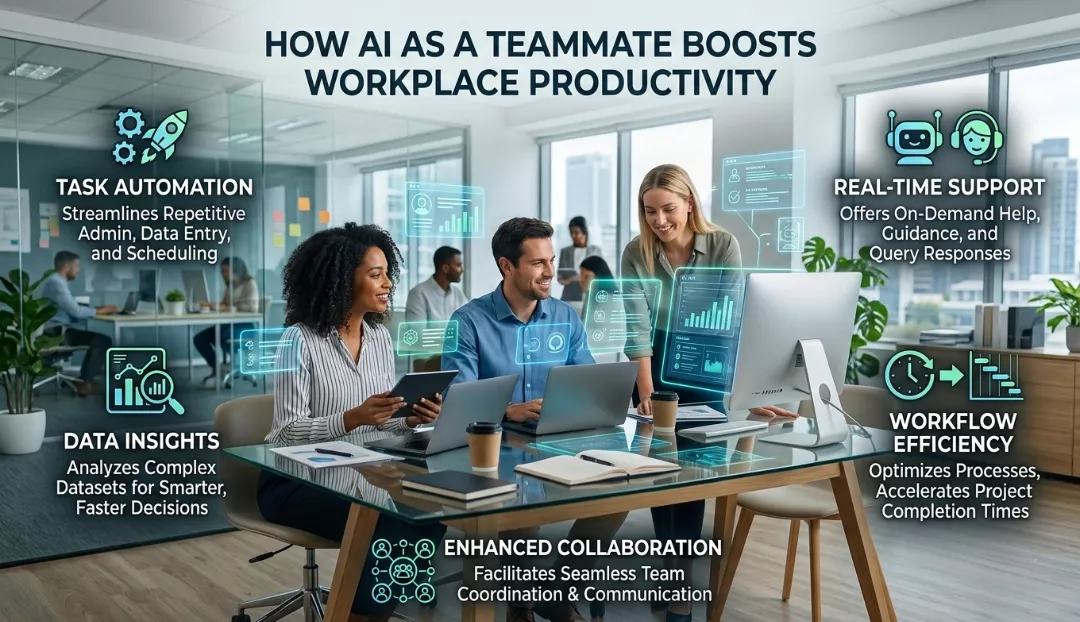
AI boosts workplace productivity by acting as a collaborative partner that automates routine workflows, synthesizes massive datasets for faster decision-making, and scales creative output. By integrating AI as a teammate rather than just a software tool, organizations can reduce “work about work,” bridge skill gaps through generative assistance, and shift human focus toward high-impact strategic initiatives. Recent data from early 2026 suggests that sectors embracing “Agentic AI“—systems capable of autonomous task execution—have seen productivity surges of up to 27%, effectively transforming the workforce from a collection of task-doers into a league of outcome directors.
The Paradigm Shift: From Tool to Teammate
For decades, technology in the workplace was reactive. A spreadsheet waited for data; a word processor waited for text. In 2026, we have entered the era of Augmented Intelligence, where AI is no longer a passive utility but a proactive “teammate.” This shift is defined by the move from command-based software to conversational, agentic partners that understand context, anticipate needs, and execute complex multi-step workflows.
The concept of “AI as a teammate” implies a bidirectional relationship. While the human provides the “vision, ethics, and final judgment,” the AI provides the “scale, speed, and analytical depth.” This synergy addresses the primary drain on modern productivity: cognitive overload. With the average employee spending nearly 60% of their day on “work about work”—answering emails, searching for information, and manual data entry—the AI teammate acts as a digital buffer, reclaiming those lost hours for deep, creative labor.
The Evolution of Workplace AI
- Passive Tools (Pre-2022): Basic automation, spell-checkers, and simple chatbots.
- Generative Assistants (2023-2024): Drafting emails, generating code snippets, and basic research.
- Collaborative Teammates (2025-2026): AI agents that manage projects, audit compliance, and offer real-time strategic suggestions.
Core Mechanisms: How AI Teammates Boost Efficiency
To understand how AI creates a 10x multiplier in the workplace, we must look at the specific mechanisms it employs to assist its human counterparts.
1. Cognitive Load Reduction
Human focus is a finite resource. AI teammates excel at “surface-level processing”—summarizing long meeting transcripts, extracting action items from messy email threads, and monitoring real-time data feeds for anomalies. By handling these low-level cognitive tasks, AI allows the human brain to stay in a “flow state” longer, which is critical for complex problem-solving.
2. Rapid Prototyping and Iteration
In creative and technical fields, the “blank page” is the greatest enemy of productivity. AI teammates provide the first draft, whether it is a software module, a marketing campaign brief, or a financial model. This reduces the time from “concept to execution” by as much as 60%. Instead of building from scratch, humans act as editors and refiners, a much faster cognitive process.
3. Real-Time Knowledge Retrieval
“Information Sprawl” is a common productivity killer in large enterprises, where crucial data is buried across Slack, Google Drive, and internal wikis. Modern AI teammates serve as a “unified brain,” capable of instantly retrieving and synthesizing information from across the entire company’s knowledge base, ensuring that no employee ever has to “reinvent the wheel.”
Departmental Impact: AI Teammates in Action
The benefits of AI collaboration are not uniform; they adapt to the specific needs of different business functions.
Software Engineering and IT
In 2026, the role of a software engineer has pivoted from writing syntax to “architecting systems.” AI teammates like advanced Copilots do more than just autocomplete; they perform real-time security audits, suggest optimizations for cloud latency, and even write documentation as the code is being developed.
- Productivity Gain: Coders using AI-first workflows report a 126% increase in output compared to those using traditional IDEs.
Marketing and Content Strategy
Marketing teams use AI to personalize content at a scale previously impossible. An AI teammate can analyze thousands of customer segments and generate 500 variations of an ad campaign, each tailored to a specific persona, in the time it takes a human to write one.
- Key Shift: Marketers have moved from “Content Creators” to “Brand Strategists,” focusing on high-level narrative and ethical alignment.
Human Resources and Recruitment
The “AI-First HR” model uses agents to handle the initial 80% of the recruitment funnel. AI teammates screen resumes for skills (rather than keywords), schedule interviews, and even provide “nudges” to managers regarding employee burnout or performance review cycles.
- Recent Stat: Only 1.4% of organizations currently qualify as “AI-First,” but those that do report a 40% reduction in time-to-hire.
The 2026 Productivity Snapshot: Key Statistics
Data from early 2026 illustrates a clear divide between organizations that treat AI as a tool and those that treat it as a teammate.
| Metric | Pre-AI Collaboration (2023) | AI-Teammate Model (2026) | % Change |
| Average Productive Hours/Day | 2 hrs 53 mins | 4 hrs 15 mins | +47% |
| Issue Resolution Rate (Customer Support) | 12.5 tickets/hr | 18.2 tickets/hr | +45.6% |
| Document Processing Speed | 45 mins/doc | 18 mins/doc | +60% |
| Employee Burnout Rate | 48% | 31% (in AI-enabled firms) | -35% |
| Global GDP Impact (Annual) | $2.1 Trillion | $4.4 Trillion | +110% |
The “Diamond Structure” of the AI-First Workforce
Historically, corporate structures were “pyramids,” with a vast base of entry-level workers performing manual or routine tasks. AI teammates are effectively hollowing out the bottom of this pyramid.
The new “Diamond Structure” features:
- The Narrow Base: Fewer entry-level roles focused on manual data entry.
- The Wide Middle: A massive cohort of “AI-enabled” professionals who manage digital agents and interpret complex outputs.
- The Sharp Top: Senior leadership focused on ethics, vision, and high-stakes human-centric negotiations.
This shift means that career progression is now determined by AI Fluency—the ability to direct, audit, and collaborate with synthetic intelligence—rather than just years of experience.
The Soft Skills Paradox: Why Humans Matter More
Counterintuitively, the rise of the AI teammate has made “soft skills” more valuable, not less. As AI handles the quantitative and the routine, the competitive advantage of a business rests on the qualities AI cannot replicate:
- Empathy and Conflict Resolution: While AI can detect sentiment, it cannot navigate a delicate interpersonal conflict between two teammates.
- Ethical Judgment: AI can provide options, but humans must take the “moral responsibility” for decisions that impact lives or the environment.
- Cross-Disciplinary Intuition: Humans are still better at connecting seemingly unrelated ideas from different fields (e.g., applying a biological concept to a financial market).
Implementing AI Teammates: A Strategic Roadmap
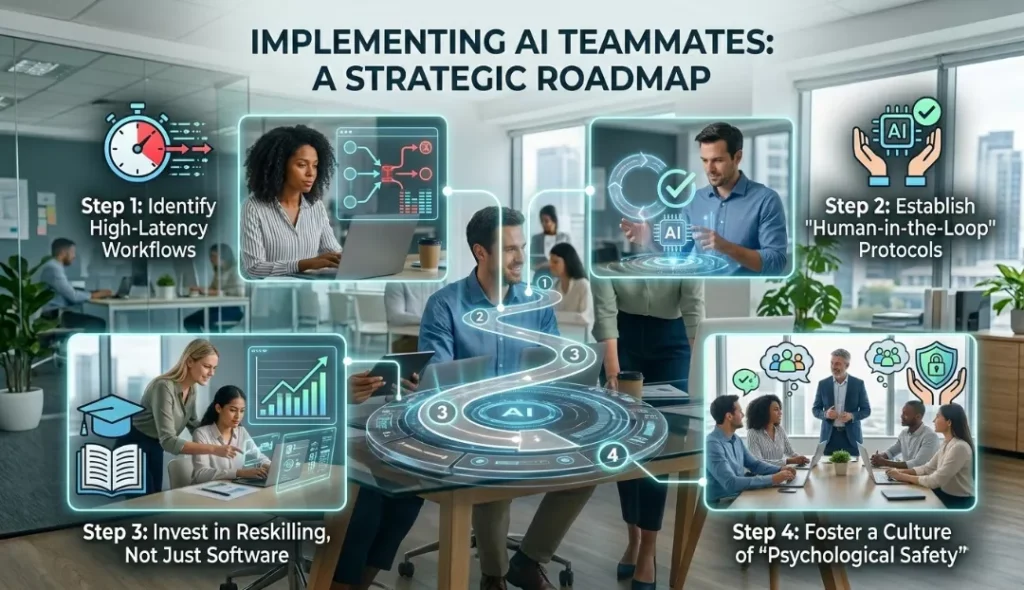
For leaders looking to move beyond simple tool adoption, the following framework is recommended:
Step 1: Identify High-Latency Workflows
Look for “friction points”—tasks that are high-volume, repetitive, and rules-based. These are the prime candidates for AI delegation. Examples include invoice processing, calendar management, and basic research.
Step 2: Establish “Human-in-the-Loop” Protocols
Never deploy AI teammates in a vacuum. Every AI output should have a human “auditor” or “director” who provides the final sign-off. This ensures quality control and maintains accountability.
Step 3: Invest in Reskilling, Not Just Software
The biggest barrier to AI productivity is not the technology, but the skill gap. Organizations must train employees in “Prompt Engineering,” “AI Auditing,” and “Agentic Management.” In 2026, 1 million workers annually require reskilling to keep pace with AI evolution.
Step 4: Foster a Culture of “Psychological Safety”
Employees often fear that AI teammates are precursors to replacement. Leaders must demonstrate that AI is intended to reduce “drudgery,” not people. Highlighting how AI improves work-life balance is key to gaining workforce buy-in.
Challenges and Ethical Guardrails
While the productivity gains are undeniable, the “AI as a teammate” model introduces new risks:
- Ghost GDP: There is a risk of “Ghost GDP,” where corporate profits and output rise on paper due to AI, but wages and employment levels stagnate.
- Algorithmic Bias: If an AI teammate is trained on biased data, it will automate that bias at scale, leading to unfair hiring or credit decisions.
- Data Sovereignty: Companies must ensure that their “unified brain” does not leak sensitive trade secrets or customer data to external LLM providers.
Conclusion: The Horizon of 2030
As we look toward the end of the decade, the distinction between “human work” and “AI work” will continue to blur. We are moving toward a future of Hybrid Pods, where small teams of three humans and a dozen specialized AI agents can run entire departments that previously required hundreds of people.
The ultimate promise of the AI teammate is not just “more output,” but “better work.” By offloading the robotic parts of our jobs to actual robots, we are finally free to be more human—spending our days on creativity, connection, and the pursuit of complex, meaningful goals.