
Artificial Intelligence (AI) in education refers to the use of intelligent systems, algorithms, and automation tools to improve teaching, personalize learning, and support students and educators in ways that traditional methods cannot. It is transforming how we learn by helping teachers save time, helping students learn at their own pace, and making education smarter, more accessible, and more effective.
Why AI in Education Matters Today
Education has always adapted to new technologies—think of chalkboards, projectors, computers, and online education. But AI brings something fundamentally different:
- It doesn’t just deliver content.
- It analyses, adapts, and supports learning in real time.
This breakthrough means learning can be tailored to each student’s pace, strengths and weaknesses rather than one-size-fits-all.
Recent data highlights the scale of change: around 86% of students globally report using AI tools in their studies. DemandSage Campus And over 60% of teachers are now using AI in classrooms for tasks like grading or progress-tracking. World Economic Forum Clearly, AI is not a future trend — it’s here now.
What Is AI in Education?
In simple terms, AI in education means leveraging technologies like machine learning, natural language processing (NLP), data analytics and automation to improve teaching and learning.
Key capabilities of AI-driven education tools include:
- Recognising learning patterns and student behaviours.
- Predicting which students might struggle and when.
- Offering personalised exercises, feedback, and study paths.
- Automating repetitive tasks for teachers (grading, attendance, etc.).
- Tailoring content in real time based on student performance.
Unlike traditional educational software, which follows fixed modules, AI systems learn and evolve based on new interactions, thus becoming better over time.
Major Ways AI Is Transforming Learning
Let’s explore how AI is making real-world changes in education:
1. Personalized Learning for Every Student
One of the biggest advantages: AI enables each student to have a learning journey suited to them.
- For example, if a student struggles with fractions but excels at geometry, the system may give more fraction problems, alternative explanations, or visual tools until mastery is reached.
- On the flip side, faster learners can skip ahead or be challenged differently.
This kind of personalised approach helps reduce boredom among advanced students and supports those who need more help. Studies show this can drive significantly better outcomes — one report claims students in AI-powered learning environments achieved 54% higher test scores, and 30% better learning outcomes.
2. AI Tutors & On-Demand Support
AI doesn’t replace teachers; it supplements them, especially outside classroom hours.
Imagine: a student working late at night, stuck on a calculus problem. An AI tutor can step in, offer hints, walk through steps, ask guiding questions.
Such tutors make support available anytime, not just during school hours. This matters especially in remote or under-resourced settings.
3. Automating Teacher Workload
Teachers often spend many hours grading, tracking progress, preparing materials. AI can significantly lighten that load.
Here are a few tasks AI is helping with:
- Grading multiple-choice and even open-ended responses.
- Providing feedback on essays or explaining where errors were made.
- Monitoring student engagement and flagging those at risk of falling behind.
- Generating lesson plans or content templates.
By freeing teachers from repetitive tasks, AI allows them to focus on what humans do best: mentoring, motivating, and teaching.
4. Intelligent Classrooms & Analytics-Driven Insights
When schools adopt AI, it’s not just about tools for students. Entire classroom systems become smarter:
- Attendance and participation tracking become automated.
- Engagement data shows how interactive or passive students are.
- Predictive analytics can flag students likely to drop out or fail before it happens.
For instance, one survey shows over 47% of education leaders use AI daily in their institutions.
5. Inclusion and Special Needs Education
AI is opening doors for students with disabilities or special learning needs:
- Speech-to-text and text-to-speech tools help hearing/visually impaired learners.
- Emotion-recognition and adaptive tasks can help students with autism or cognitive challenges.
- Customised pace and repeated practice support those who otherwise struggle in regular classrooms.
This makes education more equitable, allowing more students to access meaningful learning.
6. Language Learning and Global Reach
AI-powered language tools can adjust to individual learners’ accents, pace, vocabulary gaps, and provide real-time correction. This has massive implications for global education, especially in multilingual or underserved regions.
7. Content Generation & Smart Curriculum
Gone are the days when every teacher must design every exercise from scratch.
AI can generate:
- Flashcards and quizzes
- Simulation activities
- Visual aids
- Adaptive modules that change based on student responses
This speeds up content creation for educators and allows for richer, more dynamic resources.
8. Assessment & Exam Preparation
Moving beyond simple tests, AI assessments can evaluate critical thinking, problem-solving strategy, time management and growth over time.
For example, AI can track how a student solved a multi-step problem and highlight which step caused difficulty – not just the final wrong answer.
Benefits of AI in Education
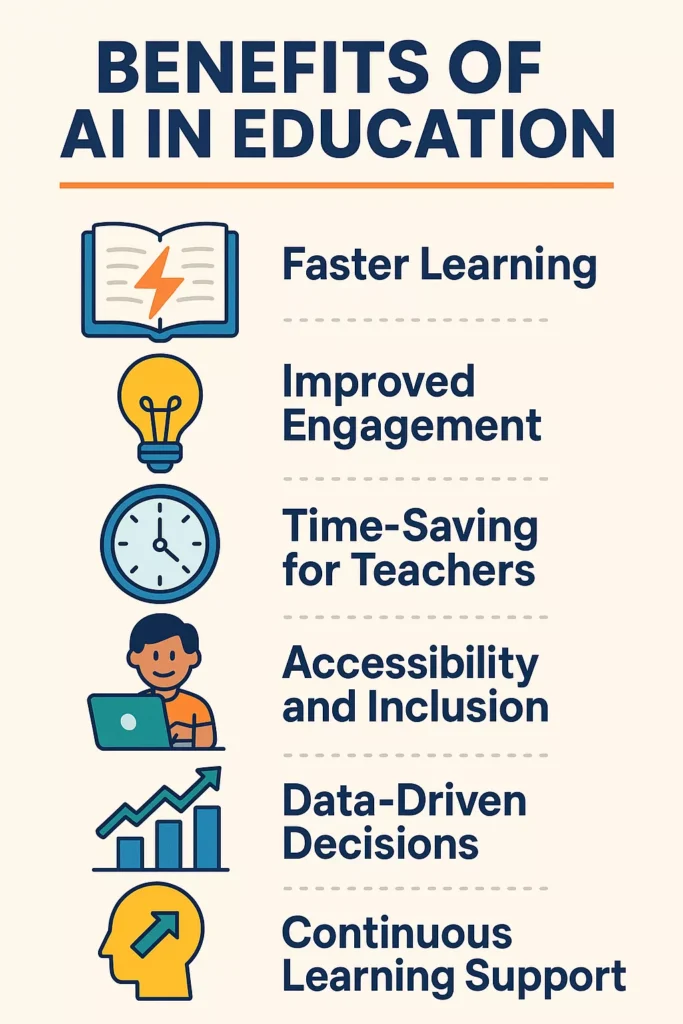
With all those transformations, what concrete benefits emerge?
- Faster, deeper learning: Because students get tailored support and timely feedback, they typically learn more in less time.
- Higher student engagement: Interactive and adaptive systems keep students motivated.
- Freed up teacher time: Teachers can spend more energy on individual mentoring, imaginative teaching rather than routine tasks.
- Greater accessibility: Students in remote areas, underserved groups or with special needs can access high-quality resources.
- Data-informed decision-making: Schools and teachers have real-time insight into what’s working and what isn’t.
- Support beyond the classroom: Learning becomes continuous, not just during school hours.
Statistics That Show the Scale of Change
Let’s highlight some recent numbers to underscore how large this shift is:
- A global survey found that 86% of students use AI tools in their studies.
- 54% of students reported using AI on a weekly basis in August 2024.
- In AI-powered learning environments, students showed 54% higher test scores and 30% better learning outcomes.
- 60% of teachers have adopted AI tools for tasks such as grading or tracking student progress.
- The global AI in education market was valued around US$2.5 billion in 2022, with projections of reaching US$88.2 billion by 2032 at a CAGR of ~43%.
These numbers show that AI in education is not experimental—it’s mainstream.
Real-World Use Cases: Putting It All Together
AI is not just a future concept—it is actively shaping classrooms, colleges, and learning platforms worldwide. Here are some of the most impactful real-world applications transforming how students learn and how teachers teach.
Case 1: Adaptive Learning Platforms
AI-powered platforms like Khan Academy, Duolingo, BYJU’S, and Coursera personalize learning based on each student’s pace and performance.
How it works
- Tracks what a learner knows and struggles with
- Adjusts difficulty in real time
- Recommends next best lessons
- Provides personalized quizzes
Impact
Students learn faster, stay engaged, and get a customized learning experience that feels “one-on-one.”
Case 2: AI Tutors & Homework Assistants
AI tutors give instant help—just like having a personal assistant available 24/7.
Examples
- Chat-based math and science solvers
- Essay feedback tools
- Step-by-step problem breakdown
- Voice-based assistants for young learners
Impact
Students don’t wait for the next class to clear doubts. Learning continues anytime.
Case 3: Automated Grading & Teacher Workload Reduction
Teachers spend hours correcting quizzes and planning lessons. AI drastically reduces this burden.
AI Helps With
- Grading multiple-choice questions
- Checking grammar, structure, and clarity in essays
- Tracking student performance trends
- Preparing lesson drafts and study materials
Impact
Teachers save time and focus more on actual teaching and student support.
Case 4: Smart Classrooms & Learning Analytics
Modern classrooms are becoming “intelligent” with AI systems that observe student interactions.
Capabilities
- Auto attendance tracking
- Monitoring student participation
- Detecting who might fall behind
- Giving teachers early warnings
- Providing insights on teaching effectiveness
Impact
Schools make data-driven decisions, improving overall learning outcomes.
Case 5: AI for Students with Special Needs
AI is a major breakthrough for inclusive education.
Examples
- Speech-to-text for hearing impairment
- Text-to-speech for visually impaired learners
- Emotion-recognition support for autism
- Customized pacing for cognitive challenges
Impact
All students—regardless of disability—get equal chances to learn effectively.
Case 6: AI-Powered Language Learning
Apps like Duolingo, ELSA Speak, and Babbel use AI to improve pronunciation, vocabulary, and fluency.
Features
- Accent detection
- Instant corrections
- Vocabulary suggestions
- Realistic conversation simulations
Impact
Language learning becomes faster, fun, and highly interactive.
Case 7: Virtual Teaching Assistants
Universities use AI bots to help answer student questions, manage queries, and improve engagement.
Tasks They Handle
- Answer FAQs
- Share resources
- Remind students about deadlines
- Provide campus information
Impact
Students get quick answers without waiting for staff replies.
Case 8: Plagiarism Detection & Academic Integrity
AI tools help institutions uphold academic honesty.
Capabilities
- Detect paraphrased content
- Flag unoriginal writing
- Check citations
- Provide similarity reports
Impact
Ensures fairness and maintains academic standards.
Case 9. Personalized Exam Preparation
AI tools provide custom practice plans for competitive exams like SAT, NEET, JEE, GRE, etc.
Features
- Tailored study schedules
- Weak-area identification
- Smart mock tests
- Real-time scoring and analytics
Impact
Students prepare more efficiently and perform better in exams.
Case 10: Virtual Labs & Simulations
AI-driven labs allow students to perform practical experiments digitally.
Examples
- Virtual chemistry labs
- Physics simulations
- Medical training simulations
- STEM project environments
Impact
Schools save resources while students gain safe, hands-on experience.
Case 11: AI in School Administration
AI helps schools run more efficiently behind the scenes.
Uses
- Predicting student dropouts
- Optimizing timetables
- Automating fee and admission processes
- Managing campus security with AI cameras
Impact
Institutions operate smoothly with less human error.
The Future: What’s Next?
Looking ahead, AI promises even deeper change in how we learn and teach.
Trends to watch:
- Hyper-personalised learning journeys where every student has a unique plan, dynamically updated.
- Smart campuses where AI handles not just learning but security, operations, campus services.
- Emotion-aware systems that sense student frustration or confusion and intervene appropriately.
- Career guidance driven by AI, linking performance, interests and industry data to recommend pathways.
- Virtual labs and simulation-based learning, especially in STEM, where AI drives immersive experiences.
- Lifelong learning ecosystems: education won’t end at school or college—AI will support learning across careers and life.
In short, the shift is from “classroom learning” to “constant learning” powered by AI.
Challenges & Ethical Considerations
Of course, with great power come important responsibilities.
Key issues include:
- Data privacy and security – Student data is sensitive; AI systems must protect it and use it responsibly.
- Bias in algorithms – If AI models are built on biased data, they may perpetuate inequalities.
- Teacher training and readiness – Teachers need to understand AI tools, collaborate with them, not feel threatened.
- Digital divide – Access to AI tools is unequal globally; if we’re not careful, the gap widens.
- Over-dependence on AI – There’s a risk that students may lose human-to-human interaction or critical thinking skills if AI is misused.
- Ethical use – What counts as appropriate use of AI in assignments? How do we ensure academic integrity?
One major international organisation, the UNESCO, emphasises that while AI has huge potential in education, “rapid technological developments inevitably bring multiple risks and challenges” which outpace policy frameworks.
It’s essential that educators, policymakers, parents and learners collaborate to shape how AI is integrated—in ways that are ethical, equitable and human-centred.
Conclusion: A Breakthrough That’s Already Here
The phrase “breakthrough” isn’t an exaggeration when we speak of AI in education. We are witnessing a fundamental shift. Artificial Intelligence is no longer a futuristic idea – it’s actively transforming how students learn, how teachers teach, and how schools run.
By enabling personalised, adaptive, and intelligent learning experiences, AI is helping make education more engaging, more efficient and more inclusive. At the same time, it places new demands on our systems: ethical frameworks, teacher support, infrastructure and access must keep pace.
For learners today, the question is no longer “Will AI affect my education?” but rather “How can I best leverage AI to learn smarter and faster?” For educators, it’s “How can I partner with AI to focus more on meaningful teaching and human connection?” And for institutions, it’s “How do we implement AI responsibly, so it benefits all students and doesn’t leave anyone behind?”