
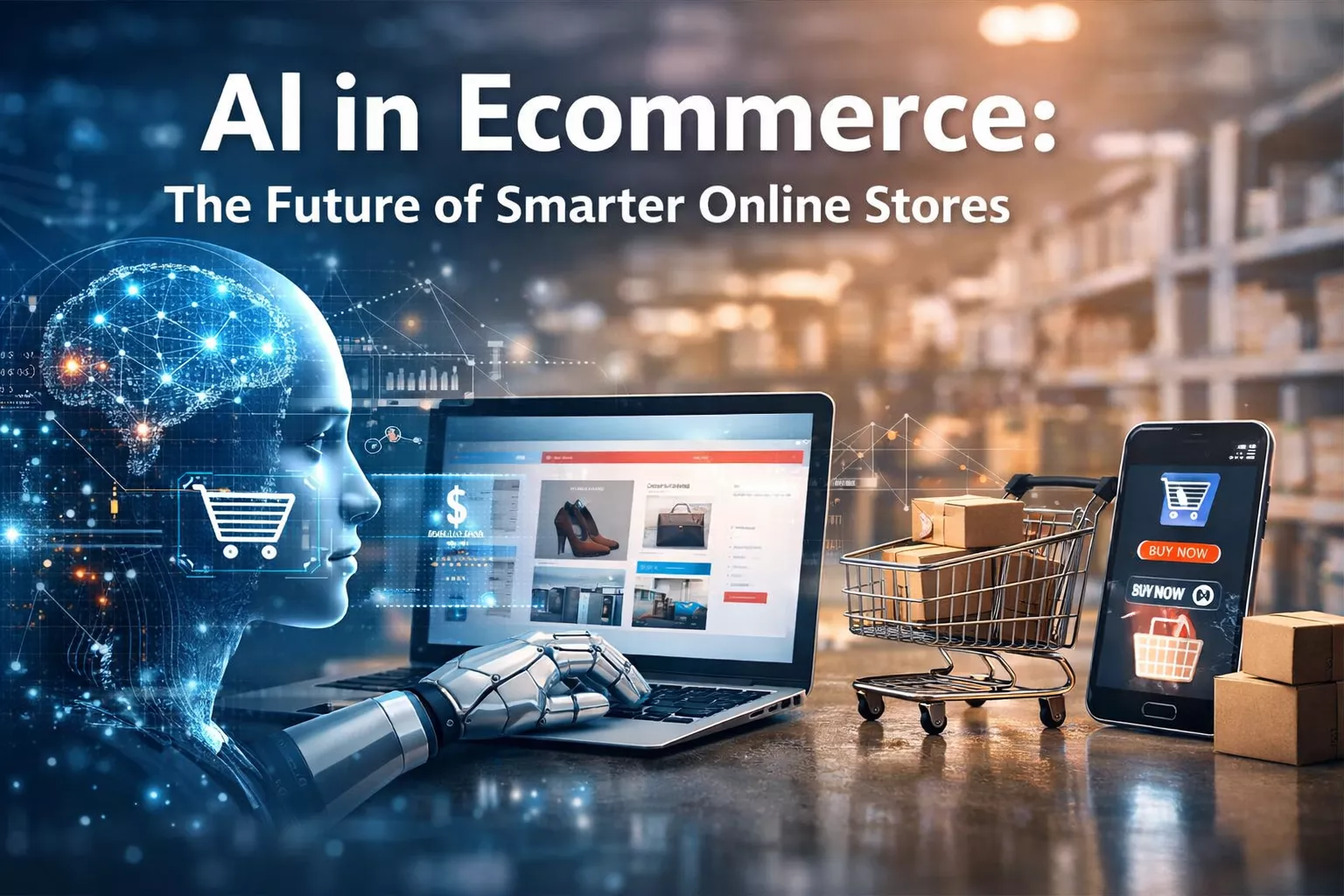
Artificial Intelligence (AI) in ecommerce is the technological evolution that transforms static online shops into intelligent, adaptive ecosystems. It goes far beyond basic chatbots; AI acts as the central nervous system of modern retail, utilizing machine learning to analyze vast amounts of data in real-time. This allows online stores to hyper-personalize the shopping experience for every individual visitor, predict inventory needs before shortages occur, and automate complex logistics like shipping and fraud detection. In essence, AI shifts the role of an online store from a passive digital catalog to an active, predictive partner that understands what a customer wants often before they do.
The Dawn of the “Thinking” Store
Remember the early days of online shopping? You would type a generic term into a clunky search bar, scroll through pages of irrelevant results, and hope the grainy photo matched the actual product. It was functional, but it wasn’t smart.
Today, we are standing on the precipice of a revolution. The online store is waking up. It is no longer just a collection of code and JPEGs; it is becoming a “thinking” entity.
For business owners, marketers, and everyday shoppers, this shift is monumental. We are moving away from the era of “We sell, you buy” into an era of “We understand, we anticipate, we serve.” The future of ecommerce isn’t about replacing the human touch; it’s about amplifying it with digital intuition. This article dives deep into how AI is rewriting the rules of retail, making stores smarter, faster, and surprisingly, more human.
1. Hyper-Personalization: The “Segment of One”
For years, marketing was built on demographics. If you were a 30-year-old male living in a city, you were put in “Bucket A.” If you were a retiree who liked gardening, you were in “Bucket B.”
AI has shattered these buckets. We are now in the era of the “Segment of One.”
The Liquid Interface
Imagine you and your best friend visit the same website at the exact same time. In a traditional ecommerce setup, you’d see the same homepage. In the AI-driven future, you are effectively visiting two different stores.
- Your View: Because you’ve been browsing running shoes and reading articles on marathon training, the homepage morphs. The hero image is a high-performance runner. The navigation bar highlights “Nutrition” and “Footwear.” A pop-up offers a bundle deal on energy gels.
- Your Friend’s View: They are looking for casual wear. Their homepage features a “New Summer Collection” lookbook. The font is different—more relaxed. The highlighted products are linen shirts and sandals.
This is the “Liquid Interface”—a website that rearranges its layout, content, and even its aesthetic based on real-time intent.
Predictive Desire
AI doesn’t just look at what you did buy; it analyzes the micro-signals of what you might buy.
- The Contextual Clue: An AI algorithm notices you are browsing winter coats, but it also detects your IP address is in a tropical location. It deduces you are likely planning a trip.
- The Action: Instead of just showing coats, it starts recommending travel accessories: compression socks for the flight, luggage tags, and travel-sized toiletries. It anticipated a need (travel prep) that you hadn’t explicitly searched for.
The Human Take: It’s like walking into your local coffee shop where the barista starts making your drink the moment they see your car pull up. It’s not creepy; it’s convenient.
2. Visual and Voice: The End of Keywords
Typing is tedious. It is not how humans naturally communicate. We point at things. We describe things. We grunt and gesture. AI is finally allowing ecommerce to speak our language.
Visual Search: “I Want That“
Visual search is the bridge between the physical world and the digital cart. It empowers the camera to be the new keyboard.
- Real-World Scenario: You are at a dinner party and see a stunning vase on the table. You don’t know the brand, and asking might be awkward.
- The AI Solution: You snap a discreet photo. The ecommerce app’s AI analyzes the shape, texture, and color. Within seconds, it finds the exact vase—or if that one is vintage and out of stock, it finds three visually similar alternatives available for delivery tomorrow.
This technology, powered by Computer Vision, understands style and aesthetics better than text ever could. It creates a “shop the world” reality where every physical object becomes a potential digital purchase.
Conversational Commerce
Voice assistants are graduating from “Set a timer” to “Be my personal shopper.” Natural Language Processing (NLP) allows AI to understand nuance.
- Old Way: You search “running shoes women red size 8.”
- New Way: You say to your phone, “I need a pair of running shoes for a muddy trail race next week. I want something bright so I can be seen, and keep it under $100.”
The AI parses this complex request. It understands “muddy trail” means you need deep treads (not standard road shoes). It understands “bright” means neon colors. It filters by price. It responds, “I found the TrailBlazer 5 in Neon Orange with high-grip soles for $89. Want to see the reviews?”
3. The Operational Backbone: Supply Chain & Pricing
While the front-end features are flashy, the true brainpower of AI lies in the back office. This is where businesses live or die.
The Self-Healing Supply Chain
Supply chains are fragile. A storm in the Atlantic or a factory closure in Asia can ruin a holiday season. AI acts as a global watchtower.
- Predictive Logistics: AI monitors millions of data points—weather patterns, political stability, social media trends, and shipping routes.
- The Intervention: If AI predicts a hurricane will delay shipments from a specific port, it can automatically reroute orders to a different warehouse or trigger an early re-stock order from a secondary supplier before the disruption hits.
Dynamic Pricing 2.0 (Ethical Pricing)
We’ve all seen “surge pricing” (getting charged more when you need it most), and everyone hates it. The future of AI pricing is Contextual Value. AI helps retailers find the “Goldilocks” price—the price that is high enough to be profitable but low enough to ensure the sale, tailored to the specific context.
- Markdown Optimization: Instead of a blanket 50% off sale at the end of the season (which kills margins), AI identifies exactly which products are stalling. It might offer a 15% discount on those specific items to users who have viewed them twice, clearing inventory without devaluing the brand.
4. Reduced Returns: The Virtual Fitting Room
Returns are the silent killer of ecommerce profitability. They eat into margins and create massive environmental waste. AI is attacking this problem with Augmented Reality (AR) and deep learning.
Virtual Try-Ons
Buying clothes online is a gamble. “Size Medium” varies wildly between brands.
- The AI Avatar: Shoppers can scan their body using their phone camera to create a precise 3D mesh of their body. They can then “dress” this avatar.
- Heat Mapping: The AI shows a “tension map” on the clothes. It highlights that the shirt fits the shoulders perfectly but is too tight around the chest (showing red heat zones).
- The Result: The shopper sizes up or chooses a different cut. The return rate drops because the “I hope it fits” guesswork is eliminated.
Beauty and Decor
This extends beyond fashion.
- Beauty: “Try on” a lipstick shade using your selfie camera to see how it looks on your specific skin tone.
- Home Decor: Place a virtual sofa in your living room. The AI calculates lighting and shadows to show you exactly how it will look at 2 PM versus 8 PM.
5. Generative AI: The Infinite Content Creator
An online store needs thousands of assets: product descriptions, blog posts, email subject lines, and ad creatives. Generative AI (like the tech behind ChatGPT and Midjourney) is the new creative engine.
Automated Storytelling
Writing unique descriptions for 5,000 SKUs is a nightmare for humans. AI can do it in minutes, adopting the brand’s unique voice.
- Input: “Men’s Jacket, Leather, Vintage Style, Waterproof.”
- AI Output (Brand Voice: Rugged): “Built for the storm. This vintage-inspired leather jacket laughs at the rain and looks better with every mile you travel.”
- AI Output (Brand Voice: Luxury): “Elegance meets utility. Hand-finished leather treated with a proprietary hydrophobic coating ensures you arrive in style, regardless of the forecast.”
Dynamic Imagery
AI can generate lifestyle images without a photoshoot.
- Need to show a tent on a snowy mountain? AI generates the background.
- Need to show the same tent on a sunny beach? AI swaps the background instantly. This allows brands to show the same product in different contexts depending on who is looking at it (e.g., showing the snowy image to a customer in Canada and the beach image to a customer in Florida).
6. Agentic AI: The Rise of Autonomous Shopping
This is the frontier. We are moving from AI that recommends to AI that acts. This is known as Agentic AI.
Imagine you have a “Digital Butler.” You tell it: “My anniversary is next Friday. My partner loves Italian food and we need a gluten-free option. Book a table and order a gift—something related to gardening, under $50.”
The Agentic AI:
- Searches open tables at top-rated Italian restaurants with GF menus.
- Books the reservation via an API.
- Browses ecommerce stores for gardening tools.
- Selects a high-rated ergonomic trowel set.
- Purchases it using your stored payment info.
- Schedules delivery to arrive on Thursday.
For ecommerce stores, this means they need to be optimized not just for human eyes, but for AI bots. If your store’s data isn’t structured so a machine can easily read “Gluten-Free” or “Delivery Date,” the Agentic AI will skip you.
7. The Critical Balance: Privacy, Trust, and Humanity
As AI becomes more pervasive, the value of Trust skyrockets.
Zero-Party Data
Because privacy laws are tightening and third-party cookies are dying, brands must rely on data customers willingly give them (Zero-Party Data).
- The Trade-Off: Customers will only share their preferences, sizes, and needs if they trust the AI will use it to help them, not harass them.
- Transparency: Stores that clearly say, “We are using AI to find your perfect fit,” will win over stores that hide their algorithms in the shadows.
The Premium Human Touch
In a world of automation, human interaction becomes a luxury product.
- Tiered Support: AI handles the “Where is my order?” questions instantly. This frees up human support agents to handle complex, emotional issues.
- Empathy: If a customer is frustrated, an AI can detect the tone and immediately escalate it to a human. “I hear you’re upset, and I’m connecting you to Sarah, a senior manager, right now.”
That transition—from cold code to a warm voice—is where brand loyalty is saved.
Real-World Use Cases: How AI Changes the Game
To truly understand the power of this technology, we need to move beyond theory. Here are five specific scenarios illustrating how AI will seamlessly integrate into our lives by 2026.
1. The “Liquid” Homepage (Hyper-Personalization)
- The Scenario: Two neighbors, Alex (a 28-year-old marathon runner) and Sarah (a 45-year-old interior designer), visit the same department store website at 8:00 AM.
- The Old Way: Both see a generic banner for “Spring Sale” and a grid of random bestsellers.
- The AI Way (2026):
- Alex’s View: The AI recognizes Alex’s recent training data (synced with permission). His homepage morphs into a high-energy dashboard. The hero image is a runner on a wet track. The headline reads: “Ready for the Rainy Season, Alex?” The top recommendations are waterproof windbreakers and anti-blister socks.
- Sarah’s View: The site loads with a calm, aesthetic minimalist layout. The AI knows she recently browsed mid-century furniture. Her hero image is a cozy living room setup. The headline reads: “Complete the Look.”The recommendations are accent lamps and textured throws that perfectly match the color palette of the sofa she bought last month.
- The Result: Both users feel the brand “gets” them. Conversion rates double because the noise is eliminated.
2. The “Wedding Guest” Proxy (Agentic AI)
- The Scenario: You receive a last-minute invite to a formal beach wedding in two weeks. You are swamped at work and have zero time to shop.
- The Old Way: You spend three hours on Saturday panic-scrolling through ten different sites, unsure about shipping times and dress codes.
- The AI Way (2026):
- You speak to your AI Shopping Assistant: “I need an outfit for a formal beach wedding in Miami on the 15th. Budget is $300. Nothing linen, please.”
- The Agent Acts:
- Scans 50+ stores for “Formal Beach Attire” excluding linen fabrics.
- Cross-references your stored 3D body scan to filter out cuts that won’t fit your shoulders.
- Verifies inventory to ensure delivery by the 13th.
- Presents you with three distinct “Looks” (Outfit + Shoes + Accessories).
- The Interaction: “Here are three options. Option 2 is a breathable silk blend from a sustainable brand, and I found a matching coupon that drops it to $280.”
- You say: “Order Option 2.” Done.
3. The “Broken Part” Detective (Visual Search)
- The Scenario: The handle on your vintage espresso machine snaps off. There is no serial number, and you have no idea what the part is called.
- The Old Way: You type “espresso machine black handle plastic replacement” into Google and browse through thousands of wrong parts, eventually guessing and ordering the wrong one.
- The AI Way (2026):
- You open the repair app and point your camera at the broken machine.
- The AI Analysis: The Computer Vision identifies the specific make and model (even though it’s 10 years old) based on the shape of the boiler. It highlights the broken handle.
- The Solution: It finds the exact OEM replacement part from a specialty warehouse in Germany. It also finds a 3D-printable file if you have a printer at home.
- The Bonus: Upon checkout, it automatically emails you a video tutorial generated by AI: “How to replace the handle on a 2015 Barista Pro in 3 minutes.”
4. The “Storm Watch” (Predictive Supply Chain)
- The Scenario: A massive snowstorm is predicted to hit the Northeast US in five days.
- The Old Way: The storm hits. People panic-buy shovels and salt. Stores run out in hours. Restocking takes days because trucks are stuck in the snow.
- The AI Way (2026):
- T-Minus 5 Days: The Retailer’s AI analyzes meteorological data and flags a “High Probability Disruption.”
- The Action: Without human input, the AI triggers emergency transfer orders. Trucks loaded with snow blowers, thermal wear, and non-perishable food are dispatched from southern warehouses to local distribution hubs before the first snowflake falls.
- The Customer Experience: When the storm warning is officially announced on the news, residents log on to order supplies. Instead of “Out of Stock,” they see “Same-Day Delivery Available.” The brand builds immense trust by being reliable when it matters most.
5. The “Empathy” Handoff (Customer Support)
- The Scenario: A customer, Maria, ordered a custom engraved watch for her husband’s anniversary, but it arrived with a typo. She is upset and calls the support line.
- The Old Way: She navigates a robotic menu: “Press 1 for Orders.” She waits on hold for 20 minutes, getting angrier by the second.
- The AI Way (2026):
- The Detection: Maria types “It’s ruined” into the chat. The AI Sentiment Analysis instantly flags this as “High Distress/Urgent.”
- The Handoff: The chatbot immediately bypasses the standard script. It does not ask for the order number (it already knows).
- The Interaction: It routes her to a senior human agent, displaying a “Empathy Cue” on the agent’s screen: “Customer is Maria. Issue: Engraving Error. Anniversary is tomorrow. High emotion.”
- The Resolution: The agent picks up, fully briefed: “Maria, I’m so sorry about the engraving error on the watch. Since the anniversary is tomorrow, I’ve already issued a full refund, and I’m sending a digital gift card you can present to him while we rush-ship the corrected one.”
- Result: A potential disaster is turned into a loyalty-building moment.
Conclusion: The Future is Frictionless
AI in ecommerce is not about robots taking over the retail world. It is about removing the friction that makes online shopping annoying.
It is about removing the friction of searching for the right word. It is about removing the friction of guessing your size. It is about removing the friction of waiting for a slow website or a lost package.
The future of smarter online stores is a paradox: The more advanced the AI becomes, the more invisible it should be. The best technology is the kind you don’t notice because it just works.
For the user, the future looks like a personal concierge in their pocket. For the business owner, it looks like a system that runs with the precision of a Swiss watch and the intuition of a seasoned shopkeeper.
We aren’t just building smarter stores. We are building stores that listen.
Frequently Asked Questions (FAQs)
1. How does AI go beyond basic product recommendations?
AI uses Hyper-Personalization by shifting to the “Segment of One.” It analyzes real-time intent to dynamically rearrange the entire website layout (the “Liquid Interface”), showing different products and designs to every visitor based on their immediate needs, not just their age or gender. It predicts needs before they are explicitly searched for.
2. What is the role of Agentic AI in future shopping?
Agentic AI moves beyond recommending products to acting on the customer’s behalf. It is a digital assistant that can complete complex, multi-step tasks across different stores—like planning an entire camping trip (selecting gear, coordinating food, verifying delivery) and placing multiple orders with a single voice command.
3. How does AI ensure products are always in stock and delivered fast?
Through Predictive Logistics, AI analyzes millions of data points (weather, trends, sales) to predict demand and position inventory in local micro-fulfillment centers before orders are placed (Anticipatory Shipping). It also runs a “Self-Healing Supply Chain,” automatically rerouting shipments to avoid delays from external factors like storms or port issues.
4. Will human customer service agents become obsolete?
No. AI handles nearly all routine and high-volume inquiries (Tier 1 support) instantly. This frees human agents to focus exclusively on complex, emotionally charged, or high-value issues (Tier 3 support). The human agent’s role transforms from answering repetitive questions to delivering high-touch empathy and complex problem-solving.
5. What is the biggest ethical challenge for AI in ecommerce?
The biggest challenge is Trust and Data Privacy. Since AI needs vast amounts of customer data to function, businesses must be completely transparent about its use. They must rely on Zero-Party Data (data willingly shared by the customer) and implement strict auditing to ensure algorithms are fair and not perpetuating biases in pricing or recommendations.