
The integration of Artificial Intelligence (AI) is fundamentally transforming the accounting profession, moving it beyond traditional bookkeeping and compliance toward a future of strategic financial advisory. By leveraging technologies like Robotic Process Automation (RPA), Machine Learning (ML), and Natural Language Processing (NLP), AI is automating repetitive, high-volume tasks—such as data entry, transaction matching, and reconciliation—to deliver unprecedented efficiency, accuracy, and real-time insights.
This shift allows accountants to transition from being historical record-keepers to being forward-looking data strategists, focusing on high-value activities like predictive forecasting, anomaly detection, and complex problem-solving, thereby elevating the entire finance function within an organization.
AI in Accounting Market Growth & Size
The market for AI in accounting is experiencing explosive growth, driven by the demand for automation and efficiency in financial operations.
- Market Size (2025): The global AI in accounting market size is estimated to be approximately USD 7.52 billion in 2025.
- Projected Market Size (2030): The market is projected to reach about USD 50.29 billion by 2030.
- Compound Annual Growth Rate (CAGR): This growth corresponds to a compelling CAGR of approximately 46.20% from 2025 to 2030.
- Regional Dominance: North America holds the largest revenue share, accounting for around 39.26% of the global AI in accounting market in 2024.
- Fastest Growing Region: The Asia Pacific region is projected to be the fastest-growing market, driven by digital transformation and a large base of tech-savvy SMEs.
AI Adoption and Usage in Accounting Firms
Accounting professionals are quickly integrating AI tools into their daily workflows for various tasks.
- Global Adoption: Globally, 83% of accounting professionals report using AI in some capacity.
- Daily Usage: Among firms actively using or planning to use Generative AI, 44% use the technology daily (or multiple times a day), and an additional 29% use it weekly.
- CFO Investment: 80% of Chief Financial Officers (CFOs) expect to increase their spending on AI within the next two years.
- Top Use Cases: The most popular applications of AI in accounting include:
- Automated Bookkeeping: Dominated the application market in 2024.
- Fraud and Risk Management: Led the application market with a 34.2% revenue share in 2024 (according to one study).
- Communication tasks: 64% of accountants use AI for communication tasks.
The AI Advantage: Core Benefits in Accounting
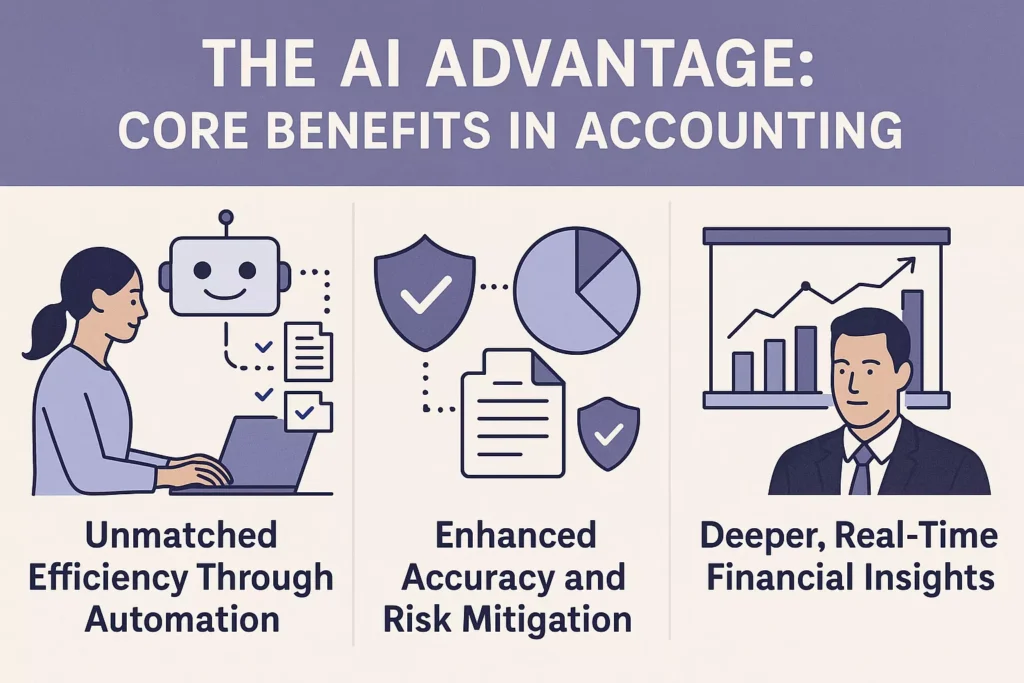
The impact of AI on accounting isn’t just about speed; it’s about fundamentally reshaping the quality and scope of financial work. The core benefits drive both operational excellence and strategic value for businesses.
1. Unmatched Efficiency Through Automation
Traditional accounting tasks are notoriously time-consuming and manual. AI is addressing this bottleneck head-on.
- 24/7 Processing: AI systems operate tirelessly, dramatically accelerating processes like accounts payable (AP) and accounts receivable (AR), allowing for real-time closing of books rather than waiting for month-end.
- Reduced Labor Cost: By handling repetitive, transactional tasks, AI reduces the operational costs associated with manual labor and re-work due to errors, freeing up personnel resources for more complex analysis.
2. Enhanced Accuracy and Risk Mitigation
Human error is inevitable when dealing with vast volumes of data. AI virtually eliminates this risk, leading to more reliable financial statements.
- Zero-Defect Data Entry: AI uses technologies like Optical Character Recognition (OCR) and specialized machine learning models to read, extract, and categorize data from documents (invoices, receipts, contracts) with near-perfect accuracy.
- Continuous Auditing: Unlike traditional periodic audits, AI tools can monitor 100% of transactions in real-time, instantly flagging inconsistencies or deviations, ensuring continuous compliance and internal control.
3. Deeper, Real-Time Financial Insights
The true power of AI lies in its ability to analyze massive, complex datasets far faster than any human, converting raw data into actionable business intelligence.
- Predictive Analytics: AI algorithms analyze historical financial data, market indicators, and macroeconomic trends to generate sophisticated financial forecasts, budget predictions, and cash flow models, enabling management to make proactive, data-driven decisions.
- Anomaly and Fraud Detection: Machine Learning is exceptionally adept at identifying patterns that deviate from the norm. This allows for the immediate detection of suspicious or fraudulent transactions that would be nearly impossible to spot through manual sampling or rule-based systems alone.
Key AI Use Cases Transforming the Finance Department
AI’s utility spans the entire accounting cycle, from initial data capture to final financial reporting and assurance.
I. Transaction Processing and Bookkeeping
This is the most mature area of AI adoption, focusing on high-volume, repetitive data handling.
- Accounts Payable (AP) Automation: AI automatically captures data from vendor invoices, matches them against purchase orders (POs) and goods received notes, and routes them for approval. This drastically shortens the procure-to-pay cycle.
- Bank and GL Reconciliation: AI systems automatically match transactions between bank statements and the general ledger (GL), flagging only true exceptions for human review, reducing reconciliation time from days to minutes.
- Expense Management: Employees can simply snap a photo of a receipt, and AI automatically extracts the data, categorizes the expense, and checks it against corporate policy for compliance before routing it for approval.
II. Auditing and Compliance
AI is revolutionizing the audit process, making it more thorough, efficient, and predictive.
- Continuous Auditing: AI tools constantly analyze transaction data, looking for policy violations, errors, or potential fraud across the entire dataset, a massive improvement over traditional sampling methods.
- Risk Assessment: AI-powered analytical models process client data to pinpoint the highest-risk areas of the business (e.g., unusual journal entries, non-standard transactions), allowing auditors to focus their valuable time and professional judgment where it matters most.
- Tax Compliance Automation: AI keeps abreast of constantly changing local, state, federal, and international tax laws, automatically calculating taxes, flagging necessary documentation, and preparing compliant returns, particularly useful for multinational operations.
III. Financial Planning and Analysis (FP&A)
In FP&A, AI shifts the focus from building models to interpreting them.
- Enhanced Budgeting and Forecasting: Machine learning models analyze thousands of variables to create more accurate and dynamic budgets and forecasts. They can run ‘what-if’ scenarios (e.g., “What if sales drop by 10% in the APAC region?”) instantly, providing management with clear financial outcomes for various strategic decisions.
- Financial Report Generation: Natural Language Generation (NLG)—a subset of AI—can convert complex financial data and analytical findings into clear, written narrative summaries, effectively drafting initial commentary for management reports.
Future Trends: The Next Evolution of AI in Accounting
The current use of AI is just the beginning. The next five to ten years promise a deeper integration, leading to new roles and structures within the finance function.
1. The Rise of Generative AI (GenAI)
The development of large language models (LLMs) is bringing sophisticated intelligence to tasks requiring human-like judgment and text-based interaction.
- Intelligent Financial Research: GenAI can quickly synthesize vast amounts of regulatory documents (e.g., GAAP, IFRS, FASB updates) and legal case files to provide instantaneous, summarized advice on complex financial reporting issues.
- Automated Policy Drafting: AI could assist in drafting initial versions of internal financial policies, control procedures, or even sections of a Management’s Discussion and Analysis (MD&A) report.
- Conversational Interfaces: Accountants and business users will interact with financial systems using natural language, asking questions like, “Show me the variance in Q3 marketing spend against budget, and tell me the probable cause.”
2. Autonomous Accounting Systems
The end-goal of many AI efforts is the creation of a nearly autonomous accounting function, where the entire general ledger process requires minimal human intervention.
- Self-Driving GL: This system will perform data ingestion, transaction coding, reconciliation, and internal controls testing automatically. Accountants will supervise the system and handle strategic exceptions, rather than performing the manual work themselves.
- Real-Time Closing: The continuous, automated nature of the GL will eliminate the need for traditional, labor-intensive month-end and year-end closes, providing stakeholders with financial positions that are accurate and up-to-the-minute.
3. Integrated Risk, Compliance, and ESG Reporting
As businesses face greater scrutiny on environmental, social, and governance (ESG) factors, AI will become essential for tracking and reporting non-financial data.
- Enhanced Regulatory Compliance: AI will monitor and enforce compliance with global regulations, sanctions, and anti-money laundering (AML) laws in real-time.
- ESG Data Harmonization: AI tools will be crucial for gathering, standardizing, and reporting diverse, non-financial data (e.g., carbon emissions, labor hours, diversity metrics) from disparate sources to ensure accurate and auditable ESG reports.
The Evolving Role of the Accountant: The Human Touch
The most profound impact of AI is not the replacement of the accountant, but the redefinition of their job. The future accountant will be an indispensable strategic partner, augmented by technology.
The New Skill Set for the AI Age
The demand for traditional “number-crunching” skills will decline, while the need for high-level human skills will soar.
| Skill Type | Traditional Accountant (Pre-AI) | Future Accountant (AI-Augmented) |
| Core Focus | Data Entry, Transaction Processing, Report Generation | Data Interpretation, Strategic Advisory, Risk Management |
| Technical Skills | Spreadsheets (Excel), Manual ERP/GL Input | Data Analytics Tools (e.g., Power BI, Tableau), AI/ML Literacy, Cybersecurity |
| Soft Skills | Attention to Detail, Organization | Critical Thinking, Communication, Ethical Judgment, Problem-Solving |
| Value to Business | Historical Record Keeper, Compliance Enforcer | Predictive Forecaster, Value Creator, Strategic Partner |
The Accountant as a Strategic Storyteller
With AI handling the how and the what, the accountant focuses on the why and the what’s next. They become the storyteller who translates complex AI-generated insights into a clear, compelling narrative for executive leadership. They move from asking “Did the numbers reconcile?” to “Based on this predictive analysis, which market expansion strategy offers the highest risk-adjusted return, and what are the ethical implications of that decision?”
The Ethical Imperative
The use of AI introduces new ethical and governance challenges. Accountants will play a critical oversight role to ensure that:
- AI Models are Free of Bias: Ensuring that historical data bias is not perpetuated by machine learning algorithms, which could lead to unfair credit decisions or fraudulent assessment models.
- Transparency and Explainability: Auditing the AI itself, demanding explainable AI (XAI) to understand why a model made a specific prediction or flagged an anomaly, thereby maintaining accountability.
- Data Security and Privacy: Governing the massive influx of data required for AI models, ensuring robust cybersecurity and compliance with global data privacy regulations (e.g., GDPR).
Challenges on the Road to AI Integration
Despite the immense potential, the journey to a fully AI-augmented accounting function has hurdles that firms must navigate.
1. Data Quality, Governance, and Infrastructure Complexity
The foundation of any successful AI initiative is high-quality, standardized data. Many organizations struggle with this foundational requirement due to legacy issues.
- Fragmentation and Silos: Financial data often resides in disparate, non-integrated systems (e.g., separate ERPs, CRM databases, Excel spreadsheets). AI requires a unified, clean data lake or warehouse, making the initial task of data consolidation and harmonization complex and time-consuming.
- Legacy Systems Incompatibility: Older, proprietary accounting systems often lack the APIs (Application Programming Interfaces) necessary for seamless communication with modern AI and Machine Learning (ML) platforms, necessitating expensive middleware or complete system overhauls.
- Data Consistency and Accuracy: The “garbage in, garbage out” principle is paramount. Inconsistent data formats, missing fields, or historical human errors must be identified and corrected, requiring a massive upfront data cleansing effort before any ML model can be trained effectively.
- Data Governance: Establishing clear policies and procedures for data ownership, access, security, and usage is critical. Firms must define who is responsible for maintaining the accuracy and integrity of the data that feeds the AI models.
2. The Talent, Skills, and Cultural Gap
Technology alone is insufficient; human capital must evolve alongside the tools. The biggest barrier is often a lack of preparedness among the current workforce.
- Scarcity of Hybrid Professionals: There’s a severe shortage of individuals—internal staff or external hires—who possess the dual expertise of deep accounting/finance knowledge and data science/ML proficiency. This gap hinders both the development and the responsible adoption of AI solutions.
- Resistance to Change: Accountants accustomed to traditional, manual processes may resist the adoption of new AI tools, fearing job displacement or simply being uncomfortable with new technology. Overcoming this requires comprehensive change management programs and clear communication about the future strategic role of the accountant.
- Deficit in AI Literacy: The general workforce lacks basic AI literacy, meaning they may not understand how to correctly interpret AI outputs, audit the models’ fairness, or even know which tasks are suitable for automation. Investment in targeted reskilling and upskilling programs focused on data visualization, predictive analytics, and XAI (Explainable AI) is crucial.
- Retraining Focus: Accounting education programs must quickly integrate curriculum focused on programming languages (like Python or R), cloud computing, and advanced statistical modeling to prepare the next generation.
3. Cost, ROI Uncertainty, and Implementation Risk
The financial commitment required to transition to an AI-augmented environment can be a major deterrent, especially for smaller entities.
- High Initial Investment: This includes the cost of specialized AI software licenses, procuring cloud computing resources, hiring expensive data science consultants, and the extensive time and resources required for data harmonization and infrastructure upgrades.
- Integration with Legacy Systems: As noted, connecting AI tools to existing ERPs and GLs is often complex, requiring custom development that adds significant cost and implementation risk. A failed or poorly integrated rollout can lead to system downtime and data integrity issues.
- Intangible ROI: While RPA shows immediate, measurable ROI (e.g., labor hour reduction), the greatest value from sophisticated ML (like predictive forecasting or advanced fraud detection) is realized in less direct, intangible benefits like improved decision quality, reduced systemic risk, and enhanced market positioning. Quantifying this value in a traditional business case can be difficult.
- Maintenance and Scaling Costs: AI systems require continuous monitoring, model retraining, and maintenance to adapt to changes in business rules, regulations, and data patterns. These ongoing operational costs are often underestimated.
4. Ethical, Regulatory, and Oversight Challenges
The increasing complexity and autonomy of AI systems introduce new governance requirements regarding fairness, compliance, and accountability.
- Bias in Algorithms: If AI models are trained on historical data that reflects past biases (e.g., biased compensation structures), the AI may perpetuate and even amplify these unfair outcomes. Accountants must ensure algorithmic fairness and ethical data sourcing to prevent discrimination.
- Explainable AI (XAI) Requirement: Regulators, auditors, and stakeholders require an understanding of why an AI system reached a specific conclusion (e.g., flagging a transaction as fraudulent or recommending a specific reserve amount). Current complex “black-box” ML models often lack this transparency, making auditability and accountability difficult.
- Data Privacy and Security: AI requires access to vast amounts of sensitive financial and customer data. Ensuring robust cybersecurity measures and compliance with evolving global data privacy laws (like GDPR or CCPA) is a major legal and technological challenge.
- Regulatory Uncertainty: Regulations regarding the use of AI in critical functions like financial reporting and auditing are still evolving. Firms face the risk that systems implemented today may not meet future compliance standards, requiring costly retrofitting.
Conclusion: Embracing the Future
The wave of AI is not a threat to the accounting profession, but a powerful catalyst for its most exciting evolution yet. It marks a clear end to the era of the human calculator and the dawn of the Strategic Advisor. The accounting function will pivot from processing transactions to generating sophisticated insights, becoming a dynamic, value-adding partner that steers the business toward greater profitability and resilience. Accountants who proactively embrace this technology and cultivate skills in data analysis, critical thinking, and strategic communication will not just survive the transformation—they will lead it.
FAQs
1. Will AI replace accountants?
No, AI will not replace accountants; it will redefine their role. AI is best at automating repetitive, rule-based, and high-volume tasks like data entry, reconciliation, and transaction matching. This shift eliminates the need for accountants to be “human calculators” and frees them up to focus on higher-value activities that require human judgment, critical thinking, ethical reasoning, strategic communication, and client relationship management. The future accountant will be an AI-augmented financial strategist and advisor.
2. What is the most common AI technology being used in accounting today?
The most common and mature AI technology currently being used in accounting is Robotic Process Automation (RPA). RPA uses software bots to mimic human interactions with digital systems to perform structured, repetitive tasks—such as copying and pasting data, logging into applications, or processing standard invoices. This is often the first step in a firm’s digital transformation journey due to its relatively low barrier to entry and quick return on investment (ROI) in areas like Accounts Payable and bank reconciliation.
3. How does Machine Learning (ML) help in financial forecasting?
Machine Learning (ML) enhances financial forecasting by increasing its accuracy and dynamism. Traditional forecasting relies heavily on historical data and human assumptions. ML algorithms, on the other hand, can analyze exponentially larger datasets, including both internal financial history and external factors (like market indicators, social media trends, and macroeconomic data), to identify complex, non-linear patterns that human analysts might miss. This allows ML to create more sophisticated predictive models and instantly run “what-if” scenarios, leading to more resilient budgeting and cash flow management.
4. Is AI useful for small accounting firms or just large corporations?
AI is increasingly accessible and useful for small to mid-sized accounting firms (SMPs), not just large corporations. While large firms adopt complex, custom AI solutions, SMPs are benefiting from cloud-based accounting software with built-in AI features. These features often include automatic transaction coding, enhanced Optical Character Recognition (OCR) for receipt scanning, and automated compliance checks. These accessible tools level the playing field by helping SMPs achieve significant efficiency gains without massive upfront investment.
5. What new skills should an accountant learn to stay relevant in the age of AI?
To stay relevant, accountants must pivot their skills toward data literacy and strategic interpretation. Key new skills include:
- Data Analysis & Visualization: Understanding how to use tools like Tableau or Power BI to interpret and present AI-generated insights.
- AI/ML Literacy: Knowing what AI tools exist, how they work (even at a high level), and how to audit the outputs of the models (Explainable AI – XAI).
- Ethical and Regulatory Judgment: Applying professional judgment to ethical dilemmas and ensuring AI usage adheres to privacy and compliance regulations.
- Communication & Storytelling: Translating complex data and predictive analytics into clear, actionable business advice for clients and management.