
Artificial Intelligence is transforming climate science by enabling weather models that predict storms, rainfall, temperature changes, and extreme events with up to 10x better accuracy than traditional systems. These new AI-powered models analyze global climate data in seconds, spot hidden patterns, and deliver faster, more precise forecasts that humans and old supercomputer systems simply cannot match.
This article explains how AI climate models work, why they are more accurate, what technologies power them, and how they are reshaping industries, governments, and the future of climate resilience.
The Rise of AI in Climate Technology
Climate change is making weather increasingly unpredictable. Heatwaves that once occurred once a decade now appear every two years. Floods, cyclones, and droughts follow patterns that defy old forecasting models. Traditional physics-based systems—although powerful—often struggle with:
- Massive and fast-changing climate variables
- Limited resolution
- Hours or days of computation
- Difficulty predicting small-scale, sudden events
AI steps in precisely where these limitations occur.
Why AI Is a Game-Changer
AI models can:
- Process global climate data millions of times faster
- Understand non-linear patterns traditional models miss
- Deliver forecasts in seconds, not hours
- Learn and improve continuously
- Achieve higher spatial resolution with less compute power
This shift is not futuristic—it’s happening right now.
Industry giants like Google DeepMind, NVIDIA, IBM, OpenAI, and NCAR are already deploying AI-driven climate systems that outperform legacy models in speed, detail, and accuracy.
How AI Weather Models Work
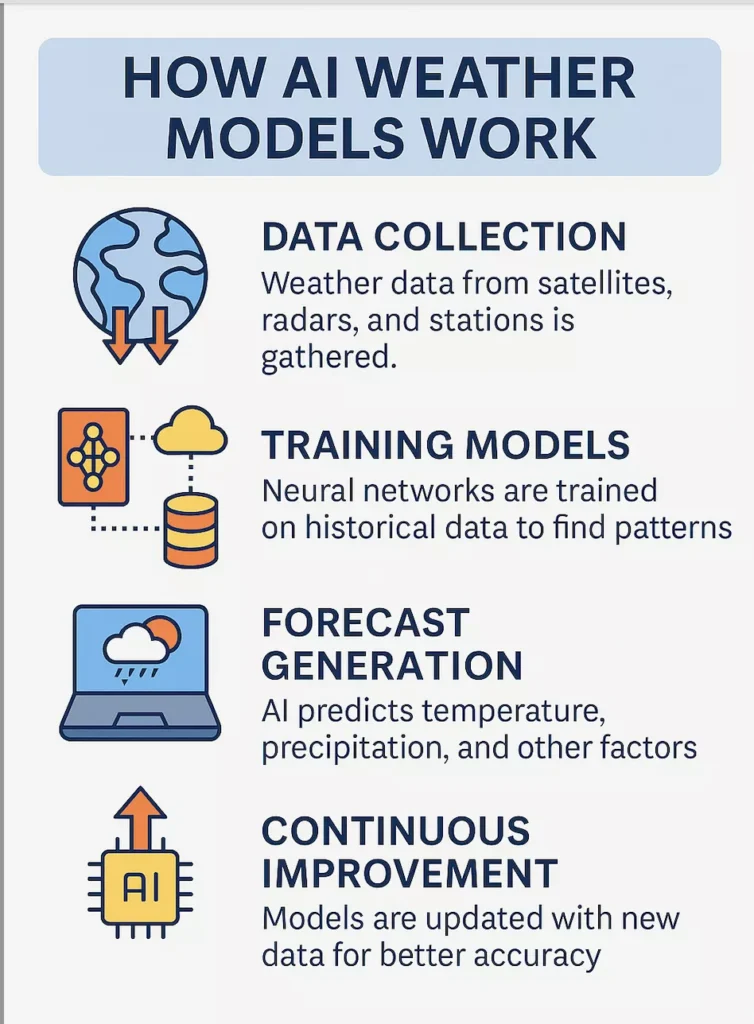
AI-powered weather forecasting operates by processing an enormous volume of climate information—ranging from satellite images and ocean temperatures to radar scans, sensor readings, humidity levels, wind speeds, and historical climate records. Instead of relying solely on traditional physics-based equations, these systems use deep learning to understand patterns in the atmosphere and predict future weather conditions with far greater accuracy and speed.
1. Data Ingestion
The process begins with AI absorbing massive datasets from multiple sources:
- Weather satellites capturing cloud movements and thermal signatures
- Doppler radars mapping precipitation and storm intensity
- Ocean buoys measuring temperature and wave patterns
- Ground climate stations tracking wind, pressure, and humidity
- Thousands of historical climate sequences stored over decades
AI integrates all of this information into a single, unified dataset that represents the current state of Earth’s atmosphere.
2. Feature Extraction
Next, advanced neural networks analyze this data to uncover subtle patterns that humans or traditional models often miss. These systems detect:
- Jet stream shifts that influence global weather
- Early signs of cyclone rotation or storm strengthening
- Small pressure variations that could trigger rainfall
- Heat anomalies developing over land or ocean surfaces
This step essentially teaches the AI model what “weather fingerprints” look like across thousands of scenarios.
3. Pattern Recognition & Prediction
After learning these features, the model compares new, incoming data with millions of previously learned examples. It then predicts the likelihood of future events—rainfall, temperature changes, wind direction, storm intensification, etc.
This rapid comparison allows the AI to forecast outcomes far faster than traditional supercomputers.
4. Real-Time Updating
One of the biggest advantages of AI models is that they continuously learn and refine themselves. As fresh data flows in from satellites, radars, and sensors, the system instantly updates its predictions.
This real-time correction ensures that sudden weather shifts—like surprise thunderstorms or cyclone path deviations—are captured early.
5. High-Resolution Forecast Generation
AI models can generate extremely detailed and hyper-local forecasts. Instead of predicting weather for an entire city, AI can analyze microclimates and deliver neighborhood-level predictions such as:
- “Rainfall expected in North Mumbai between 4:00 PM and 6:00 PM.”
- “Wind gusts likely to intensify by 20% along the coastal belt near Gujarat.”
This level of resolution—often down to 1–2 km grids—is a major reason AI delivers up to 10x better forecasting accuracy compared to traditional methods.
Why AI Models Are Achieving 10x Better Accuracy
AI weather models are outperforming traditional forecasting systems because they approach the atmosphere in an entirely new way. Instead of relying solely on fixed physics equations, these models learn directly from the world’s climate data—spotting patterns, connections, and warning signals that humans and legacy systems often miss. Here’s why this results in dramatically higher accuracy.
i. AI Understands Nonlinear and Chaotic Climate Behavior
Weather is inherently chaotic. A slight shift in humidity, temperature, or wind speed can trigger major changes hours or days later. Traditional forecasting systems often struggle because their physics-based equations cannot capture every tiny variable or sudden atmospheric shift.
AI, on the other hand, excels in complexity.
Deep learning models thrive on massive, messy datasets where patterns are hidden beneath layers of noise. They detect relationships that would be impossible to explain mathematically—recognizing early cyclone signatures, spotting silent heat anomalies, or predicting sudden rainfall bursts.
In short, AI doesn’t just model chaos—it learns from it.
ii. Higher Spatial and Temporal Resolution
One of the biggest limitations of older weather models is resolution. Many rely on coarse grids, such as 25 km × 25 km, which means they overlook small but impactful weather events like local thunderstorms, heat pockets, or sudden wind shifts.
AI dramatically improves this by bringing resolution down to 2 km or even 1 km.
This ultra-fine granularity allows the model to visualize microclimates—small-scale weather patterns that directly affect cities, neighborhoods, and even individual districts. As a result, AI can forecast:
- localized cloudbursts
- narrow storm bands
- urban heat zones
- rapid wind fluctuations
These details are essential for modern climate-sensitive planning.
iii. AI Uses Global Datasets, Not Just Local Inputs
Traditional forecasting systems often rely heavily on local or regional station data. AI models take a much bigger step—they learn from global climate behavior, absorbing vast datasets such as:
- 50+ years of historical weather archives
- global ocean currents and temperature profiles
- greenhouse gas concentrations
- detailed satellite imagery
- atmospheric chemistry and aerosol data
This broad perspective helps AI understand how events in one part of the world influence weather elsewhere. For example, a temperature shift in the Pacific Ocean may signal a monsoon pattern change in India.
By learning from the entire planet, AI creates holistic, interconnected forecasts that are far more accurate.
iv. Ability to Simulate Millions of Scenarios Instantly
Traditional models often take hours—sometimes half a day—to simulate a single forecast due to the heavy computational load of physics-based calculations. AI completely transforms this process.
AI models can simulate millions of possible scenarios in seconds, including:
- cyclone formation and path deviations
- rainfall intensity across regions
- temperature fluctuations hour by hour
- flood likelihood based on soil saturation
This speed allows meteorologists to analyze multiple possibilities, giving time to prepare for worst-case events. The result is faster alerts, earlier warnings, and fewer surprises.
v. Continuous Learning and Real-Time Adaptation
Traditional weather models are static—they run, produce output, and wait for the next scheduled update. AI models are fundamentally different.
AI continuously learns and updates itself with new information every minute, including:
- fresh satellite images
- updated moisture levels
- new radar scans
- ocean temperature shifts
This constant feedback loop allows AI to correct its own predictions in real time. If conditions change suddenly, the model adjusts instantly, ensuring that its forecast remains accurate even in rapidly evolving situations.
Top AI Weather Models Leading the Revolution
1. Google DeepMind GraphCast
GraphCast is one of the most advanced AI weather models ever built. It can:
- Predict global weather conditions up to 10 days in advance
- Consistently outperform ECMWF, the world’s top physics-based forecasting model
- Generate a full global forecast in under 60 seconds
Its speed and accuracy have made it a breakthrough in long-range prediction and early warning systems.
2. NVIDIA FourCastNet

NVIDIA’s FourCastNet focuses on high-speed, high-resolution climate simulations. It excels at forecasting complex and extreme events such as:
- Cyclone formation and paths
- Heatwaves and temperature anomalies
- Intense rainfall and storm patterns
Its ability to simulate multiple scenarios instantly makes it invaluable for disaster preparedness.
3. IBM GRAF (Global High-Resolution Atmospheric Forecast)
IBM GRAF delivers precise, localized forecasts with exceptional frequency. It provides:
- Weather updates every hour
- Real-time information for more than 2.2 billion people worldwide
By offering hyper-local predictions, GRAF helps communities, businesses, and governments respond faster to rapidly changing conditions.
4. Huawei Pangu Weather
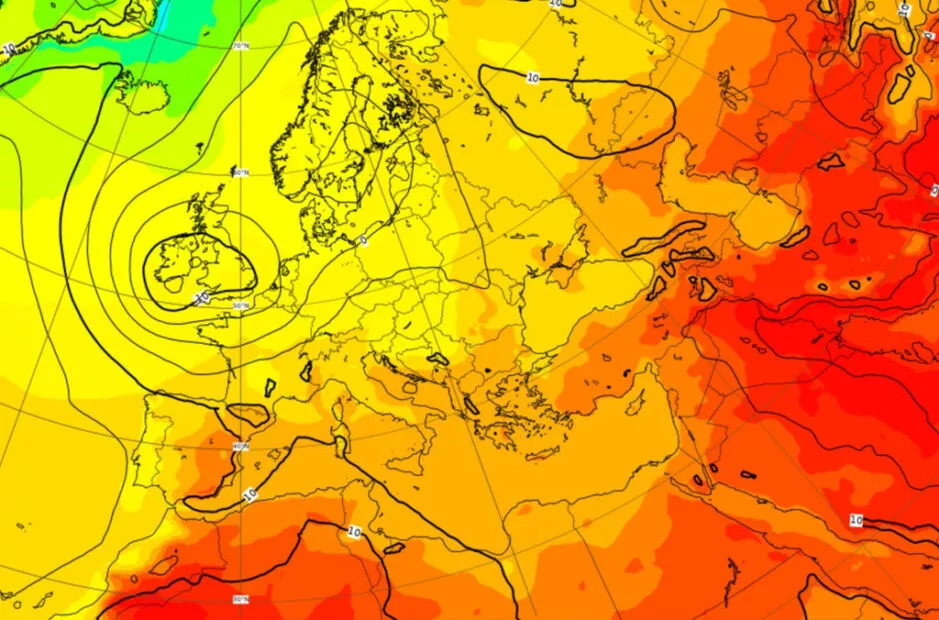
Pangu Weather is a major leap for Asian and global forecasting. It is known for:
- Predicting typhoons hours earlier than many traditional models
- Offering accurate short-term and medium-term forecasts across complex terrains
Its early-warning capabilities have already improved disaster response in typhoon-prone regions.
These AI weather systems are not just technological milestones—they have already proven their value in real-world scenarios, especially when it comes to forecasting extreme weather events. As they continue to evolve, they will play a crucial role in protecting lives, guiding policy, and strengthening climate resilience worldwide.
Real-World Applications: How AI Is Changing Weather Forecasting
AI-driven weather models are not just scientific breakthroughs—they are reshaping entire industries, strengthening climate resilience, and helping societies make smarter, faster decisions. Here’s how AI is making a real-world impact across critical sectors.
i. Disaster Management
AI-powered forecasts give authorities much-needed time to act before severe weather strikes. With earlier and more accurate predictions of:
- cyclones,
- flash floods,
- wildfires,
- and heatwaves,
emergency teams can evacuate vulnerable areas, deploy resources, and issue warnings sooner. In many cases, even a two-hour improvement in forecasting can mean the difference between safety and catastrophe, potentially saving thousands of lives.
ii. Agriculture
For farmers, weather isn’t just information—it’s survival. AI provides highly precise insights such as:
- upcoming rainfall patterns,
- irrigation planning guidance,
- early pest and disease outbreak alerts,
- and drought monitoring.
These data-driven predictions help farmers optimize planting schedules, protect crops, reduce losses, and increase yields, making agriculture more resilient in a rapidly changing climate.
iii. Aviation
The aviation industry depends heavily on weather accuracy. AI enhances:
- turbulence prediction,
- storm and lightning avoidance,
- fuel-efficient route planning,
- and real-time flight adjustments.
With better forecasts, airlines can reduce delays, cut fuel consumption, enhance safety, and save millions in operational costs—all while improving passenger comfort.
iv. Renewable Energy
Solar and wind energy providers rely on accurate weather forecasts to maintain stable power output. AI helps them manage:
- energy storage systems,
- smart grid distribution,
- load balancing,
- and production forecasting.
This precision prevents power shortages, minimizes waste, and improves renewable energy efficiency across entire regions.
v. Urban Planning
Modern cities face rising climate challenges. AI assists urban planners in analyzing:
- heat island effects,
- flood-prone zones,
- drainage capacity risks,
- and infrastructure pressure points.
These insights guide the development of climate-resilient cities with smarter drainage systems, greener public spaces, and improved heat mitigation strategies.
vi. Insurance & Finance
Banks, insurers, and investment firms increasingly rely on AI climate models to assess:
- risk exposure,
- potential natural disaster losses,
- asset vulnerability,
- and long-term climate impact on investments.
By accurately forecasting climate-related risks, financial institutions can make better decisions, price insurance more effectively, and protect portfolios in an era of rising weather volatility.
How AI Helps Predict Extreme Weather Events More Accurately
Extreme weather events are historically the most difficult to forecast. Their sudden onset, rapid intensification, and complex behavior often make traditional models struggle to keep up. AI completely changes this by identifying subtle warning signs long before they become visible to humans or conventional forecasting systems. Here’s how AI improves prediction across the most dangerous climate events.
i) Heatwaves
AI can detect early temperature anomalies, atmospheric pressure shifts, and jet stream changes weeks before a heatwave forms. By analyzing long-term global temperature patterns and circulation trends, it provides early warnings that help cities prepare cooling centers, hospitals manage capacity, and communities stay safe.
ii) Cyclones & Hurricanes
Cyclone forecasting demands precision—every hour matters. AI models excel by analyzing:
- early eye formation indicators,
- potential path deviations,
- sudden intensity spikes,
- and warm ocean patterns that fuel storms.
This allows meteorologists to track cyclone behavior with greater accuracy, offering more reliable timelines for evacuation and disaster planning.
iii) Floods
Flood prediction is one of the biggest challenges for climate scientists, especially during monsoons or heavy storm seasons. AI uses high-resolution data on:
- rainfall intensity,
- river levels,
- soil moisture saturation,
- and terrain structure
to calculate flood likelihood at a neighborhood-level scale. This helps authorities pinpoint which areas need early evacuation or additional protective measures.
iv) Wildfires
Wildfires can escalate rapidly, making early detection crucial. AI evaluates a combination of factors such as:
- wind speed and direction,
- vegetation dryness,
- temperature patterns,
- and lightning strike probability.
By processing these inputs together, AI identifies where fires are most likely to ignite days before they occur, giving firefighters a critical advantage.
Future of AI Weather Prediction
AI’s next evolution is set to revolutionize how humanity understands and responds to the atmosphere. The coming years will bring forecasting tools that are faster, more localized, more intelligent, and far more accessible—reshaping everything from disaster planning to daily decision-making.
a. Personalized Micro-Weather Forecasting
Weather predictions will soon become hyper-personalized. Instead of city-wide forecasts, AI will deliver minute-by-minute updates tailored to your exact location. People will receive alerts like:
- “Rain expected at your home in 17 minutes.”
- “High humidity near your office around 3 PM.”
- “UV index spike at your beach spot this afternoon.”
This micro-level precision will help individuals plan travel, outdoor activities, work schedules, and safety decisions with unmatched accuracy.
b. Autonomous Climate Decision-Making
AI will evolve from predicting weather to acting on it automatically. Future climate systems will be intelligent enough to manage critical infrastructure autonomously. They will:
- adjust dam gates in real time to prevent floods,
- optimize power grids during heatwaves to avoid blackouts,
- control smart irrigation systems to conserve water,
- and dynamically protect infrastructure without waiting for human instructions.
This automation will drastically improve preparedness and reduce climate-related damages.
c. Global Climate Twins
Digital replicas of Earth—known as climate digital twins—will simulate entire decades of climate behavior in hours. These virtual models will help predict:
- long-term climate shifts,
- forest and vegetation growth,
- ice sheet melting patterns,
- rising urban temperatures,
- and ecosystem changes.
Policymakers, scientists, and businesses will use these simulations to test ideas and prepare for the future with scientific accuracy.
d. Lower Computation Costs and Global Accessibility
AI-enabled forecasting removes the need for massive supercomputers. Models that once required giant climate labs will soon run efficiently on standard hardware. This means:
- forecasting becomes dramatically cheaper,
- developing nations gain access to advanced weather tools,
- local regions can run their own climate models,
- and global forecasting becomes more inclusive and equitable.
This democratization of climate technology is one of AI’s most transformative impacts.
e. Climate Change Predictions with Unprecedented Accuracy
AI will give researchers clearer insights into the long-term impacts of global warming. Future models will more accurately predict:
- sea level rise patterns,
- monsoon variability,
- jet stream behavior,
- extreme temperature shifts,
- and regional climate disruptions.
With this level of precision, governments and businesses will be able to plan infrastructure, food systems, coastal protection, and resource management with far greater confidence.
Challenges and Ethical Concerns
1. Data Gaps
Despite rapid advancements, AI climate systems still struggle with incomplete or inconsistent data. Many regions lack adequate radar coverage, weather stations, or high-resolution satellite monitoring. Because AI models depend on large, diverse datasets to make accurate predictions, these gaps can weaken performance—especially in developing countries or remote areas where climate risks are often highest.
2. Interpretability Issues
AI weather models often operate like “black boxes.” While they may deliver extremely accurate forecasts, they do not always provide clear explanations for how those predictions were generated. This lack of transparency poses challenges for meteorologists, disaster authorities, and policymakers who must understand the reasoning behind forecasts before making critical decisions.
3. Risk of Overreliance
As AI continues to outperform traditional forecasting tools, there is a growing risk of overdependence. Relying solely on automated predictions—without human oversight—can be dangerous. Even small model errors or unexpected atmospheric anomalies could lead to major disruptions. Expert judgment must remain an essential part of the forecasting process.
4. Bias in Data
Uneven data representation can introduce bias into AI predictions. Regions with dense monitoring networks benefit from more accurate forecasts, while sparsely monitored areas may receive less reliable predictions. This disparity can reinforce existing climate vulnerabilities and widen global forecasting inequalities.
5. Cybersecurity Threats
Weather monitoring systems and AI-driven climate models are becoming critical infrastructure. As reliance on these systems increases, so do cybersecurity risks. Any manipulation, breach, or corruption of weather data could have severe consequences, affecting disaster response, aviation, agriculture, and national security. Protecting AI climate systems from cyber threats is now a top priority.
Why AI Weather Prediction Matters for Everyone
Whether you are a farmer, pilot, business owner, policymaker, or everyday citizen—AI weather forecasting impacts your life daily.
Benefits for Individuals
- Better travel planning
- Protection from heatwaves
- More accurate rainfall alerts
- Safer outdoor events
- Early disaster warnings
Benefits for Businesses
- Reduced losses
- Efficient operations
- Improved logistics
- Better insurance planning
Benefits for Governments
- Faster emergency response
- Lower disaster fatalities
- More resilient infrastructure
- Better climate policies
AI weather prediction is not just a technological upgrade—it’s a societal necessity.
Conclusion: A New Era of Intelligent, Accurate Weather Forecasting
AI-powered climate models are transforming global weather forecasting with 10x better accuracy, faster simulations, and deeper insights. These models overcome limitations of traditional physics-based systems, providing real-time, granular, and highly reliable predictions.
As climate change intensifies extreme weather, AI is becoming the world’s most powerful tool for saving lives, protecting economies, and building a climate-resilient future.
The integration of machine learning, super-resolution models, and global climate datasets is shaping the future of forecasting—and the world is entering an era where weather predictions are more precise and actionable than ever before.