
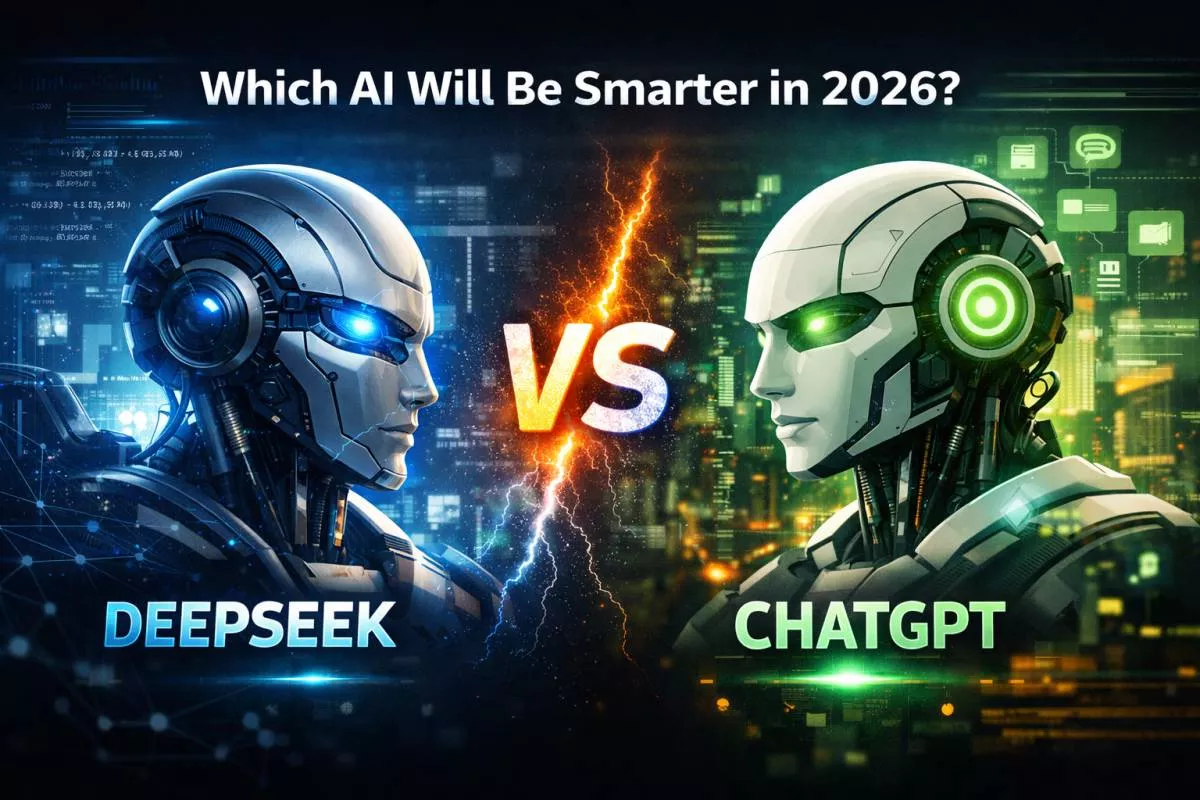
In 2026, ChatGPT will likely remain “smarter” for general users, creatives, and enterprise businesses requiring polished, multimodal capabilities (voice, image, and seamless app integration), while DeepSeek is projected to surpass ChatGPT in pure “computational smarts”—specifically in complex mathematics, coding, and logical reasoning—at a fraction of the cost. The definition of “smart” is splitting: OpenAI is building a comprehensive digital assistant, whereas DeepSeek is building a highly efficient computational engine. If you need a partner to write a novel or manage your calendar, bet on ChatGPT; if you need to solve a PhD-level physics problem or optimize server code, DeepSeek may well be the superior intellect.
The “Smarts” Split: A Fork in the Road
For years, we assumed the path to AGI (Artificial General Intelligence) was a single straight line: bigger models, more data, smarter AI. But as we approach 2026, two distinct philosophies are emerging.
OpenAI (ChatGPT) is chasing Scale & Utility. Their “smartness” comes from massive data centers, proprietary partnerships (like Apple and Microsoft), and the ability to “see” and “hear” the world. Their goal for 2026 is an AI that feels like a human expert in every field.
DeepSeek is chasing Efficiency & Logic. Their “smartness” comes from algorithmic elegance. By optimizing how the AI “thinks” (using techniques like Mixture-of-Experts), they are achieving GPT-4 level performance with significantly less computing power. Their goal for 2026 is an AI that provides the correct answer instantly, without the fluff.
1. Reasoning & Logic: The DeepSeek Advantage
The “Math Whiz” vs. The “Generalist”
By 2026, expert predictions suggest DeepSeek’s specialized “reasoning models” (like their R-series) could consistently outperform OpenAI’s general models in raw logic benchmarks.
- DeepSeek’s Edge: DeepSeek has aggressively optimized for STEM (Science, Technology, Engineering, Math). Their open-weight nature allows the global developer community to fine-tune them, accelerating their growth rate faster than a single closed company can manage.
- ChatGPT’s Defense: OpenAI’s “o” series (like o1 and o3) focuses on “chain of thought” reasoning. While powerful, it is computationally expensive.
- 2026 Prediction: If you ask a complex riddle or a high-level calculus problem in 2026, DeepSeek will likely give you the answer faster and more accurately.
Takeaway: For pure IQ tests, code generation, and scientific research, DeepSeek is on track to be the “smarter” model.
2. Creativity & Nuance: The ChatGPT Moat
The “Artist” vs. The “Calculator”
“Smart” isn’t just about math; it’s about understanding context, humor, and emotional nuance. This is where OpenAI has an unshakeable lead that will likely hold through 2026.
- The Human Touch: ChatGPT is fine-tuned using massive amounts of human feedback (RLHF) to sound conversational, empathetic, and safe. DeepSeek, with its focus on efficiency, often sounds more robotic or terse.
- Multimodality: In 2026, “smart” will mean being able to watch a video and explain it, or listen to a song and critique the lyrics. OpenAI’s native integration of audio and vision (Omni models) is years ahead of DeepSeek’s text-heavy focus.
- 2026 Prediction: For writing a wedding toast, brainstorming a marketing campaign, or having a philosophical chat, ChatGPT will feel significantly superior.
3. The “Brain” Size vs. Efficiency
Why DeepSeek Might Win by Being Smaller
One of the most shocking revelations of late 2024 and 2025 was that DeepSeek could match top-tier American models using a fraction of the budget.
| Feature | DeepSeek Strategy | ChatGPT (OpenAI) Strategy |
| Training Cost | Low ($5-6M range) | Massive ($100M+ range) |
| Architecture | Mixture-of-Experts (MoE) | Dense / Complex Hybrid |
| Availability | Open Weights (Run it yourself) | Closed Service (API/Cloud) |
| Primary Goal | Democratized Logic | Consumer Product dominance |
In 2026, this efficiency matters because it allows DeepSeek to run on cheaper hardware (even high-end laptops). An AI you can run privately on your own machine is “smarter” for privacy-focused users than a genius AI trapped in a cloud server.
4. The Ecosystem Factor: Smart is as Smart Does
A genius locked in a room is less useful than a smart person with a phone and a laptop.
- ChatGPT in 2026: Will likely be integrated into your OS. It will read your emails, see your screen, and take actions for you (“Book a flight for me”). Its “smartness” will be defined by agency—the ability to do things.
- DeepSeek in 2026: Will likely remain a backend engine. It will be the brain powering specific tools—the “Intel Inside” for specialized coding IDEs, scientific analysis tools, or financial prediction bots.
5. The “Wildcard”: Open Source Collaboration
The biggest threat to ChatGPT’s dominance is the open-source community. Because DeepSeek releases its model weights, thousands of independent researchers work to improve it every day. OpenAI has hundreds of employees; DeepSeek effectively has millions of volunteer contributors.
By 2026, this “swarm intelligence” could allow DeepSeek to iterate faster than OpenAI, fixing bugs and learning new languages overnight, whereas OpenAI must wait for scheduled major updates.
DeepSeek V5 vs. GPT-6: Projected Feature Comparison (2026)
| Feature | DeepSeek V5 (Projected) | OpenAI GPT-6 (Projected) |
| Core Philosophy | “The Engine” (Efficient, Logical, Open) | “The Assistant” (Human-like, Omni-capable, Closed) |
| Primary Strength | Logic & Code: Surpassing human expert levels in STEM, math proofs, and software architecture. | Multimodality: Seamlessly understanding video, audio, and text simultaneously with near-zero latency. |
| Architecture | Hyper-Efficient MoE (Mixture of Experts): massive parameter count but extremely low active parameters per token. | Massive Dense/Hybrid: Trillions of parameters designed for “world simulation” and broad general knowledge. |
| Availability | Open Weights / Local: capable of running on high-end consumer hardware or private enterprise clouds. | Cloud Service / OS Integration: deeply embedded into operating systems (like iOS/Windows) as an agent. |
| Agency (Doing things) | Backend Execution: Powers IDEs and automated coding bots; the “brain” inside other software. | Autonomous Agent: Can book flights, manage calendars, and browse the web as a distinct persona. |
| Memory | Context-Based: Massive context windows (likely 1M+ tokens) for analyzing huge codebases/books in one go. | Persistent Persona: Remembers you forever—your preferences, past conversations, and life details. |
| Cost to Run | Ultra-Low: Designed to be the cheapest “smart” API, making it the standard for bulk data processing. | Premium: Higher cost per token, justified by the “white glove” polished experience and safety features. |
| Privacy | High (Air-Gapped): Can be downloaded and run offline, ensuring 100% data sovereignty. | Managed Trust: Your data lives in OpenAI’s cloud, protected by enterprise-grade compliance but not local. |
| Best Use Case | Debugging a 10,000-line kernel; solving physics equations; local data analysis. | Planning a vacation; voice conversation; creative writing; generating video content. |
Verdict: Who Wins in 2026?
The answer depends entirely on who you are.
DeepSeek will be the “Smarter” AI if:
- You are a Developer or Data Scientist.
- You care about Accuracy, Code Quality, and Logic.
- You want Privacy (running models locally) and Low Cost.
- Smartness definition: Raw computational power and logical precision.
ChatGPT will be the “Smarter” AI if:
- You are a Content Creator, Marketer, or General User.
- You care about Workflow, Voice/Image Interaction, and Ease of Use.
- You want an Assistant that manages your digital life.
- Smartness definition: Versatility, emotional intelligence, and utility.
Final Takeaway
If you’re asking “Which AI will be smarter in 2026?”, the best answer is:
ChatGPT will lead in overall intelligence and usability, while DeepSeek will lead in efficiency and technical precision.
The smartest move? Choose the AI that aligns with your goals, not just the hype.
FAQs: DeepSeek vs. ChatGPT in 2026
1. Will DeepSeek totally replace ChatGPT by 2026?
No, they will likely serve different purposes. By 2026, the AI market is expected to split. DeepSeek will likely replace ChatGPT for developers, engineers, and researchers who need raw “computational horsepower” and code generation. However, ChatGPT will remain the dominant choice for general consumers, writers, and businesses who need a polished, “human-like” assistant that integrates with their email, calendar, and apps.
2. Which AI will be better for coding and math in 2026?
DeepSeek is projected to win here. DeepSeek’s architecture focuses heavily on logic and reasoning efficiency (STEM tasks). Predictions suggest that by 2026, DeepSeek’s specialized models will solve complex coding bugs and high-level math proofs faster and more accurately than OpenAI’s general-purpose models, largely due to its open-source community training it specifically for technical tasks.
3. Why would I pay for ChatGPT if DeepSeek is cheaper or free?
You are paying for the “Assistant” experience. While DeepSeek might be free to download and run, it requires technical know-how to set up effectively. You pay for ChatGPT to get a seamless, easy-to-use product that remembers your preferences, speaks to you (voice mode), sees what you see (vision), and handles tasks for you without you needing to write a single line of code.
4. Can I run DeepSeek offline on my own computer in 2026?
Yes, highly likely. One of DeepSeek’s biggest advantages is its efficiency. By 2026, consumer hardware (like MacBook Pros or gaming PCs) will likely be powerful enough to run sophisticated versions of DeepSeek entirely offline. This offers 100% privacy for your data. ChatGPT, conversely, will almost certainly remain a cloud-based service requiring an internet connection.
5. Which AI is “smarter” for creative writing and content creation?
ChatGPT retains the edge here. OpenAI invests heavily in “Reinforcement Learning from Human Feedback” (RLHF), which trains the AI to understand nuance, humor, tone, and empathy. In 2026, if you need to write a novel, a marketing script, or a sensitive email, ChatGPT will likely provide a result that feels more “human,” whereas DeepSeek might feel more robotic and factual.