
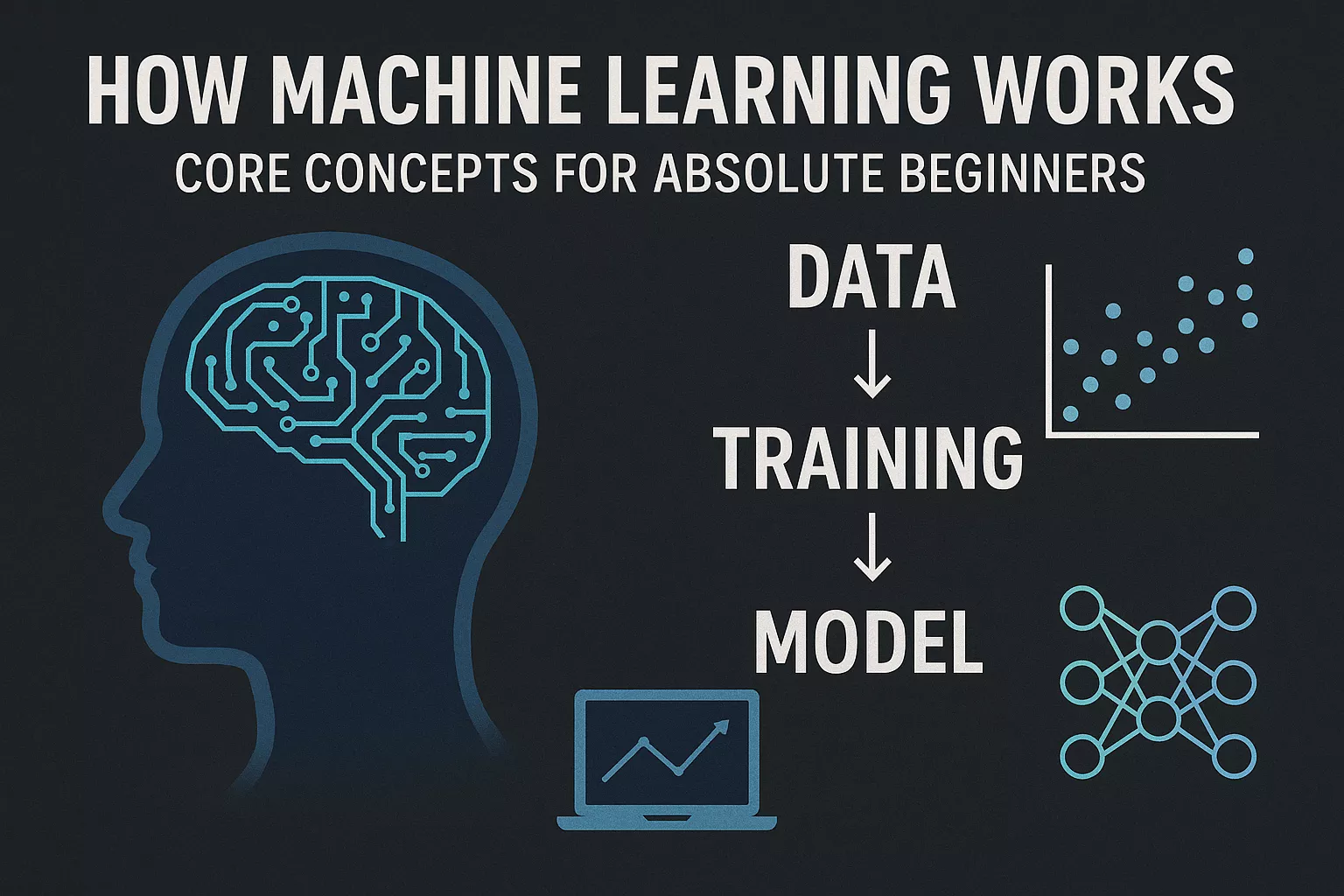
Machine learning works by training computers to learn patterns from data instead of following fixed instructions. In simple terms, you give the machine examples, it studies them, finds patterns, and then uses those patterns to make predictions or decisions on new data. That’s the entire core—machines learn from data the same way humans learn from experience.
Why Machine Learning Matters Today
Machine learning (ML) is everywhere—your Netflix recommendations, YouTube video suggestions, fraud detection on your bank account, self-driving cars, medical diagnosis tools, and even the spam filter catching unwanted emails.
Although ML sounds technical, the core idea is surprisingly simple: machines learn by identifying patterns inside data.
This guide is designed for absolute beginners who want a clear, simple breakdown of:
- What machine learning actually is
- How it works step-by-step
- The main types of ML
- Real-world examples
- Key terms explained in simple language
- Why ML matters in 2025 and beyond
By the end, you’ll understand machine learning at a level where you can talk about it confidently—even if you’ve never coded before.
What Exactly Is Machine Learning?

Machine Learning is a field of artificial intelligence that allows computers to learn from data and improve through experience—without anyone manually programming every rule.
The concept is simple. Imagine teaching a child:
- You show the child 100 pictures of cats.
- The child notices patterns and learns what a cat looks like.
- You show a new picture.
- The child confidently says, “This looks like a cat!”
Machine learning works the same way.
Instead of writing step-by-step rules, we give the computer examples, and it learns the patterns on its own.
How Machine Learning Works (Step-by-Step for Beginners)

Understanding how machine learning works becomes much easier when you break it down into simple steps. Below is a clear 7-step walkthrough of what happens behind the scenes when a machine learns from data.
1. Collecting the Data
Every machine learning project begins with data.
This data can come in many forms, such as:
- Images
- Emails
- Videos
- Customer browsing behavior
- Medical reports
- Weather logs
- Sales history
- Sensor readings from devices
The golden rule is simple: better data leads to a smarter model.
Example:
If you want to build a model that predicts house prices, you must gather useful information such as:
- Location of the house
- Square footage
- Number of bedrooms and bathrooms
- Historical price trends
- Neighborhood quality and amenities
These features help the machine understand what affects the price, just like a real estate expert would.
2. Preparing and Cleaning the Data
Raw data is rarely perfect. It often contains:
- Missing values
- Human or system errors
- Duplicate entries
- Extreme outliers
- Irrelevant details
Cleaning the data is one of the most important steps, because machines learn directly from whatever you feed them.
Dirty data = Confused model.
Clean data = Accurate model.
This step may involve:
- Removing duplicates
- Filling or removing missing values
- Converting data into readable formats
- Removing noise
- Selecting the most relevant features
3. Choosing the Right Machine Learning Model
The “model” is the brain of your system — the algorithm that actually learns from the data.
Different models are suited for different tasks. Some popular ones include:
- Linear Regression: predicts numerical values (e.g., predicting price).
- Decision Trees: make rule-based decisions by asking “yes/no” questions.
- Neural Networks: powerful models that learn complex patterns in images, voice, and text.
- Random Forests: collections of many decision trees working together.
- Support Vector Machines (SVM): great for separating data into categories.
Choosing the right model depends on:
- The type of problem
- The amount of data
- The complexity of the task
4. Training the Model
Training is the process of teaching the model using many examples.
This is where the model begins to understand the relationship between inputs and outputs.
Example:
To train a house-price prediction model, you feed it a dataset like:
| Input (Features) | Output (Label) |
|---|---|
| House size | Price |
| Bedrooms | Price |
| Location | Price |
After seeing thousands of such examples, the model figures out patterns such as:
“Larger homes in premium areas usually have higher prices.”
Training is basically the model’s study phase — the more quality examples it sees, the smarter it becomes.
5. The Model Learns Patterns
During training, the model doesn’t just memorize data.
It repeatedly adjusts its internal settings (called weights) to reduce errors.
This happens through mathematical techniques like:
- Gradient descent (helps the model improve step by step)
- Loss functions (calculate how wrong the model is)
- Weight adjustments (fine-tuning the model for better accuracy)
You don’t need to understand the math to grasp the concept.
Just remember:
The model improves itself again and again until it becomes accurate.
6. Testing the Model
After training, it’s time to check how well the model performs.
For this, you show it new data that it has never seen before.
Testing helps measure:
- Accuracy: How often the predictions are correct
- Reliability: Does it work consistently?
- Real-world performance: Can it handle unseen situations?
If the model performs well on new data, it proves that the model has actually learned the patterns, and not just memorized the training examples.
7. Making Predictions (Real-World Use)
Once the model has passed the testing phase, it’s ready for deployment.
This is where machine learning becomes truly valuable.
The trained model can now make predictions or decisions on real-world tasks, such as:
- Forecasting tomorrow’s weather
- Identifying whether an email is spam
- Recognizing faces in photos
- Recommending movies on Netflix
- Detecting suspicious banking transactions
- Predicting which products a customer will buy
At this stage, the model works automatically — and improves over time as it receives more data.
Types of Machine Learning
Machine learning breaks down into three big, easy-to-grasp families. Each one answers a different kind of problem and learns in a different way. Below is a clear, friendly guide that explains what each type does, how it learns, where it shines, and simple examples you can relate to.
i) Supervised Learning — Learning with Answers
What it is Supervised learning trains models using examples that already include the correct answers. Think of it as studying from a workbook where every problem comes with a solution.
How it works
- You provide: input data and matching labels (the correct outputs).
- The model’s job: discover the mapping from inputs to outputs so it can predict labels for new, unseen inputs.
- Training loop: feed examples → measure error between prediction and true label → adjust the model to reduce error.
Common tasks
- Regression: predict continuous values (e.g., house price).
- Classification: assign items to categories (e.g., spam vs non-spam, cat vs dog).
Typical algorithms
- Linear regression; logistic regression; decision trees; random forests; support vector machines; neural networks.
Why it’s useful
- High accuracy when you have good labeled data.
- Widely used in production systems like recommendation engines, fraud detection, and medical diagnosis.
Examples
- Predicting house prices from features like size and location.
- Email spam filters that learn from labeled spam and non-spam messages.
- Image classifiers that tag photos as cat, dog, or car.
- Sales forecasting from historical sales and promotions.
ii) Unsupervised Learning — Learning Without Answers
What it is Unsupervised learning explores raw data without labels. The model’s job is to find structure, patterns, or groupings that humans might not notice.
How it works
- You provide: only input data, no correct answers.
- The model’s job: discover relationships, clusters, or low-dimensional representations that summarize the data.
Common tasks
- Clustering: group similar items (e.g., customer segments).
- Dimensionality reduction: compress data while keeping important structure (e.g., PCA, t-SNE).
- Anomaly detection: spot unusual items that don’t fit the pattern.
Typical algorithms
- K-means; hierarchical clustering; DBSCAN; principal component analysis (PCA); autoencoders.
Why it’s useful
- Discovery-driven: great for exploration when you don’t have labels.
- Insight generation: uncovers hidden structure, helps form hypotheses, and supports downstream tasks.
Examples
- Grouping customers by buying behavior to tailor marketing.
- Detecting unusual bank transactions that could indicate fraud.
- Segmenting images into meaningful regions for further analysis.
- Finding latent topics in a collection of documents.
iii) Reinforcement Learning — Learning by Trial and Error
What it is Reinforcement learning (RL) teaches agents to make sequences of decisions by rewarding good behavior and penalizing bad behavior. It’s like training a pet: actions that lead to rewards get reinforced.
How it works
- Agent interacts with an environment by taking actions.
- Environment returns a reward (positive or negative) and a new state.
- Agent learns a policy that maximizes cumulative reward over time through trial and error.
Core concepts
- State: the current situation the agent observes.
- Action: a choice the agent makes.
- Reward: feedback signal that evaluates the action.
- Policy: strategy mapping states to actions.
- Value: expected future reward from a state or action.
Typical algorithms
- Q-learning; Deep Q-Networks (DQN); policy gradient methods; actor-critic architectures.
Why it’s useful
- Decision-making in dynamic settings: excels where actions affect future outcomes.
- Learns strategies that are hard to program by hand.
Examples
- Self-driving cars learning to navigate complex traffic.
- Game-playing AIs that master chess, Go, or video games.
- Robots learning to pick and place objects or walk.
- Navigation systems that adapt to changing environments.
Key Machine Learning Concepts
To truly understand how machine learning works, you need to become familiar with a few core concepts. These terms are the building blocks of ML. Once you grasp them, the entire field starts to feel much more intuitive and less intimidating.
Below are the most important concepts—explained in a friendly, beginner-focused way.
1. Dataset
A dataset is simply a collection of data that the machine learns from.
Think of it as the “study material” for the model.
A dataset usually contains:
- Inputs (what you give the model)
- Outputs or labels (the correct answers)
- Thousands or even millions of examples
The size and quality of your dataset play a huge role in how well the model performs. Better data = better learning.
2. Features
Features are the individual pieces of information used to make predictions.
They act like clues the model uses to understand a pattern.
Example for predicting house prices:
- Square footage
- Number of bedrooms
- Neighborhood
- Age of the house
- Distance to schools or markets
Each of these is a feature.
The more relevant features you provide, the smarter your model becomes.
3. Labels
A label is the correct answer the model is trying to learn.
Labels only exist in supervised learning, where the model must learn the mapping between input and output.
Examples:
- For house price prediction → the label is the actual price
- For email classification → the label is “spam” or “not spam”
- For image recognition → the label is “cat,” “dog,” “car,” etc.
Labels serve as the teacher, showing the model what the right answer looks like.
4. Training
Training is the process of teaching the model using examples.
During training, the model:
- Studies thousands of data points
- Looks for patterns
- Adjusts itself to reduce mistakes
- Gradually becomes more accurate
You can think of training as the model’s “learning phase,” similar to how students learn by practicing problems repeatedly.
5. Testing
Once the model is trained, it must be tested using new data it has never seen before.
This step reveals whether the model has learned true patterns or simply memorized the training data.
Testing helps measure:
- Real-world performance
- Generalization ability
- Overall accuracy
If the model performs well on testing data, it means it has genuinely understood the underlying patterns.
6. Model
A model is the brain of a machine learning system. It is the mathematical structure that processes data, learns patterns, and makes predictions.
Different models serve different purposes:
- Linear regression → predicts numbers
- Neural networks → handle complex tasks like vision and speech
- Decision trees → make structured yes/no decisions
Think of the model as a black box that transforms input into useful output after learning.
7. Algorithm
An algorithm is the method or set of rules the model uses to learn from the data.
It’s the strategy that teaches the model how to adjust itself and improve.
Popular ML algorithms include:
- Gradient descent
- Decision tree algorithm
- K-means clustering
- Backpropagation (used in neural networks)
You can imagine an algorithm as the learning technique, while the model is the structure that learns.
8. Overfitting
Overfitting happens when the model learns the training data too well — almost like memorizing every example instead of understanding general patterns.
Symptoms of overfitting:
- Excellent performance on training data
- Poor performance on new, unseen data
This is similar to a student who memorizes answers instead of understanding concepts.
They do great on familiar questions, but fail when the questions change.
9. Underfitting
Underfitting occurs when the model is too simple or does not learn enough to capture meaningful patterns in the data.
Symptoms:
- Poor results on training data
- Poor results on testing data
- Model fails to identify trends
It’s like studying too little or using oversimplified notes—you never truly learn the topic.
10. Accuracy
Accuracy measures how often the model’s predictions are correct.
For example:
- If a model predicts correctly 90 times out of 100 → 90% accuracy
- Higher accuracy means the model aligns more closely with real-world outcomes
Accuracy is one of the most common ways to evaluate how good a machine learning model is, especially for classification tasks.
Real-World Examples of Machine Learning You Use Daily
Machine learning (ML) powers many everyday services and devices, often behind the scenes. Below are clear, practical examples of how ML shows up in daily life, what it does in each case, and why it matters.
a. YouTube and Netflix Recommendations
What it does ML analyzes your viewing history, watch time, and interactions to predict videos or shows you’re likely to enjoy.
How it works Models compare your behavior with similar users and surface content with the highest predicted interest.
Why it matters
- Saves time by surfacing relevant content.
- Improves discovery of new creators and shows.
- Increases engagement by personalizing the experience.
b. Google Search Results
What it does Search algorithms rank pages and tailor results based on query intent and user behavior.
How it works ML models learn from clicks, dwell time, and content signals to refine relevance and ordering.
Why it matters
- Delivers faster answers and more relevant links.
- Adapts to trends and evolving language use.
- Reduces noise by prioritizing authoritative sources.
c. Face Recognition
What it does Devices use ML-based facial models to identify or verify people for unlocking phones and tagging photos.
How it works Neural networks learn facial features from many examples and match new images to stored profiles.
Why it matters
- Convenience through quick, hands-free access.
- Security by adding biometric authentication.
- Organization by automatically grouping photos by person.
d. Email Spam Filtering
What it does Email systems automatically separate spam and phishing from legitimate messages.
How it works Models detect patterns in message content, sender behavior, and metadata to classify emails.
Why it matters
- Protects users from scams and malicious links.
- Keeps inboxes clean so important messages aren’t missed.
- Learns continuously as spammers change tactics.
e. E-commerce Suggestions
What it does Online stores recommend products based on your browsing, purchases, and similar shoppers’ behavior.
How it works Recommendation engines combine user profiles, item features, and collaborative signals to suggest items.
Why it matters
- Personalized shopping that surfaces relevant products.
- Increases convenience by reducing search time.
- Boosts discovery of complementary or new items.
f. Maps and Navigation
What it does Navigation apps predict traffic, estimate arrival times, and suggest optimal routes.
How it works ML ingests historical traffic, live sensor data, and user movement to forecast congestion and reroute accordingly.
Why it matters
- Saves time by avoiding delays.
- Improves planning with accurate ETAs.
- Adapts in real time to accidents and road closures.
g. Healthcare Diagnosis
What it does ML assists clinicians by analyzing medical images and patient data to detect conditions earlier.
How it works Models trained on labeled medical scans identify patterns associated with diseases and flag areas of concern.
Why it matters
- Supports early detection and faster triage.
- Augments clinician judgment with data-driven insights.
- Helps scale expertise to underserved areas.
h. Fraud Detection
What it does Banks and payment systems spot suspicious transactions and unusual account activity. How it works ML models learn normal spending patterns and raise alerts when behavior deviates significantly.
Why it matters
- Protects finances by catching fraud quickly.
- Reduces false alarms through adaptive learning.
- Enables proactive responses like temporary holds or verification steps.
Why Machine Learning Is So Powerful
- Handles massive data
ML processes enormous volumes of information—far beyond what humans or traditional software can analyze—making it ideal for data-heavy industries. - Improves automatically
Models continuously learn from new data, becoming more accurate and effective without needing to be manually updated. - Predicts at large scale
ML systems deliver instant, real-time predictions for millions of users at once, enabling personalization and automation at a global level. - Reduces human workload
Automates repetitive, time-consuming tasks such as sorting, categorizing, monitoring, and data entry—saving time and reducing errors. - Uncovers hidden insights
Identifies patterns, correlations, and trends that humans may overlook, helping organizations make smarter and more informed decisions.
Common Misconceptions About Machine Learning
Machine learning is a powerful technology, but it’s also surrounded by misunderstandings. Let’s clear up some of the most common myths so you can see ML for what it truly is.
Myth 1: Machine Learning is the same as Artificial Intelligence
Many people use the terms interchangeably, but they are not the same.
Artificial Intelligence (AI) is the broad field focused on creating intelligent systems.
Machine Learning (ML) is just one branch within AI that specifically deals with learning from data.
In simple terms:
AI is the big umbrella, ML is one of the tools underneath it.
Myth 2: Machines learn in the same way humans do
Machines don’t understand context, feelings, common sense, or meaning.
They learn by recognizing mathematical patterns in data—not by “thinking” or “understanding” the way humans do.
A machine doesn’t know why something is true.
It only knows patterns like:
“Whenever X happens, Y usually follows.”
Myth 3: You need to know coding to understand ML
Understanding how machine learning works conceptually does not require programming knowledge.
You can grasp key ideas—such as training, testing, models, and predictions—without writing a single line of code.
Coding becomes useful only when you want to build models, not when you want to understand them.
Myth 4: Machine Learning always needs massive data
While big data can improve accuracy, it’s not always necessary.
Many ML tasks work perfectly well with small, clean, and well-structured datasets.
Examples include:
- Simple price prediction
- Basic classification tasks
- Customer segmentation
- Small image or text datasets
Quality often matters more than quantity.
How Beginners Can Start Learning Machine Learning (Step-by-Step Guide)
You don’t need advanced math, deep coding skills, or a technical background to begin your machine learning journey. All you need is curiosity and a structured approach. Here’s a clear step-by-step roadmap to help you get started.
Step 1: Understand the Core Concepts
Before diving into tools or coding, start by learning the foundational ideas that drive machine learning.
Focus on understanding:
- What a model is — the “brain” that learns from data.
- How training works — the process of teaching a model with examples.
- Supervised vs. Unsupervised Learning — two major ways ML systems learn.
- Predictions and patterns — the goal of most ML tasks.
You don’t need technical expertise here—just a solid understanding of how ML works at a high level.
Step 2: Practice with No-Code Machine Learning Tools
Once you understand the basics, start experimenting with no-code ML platforms. These tools let you build real machine learning models simply by clicking, dragging, and uploading data—no programming required.
Popular no-code tools include:
- Google Teachable Machine – create image, sound, or pose recognition models in minutes.
- Microsoft Lobe – train image classification models with an easy visual interface.
- Runway AI – powerful for creative AI tasks like image generation and video analysis.
These platforms give you hands-on experience and help you understand ML workflows without feeling overwhelmed.
Step 3: Explore Beginner-Friendly Programming Libraries (Optional)
If you enjoy ML and want to go deeper, this is where learning a bit of coding becomes valuable. Python is the most popular language for machine learning because of its simplicity and strong community support.
Beginner-friendly ML libraries include:
- Scikit-Learn – great for beginners; perfect for simple models and quick experiments.
- TensorFlow – widely used for deep learning and neural networks.
- PyTorch – intuitive and favored by researchers and developers for advanced ML.
You don’t need to master everything at once. Start small and grow gradually.
Step 4: Build Small, Practical Projects
The best way to learn ML is by doing. Start with small, manageable projects that give you confidence and help you apply key concepts.
Beginner project ideas:
- Predict stock prices using historical patterns
- Classify images (cats vs. dogs, objects, etc.)
- Build a spam email filter using text data
- Sentiment analysis on social media comments or reviews
These projects help you understand how real-world data behaves and how models react to it.
Step 5: Keep Learning and Improving
Machine learning is a fast-changing field. New tools, models, and techniques emerge constantly.
To grow consistently:
- Follow ML blogs and YouTube tutorials
- Explore free courses from Google, Coursera, and fast.ai
- Practice new projects regularly
- Stay updated with trends in AI and data science
Continuous learning is the key to becoming confident and skilled in machine learning.
The Future of Machine Learning (2025–2035 Outlook)

ML is expected to grow exponentially in the next decade.
Trends to watch:
- More automation in workplaces
- Smarter AI assistants
- ML in every industry (healthcare, education, finance)
- AI-powered personalization everywhere
- Growth of robotics + reinforcement learning
- Hyper-accurate forecasting systems
- ML embedded in everyday devices
Machine learning will become as common as the internet itself.
Final Summary: The Simplest Way to Understand ML
Machine learning is all about:
Learning from data → Finding patterns → Making predictions
You don’t need to know advanced math or coding to understand how ML works.
Just remember:
- Data is the fuel
- Models learn patterns
- Training improves accuracy
- Predictions come from learned patterns
If you grasp these ideas, you’ve already understood 80% of machine learning.