
A dataset is a structured and organized collection of information—such as text, images, numbers, audio, or videos—used to train, test, and improve AI systems. In simple terms, datasets are the examples AI studies to learn patterns, understand tasks, and make decisions. Without datasets, AI cannot learn, cannot predict, and cannot improve. They are the core building blocks that make artificial intelligence possible.
Why Datasets Matter in AI
Datasets are the lifeblood of artificial intelligence. Just as humans learn by observing the world, practicing tasks, and absorbing information from experience, AI models learn by processing examples contained within datasets. These examples help the model understand what different things look like, sound like, or mean.
Whether it’s a small chatbot or a highly advanced autonomous system, every AI entirely depends on the data it is trained on. If the data is high-quality, diverse, and accurate, the AI becomes powerful and reliable. If the data is limited or flawed, the AI will produce weak, biased, or incorrect outputs. This is why datasets sit at the very heart of machine learning and deep learning—without them, AI has nothing to learn from and no way to improve.
How AI Uses Datasets
AI systems cannot think, reason, or understand the world naturally. Instead, they learn by identifying patterns hidden within massive amounts of data. Each type of dataset helps AI develop a different skill:
- Image datasets teach visual understanding
AI learns what objects like cats, cars, or medical conditions look like by analyzing thousands or millions of sample images. - Text datasets teach language comprehension
From articles, books, and conversations, AI learns grammar, meaning, context, and how humans express ideas. - Audio datasets teach speech and sound recognition
By listening to recorded voices and environmental sounds, AI learns accents, tones, emotions, and speech patterns. - Numerical datasets teach prediction and pattern analysis
Financial data, sensor readings, and performance metrics help AI forecast trends and detect anomalies.
The broader, cleaner, and more representative the dataset is, the more capable the AI becomes. High-quality datasets allow models to generalize better, avoid bias, and perform accurately in real-world scenarios.
Types of Datasets in AI Training
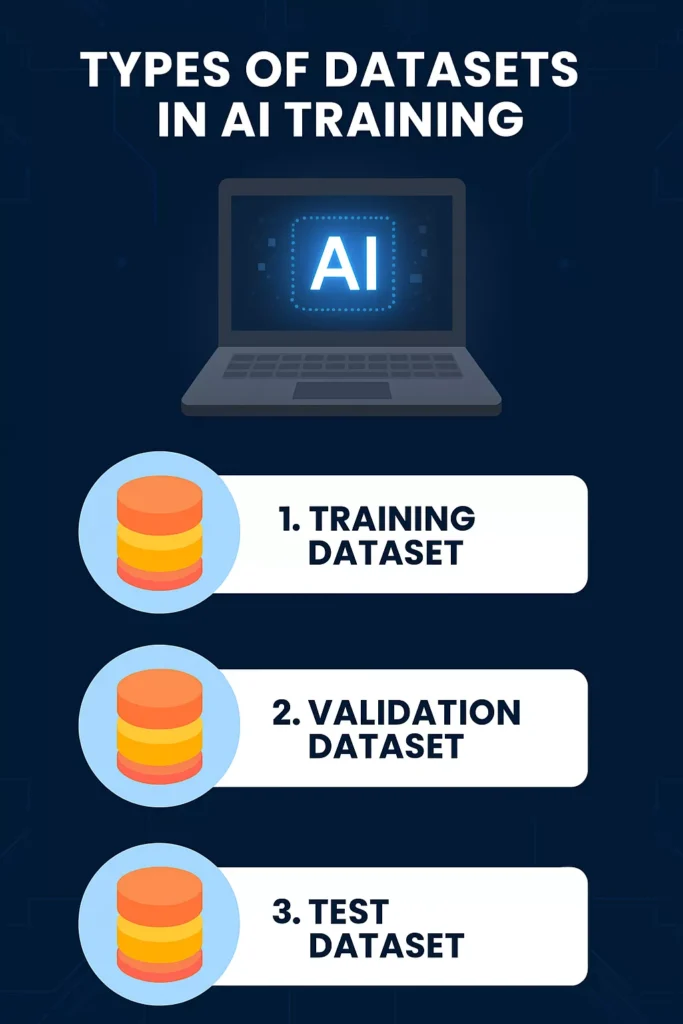
To truly understand how AI learns, you need to explore the three essential dataset types used during training. Each dataset plays a unique role, and together they shape how intelligent, accurate, and reliable an AI model becomes.
1. Training Dataset
The training dataset is the foundation of the entire learning process. It is the largest portion of data and contains the real examples that the AI studies again and again to understand patterns.
Why the Training Dataset Is So Important
This dataset provides the core learning material that helps AI:
- Detect features and characteristics
Such as shapes in images, keywords in text, or tones in audio. - Understand relationships between variables
For example, learning that price increases may relate to a specific trend. - Generate accurate predictions
Every decision the AI makes is influenced by what it learns here.
Real Example
Imagine you feed an AI one million labeled cat photos.
Through repetition, the AI learns what cats generally look like—their shape, color patterns, ears, eyes, and more.
This understanding comes entirely from the training dataset.
2. Validation Dataset
The validation dataset acts like a coach that evaluates the AI while it is still learning. It is not used to teach new concepts but to ensure the learning process is happening correctly.
Why the Validation Dataset Matters
It plays a critical role in fine-tuning the AI by:
- Identifying overfitting, where the AI memorizes training data instead of learning true patterns.
- Adjusting model settings and parameters so the AI learns efficiently.
- Improving the model’s accuracy before final testing begins.
A Simple Analogy
Think of it like taking mini-quizzes during a course.
You’re not learning new chapters—you’re checking if what you’ve learned is correct and identifying where improvements are needed before the real exam.
3. Test Dataset
The test dataset is used only after training is fully complete. This dataset acts as the final judge, evaluating how well the AI performs on brand-new, unseen data.
Purpose of the Test Dataset
It answers the most important questions:
- How accurate is the AI overall?
- Does the model generalize well to real-world cases?
- Is the system fair, dependable, and ready to be deployed?
Why It’s Crucial
A model isn’t considered production-ready unless it performs strongly on test data it has never encountered before.
This ensures the AI can handle real-life situations—not just examples it was trained on.
Major Types of Data Used in AI
AI systems are incredibly flexible—they can learn from almost any form of digital information. Each type of data teaches AI a different skill, allowing it to understand language, recognize images, process sounds, analyze numbers, and even interpret movement. Below are the most common and important dataset types that power today’s AI technologies.
A. Text Datasets
Text datasets form the backbone of many AI applications that work with language. They provide written content that helps AI understand how humans communicate.
Where Text Data Comes From
AI studies millions of pieces of text, such as:
- Articles and blog posts
- Emails and messages
- Books and research papers
- Social media comments and captions
What AI Learns from Text
From these examples, AI learns:
- Grammar and sentence structure
- The meaning of words and phrases
- Emotional tone and sentiment
- Intent behind a user’s query
- How to respond naturally and accurately
Text datasets are crucial for chatbots, translation systems, virtual assistants, search engines, and AI writing tools.
B. Image Datasets
Image datasets allow AI to understand the visual world. These collections contain labeled photos, diagrams, or scans that help computer vision models learn how to recognize patterns and objects.
What AI Learns to Identify
Through image datasets, AI can detect:
- Everyday objects like dogs, cars, or furniture
- Human faces and expressions
- Medical imaging insights (e.g., tumors or fractures)
- Road signs for autonomous vehicles
- Products on shelves for retail automation
Each image is labeled with information such as “cat,” “person,” “stop sign,” or “tumor detected,” which teaches AI what these items look like from different angles and lighting conditions.
C. Audio Datasets
Audio datasets contain recordings of speech, music, environmental sounds, and more. They help AI interpret and respond to sounds just as humans do.
Applications of Audio Data
AI trained on audio datasets is used for:
- Speech recognition tools
- Smart voice assistants (e.g., Siri, Alexa)
- Music and sound analysis
- Emotion and tone detection in customer calls
What AI Learns From Audio
These datasets teach AI to understand:
- Pitch and tone
- Language, accents, and pronunciation
- Background noise vs. human speech
- Emotional cues in voice
This makes audio datasets essential for creating conversational and interactive AI.
D. Video Datasets
Video datasets combine images, motion, and sound, making them incredibly rich sources of information. They are essential for AI systems that must interpret real-time environments.
Where Video Data Is Used
AI trained on video datasets powers:
- Autonomous vehicles that detect movement and obstacles
- Robotics systems that track human gestures
- Surveillance models that detect unusual activities
- Sports and motion analysis tools
Why Video Data Is Powerful
Videos teach AI:
- How objects move over time
- How events unfold in sequences
- How to track motion and predict behavior
This level of understanding goes far beyond single images, enabling real-world decision-making.
E. Numerical Datasets
Numerical datasets consist of rows and columns filled with numbers—similar to spreadsheets. These datasets are structured, easy to process, and extremely useful for analytical AI models.
Common Uses
Numerical data is widely used in industries such as:
- Finance (market trends, stock predictions)
- Weather forecasting (temperature, humidity, wind patterns)
- Scientific research
- Business analytics
What AI Learns From Numbers
With numerical data, AI can:
- Identify trends
- Detect anomalies
- Make mathematical predictions
- Generate forecasts with high accuracy
These datasets are the backbone of predictive modeling.
How Datasets Are Created for AI
Building a high-quality dataset is often more challenging and time-consuming than creating the AI model itself. The process involves multiple steps to ensure that the data is accurate, meaningful, and truly useful for machine learning. A well-prepared dataset can dramatically improve the intelligence and reliability of an AI system, while a poorly prepared one can ruin its performance.
Dataset Creation Steps
1. Data Collection
The first step is gathering raw data from various trusted sources. These may include:
- Sensors and IoT devices
- Websites and public datasets
- Customer surveys and forms
- System logs and transaction records
- Medical imaging and patient records
- Business databases
The goal is to collect enough diverse and relevant information for the AI to learn effectively.
2. Data Cleaning
Raw data usually contains imperfections. Cleaning the data ensures the AI model learns from accurate and consistent information by:
- Removing errors or incorrect entries
- Eliminating duplicate records
- Filling in or handling missing values
- Filtering out irrelevant or noisy data
Clean data is essential to avoid misleading the AI.
3. Annotation & Labeling
This step gives meaning to the data. Human annotators or AI-assisted tools carefully label the collected information.
Examples include:
- Identifying objects in images
- Tagging emotions in audio
- Categorizing text into topics
- Marking actions in videos
Accurate labeling ensures the model understands what each piece of data represents.
4. Formatting & Structuring
Once labeled, the data must be organized in a format the AI model can process. This involves:
- Standardizing file types
- Converting text into tokens
- Organizing images into folders
- Structuring numerical data into tables
A well-structured dataset speeds up training and reduces errors.
5. Balancing the Dataset
A balanced dataset prevents the AI from developing bias. This step ensures:
- Equal representation of categories
- Fair distribution of demographic groups
- Avoidance of over-representation
- Inclusion of all possible scenarios
Balanced datasets help the AI make fair and accurate predictions.
Why Dataset Quality Is Critical
The quality of the dataset directly determines how well the AI performs. If the dataset contains errors, bias, or outdated information, the resulting model will also behave inaccurately.
A strong dataset is:
- Clean — free from noise, errors, or contradictions
- Diverse — covering a wide range of real-world examples
- Balanced — representing categories fairly
- Up-to-date — reflecting current patterns and environments
- Representative — mirroring real-world situations the AI will encounter
Good data leads to good AI. Poor data leads to unreliable, biased, or ineffective AI systems.
Real-World Examples of Popular Datasets
To understand how AI becomes smarter, it’s helpful to look at the real datasets that power today’s most advanced models. These well-known datasets have shaped the development of computer vision, speech recognition, language understanding, and more. Each one has played a key role in pushing AI research and real-world applications forward.
i) ImageNet
One of the most influential datasets in AI history, ImageNet contains over 14 million labeled images.
It is widely used to train models that recognize everyday objects, animals, and scenes.
ImageNet helped revolutionize computer vision and sparked breakthroughs in deep learning.
ii) COCO (Common Objects in Context)
COCO is a rich dataset designed for more advanced tasks such as object detection, segmentation, and image labeling.
It includes everyday scenes with multiple objects interacting, helping AI understand context—not just isolated items.
iii) LibriSpeech
LibriSpeech is a massive audio dataset built from thousands of hours of public-domain audiobooks.
It is one of the most popular datasets for training speech recognition models, helping AI learn how humans speak in natural conditions.
iv) MNIST
MNIST is a classic dataset containing 70,000 handwritten digits.
Though simple, it is commonly used to teach beginners how machine-learning models work. It’s the “hello world” of AI datasets.
v) Wikipedia + WebText
These are enormous text datasets made from millions of articles, webpages, and written content.
They are used to train language models, helping AI understand grammar, context, meaning, and human communication patterns.
What Makes a Good Dataset for AI
A great dataset is the foundation of any reliable AI system. Not all collections of data are created equal—quality matters at every step, from how the information is recorded to how well it reflects the real world the model will operate in. Below are the core principles that turn raw records into training gold.
Core Principles of a High-Quality Dataset
- Accuracy
Data must reflect reality. Each entry should represent facts correctly and be free from transcription errors, mislabeled examples, or systemic measurement mistakes. When accuracy slips, models learn the wrong patterns and produce unreliable or even harmful outputs.
- Consistency
A dataset should use a uniform format and structure across all entries. Consistent units, naming conventions, and annotation rules make it easier for models to learn meaningful relationships and for engineers to preprocess data without introducing errors.
- Completeness
Missing values and gaps weaken a model’s ability to generalize. A complete dataset either contains the necessary features for the task or documents why certain fields are absent, enabling robust handling of missingness during training and evaluation.
- Diversity
AI must be trained on examples that span different conditions, populations, and environments. Diversity prevents blind spots: when models see varied scenarios during training, they perform more reliably across real-world situations and reduce the risk of unfair or brittle behavior.
- Relevance
Every feature and example should be aligned with the task the AI is intended to solve. Irrelevant or noisy data dilutes learning signals and increases training time; relevant data sharpens the model’s focus on what truly matters for the problem at hand.
- Balance
A balanced dataset avoids overrepresentation of any single class, group, or scenario. When one type dominates, the model becomes biased toward it; careful sampling, augmentation, or weighting helps ensure fairer, more accurate predictions across categories.
How Datasets Impact AI Performance
The quality of a dataset directly determines how well an AI system performs. A powerful model is only as good as the data it learns from. Here’s how different aspects of a dataset influence the final outcome:
1. Better Dataset = Higher Accuracy
When an AI is trained on a rich, diverse, and well-labeled dataset, it learns deeper patterns and understands real-world scenarios more effectively.
This results in more accurate predictions, fewer mistakes, and stronger overall performance.
2. Poor Dataset = Unreliable AI
If the dataset contains bias, errors, missing values, or misleading examples, the AI will absorb these flaws.
This leads to inaccurate results, unfair decisions, and unpredictable behavior.
In short: bad data creates bad AI.
3. Larger Dataset = More Knowledge
Deep learning models improve significantly when exposed to large amounts of data.
The more examples the AI sees, the better it becomes at recognizing variations, handling edge cases, and generalizing to new situations.
A bigger dataset means broader knowledge and stronger learning.
4. Clean Data = Faster Training
Well-prepared data reduces the amount of correction and processing needed during training.
This helps models learn more efficiently, speeds up training time, and minimizes computational costs.
Clean data = faster learning + better results.
Challenges in Building AI Datasets
Creating datasets for AI is still one of the toughest parts of building reliable systems. Even with better tools and more data than ever, teams run into practical, ethical, and technical roadblocks that can undermine model performance and trust.
Data Privacy
Sensitive information—medical records, financial details, or personal identifiers—must be guarded at every step. Protecting privacy isn’t just a legal requirement; it affects how data can be collected, shared, and used, and it shapes what kinds of models are even possible.
Data Bias
When a dataset overrepresents certain groups, locations, or scenarios, the model learns skewed patterns and produces unfair outcomes. Bias can be subtle and baked into labels, sampling methods, or historical sources, so spotting and correcting it is essential for fair, trustworthy AI.
High Cost of Annotation
Labeling images, video, audio, and complex text often demands thousands of human hours and domain expertise. That time and expense slow development, limit iteration, and make high-quality supervised learning projects expensive to scale.
Data Scarcity
Some domains—rare diseases, niche industrial faults, or uncommon languages—simply don’t have enough examples to train robust models. Scarcity forces teams to rely on synthetic data, transfer learning, or creative partnerships, each with trade-offs.
Constant Updates Needed
Real-world conditions change: user behavior shifts, regulations evolve, and new edge cases appear. Datasets that aren’t refreshed become stale, and models trained on them lose accuracy and relevance over time.
How Datasets Shape the Future of AI
As AI continues to advance, the datasets powering these systems must evolve alongside them. The future of AI will be shaped not just by smarter algorithms, but by smarter, richer, and more dynamic data sources. Below are the key trends that will redefine how datasets are created and used.
Future Trends
- Synthetic Datasets
AI-generated data to fill gaps and reduce costs. - Real-Time Data Streaming
Continuous learning from live information. - Privacy-Preserving Data
Techniques like federated learning to protect user information. - Multimodal Datasets
Combining text, images, audio, and sensor data for richer AI understanding. - Self-Labeled Data
AI models assisting in their own dataset creation.
The future of AI depends on better, more diverse, and more intelligent data sources.
Conclusion
A dataset is the essential foundation of AI training.
It acts as the “learning material” that helps AI understand the world, recognize patterns, make decisions, and continuously improve. With high-quality datasets, AI systems become more accurate, fair, and powerful. As the world moves toward more advanced technologies like autonomous agents, robots, and large language models, datasets will remain the core element driving innovation.
Understanding how datasets work is not only important for developers—it’s essential for anyone who uses or relies on AI in everyday life.
FAQs
1. What is a dataset in simple terms?
A dataset is a collection of organized information—such as text, images, numbers, or audio—that is used for analysis, research, or training AI models. It’s essentially the data that helps machines learn patterns and make predictions.
2. Why are datasets important in AI and machine learning?
Datasets are critical because AI models learn entirely from the examples they contain. The better and more diverse the dataset, the more accurate, fair, and intelligent the AI becomes.
3. What are the main types of datasets used in AI?
AI commonly uses three types of datasets:
- Training dataset for learning patterns
- Validation dataset for tuning and improving accuracy
- Test dataset for evaluating real-world performance
4. What makes a dataset high quality?
A good dataset is clean, accurate, diverse, balanced, up-to-date, and representative of real-world situations. Poor-quality data leads to unreliable or biased AI models.
5. Where do datasets come from?
Datasets can be collected from websites, sensors, surveys, business systems, public repositories, scientific research, or even generated by AI itself (synthetic data).