
Agentic RAG is a next-generation AI framework that combines Retrieval-Augmented Generation (RAG) with autonomous AI agents so that models can think, plan, and take actions on their own—not just generate text. In simple terms, Agentic RAG is an AI system that retrieves accurate information and uses agent-like reasoning to decide what to do next, making it far more reliable, adaptive, and capable than traditional RAG or standalone LLMs.
This new approach represents a major shift toward self-directed, task-solving AI systems that can search, verify, execute, and refine their work without constant human input.
What Is Agentic RAG?
Agentic RAG (Agentic Retrieval-Augmented Generation) represents the next major advancement in how AI systems gather information, think, and execute tasks. Traditional RAG focuses on a single capability: retrieving relevant documents and passing them to a large language model to generate a response. While this improves accuracy, it is still limited because the model remains passive—it simply reacts to the information provided.
Agentic RAG goes far beyond this. It upgrades retrieval with multi-step reasoning, strategic planning, autonomous decision-making, and tool execution, allowing AI to behave much more like a real problem-solving agent. Instead of only generating text, the AI can break tasks into steps, evaluate options, run external tools, verify its own output, and refine the results.
Put simply:
- Traditional RAG = “Fetch useful information before answering.”
- Agentic RAG = “Fetch information → analyze → plan → execute tools → verify → refine → deliver accurate results.”
This transforms the AI from a simple answer generator into something closer to an AI researcher, assistant, or autonomous worker—capable of taking initiative, solving complex tasks, and continuously improving its output instead of relying on guesswork or one-shot responses.
Agentic RAG marks a fundamental shift from static chatbots to active, intelligent agents that can understand context, execute workflows, and deliver reliable, high-quality decisions.
Why Agentic RAG Matters in 2026 and Beyond
In 2026, AI is no longer judged by how well it generates text – it’s measured by how effectively it can handle real-world tasks. Modern businesses need AI systems that can search massive datasets, use tools, break problems into logical steps, verify their own answers, correct mistakes, and adapt strategies on the fly. Traditional RAG or standard LLMs simply cannot meet these demands.
This is where Agentic RAG becomes a game-changer.
It turns AI from a passive responder into an active problem solver—one that retrieves information, reasons independently, takes action, and continuously improves its output.
As organizations prioritize accuracy, autonomy, and deep domain understanding, Agentic RAG emerges as the foundation for the next generation of intelligent systems, including:
- Advanced AI agents
- Smart AI copilots
- Fully autonomous workflows
- Enterprise-wide knowledge assistants
- Domain-specific AI applications
In essence, Agentic RAG gives AI the ability to stop guessing and start acting with purpose, bringing us closer to truly intelligent, self-directed systems that can operate with the reliability businesses need.
How Agentic RAG Works (Step-by-Step)
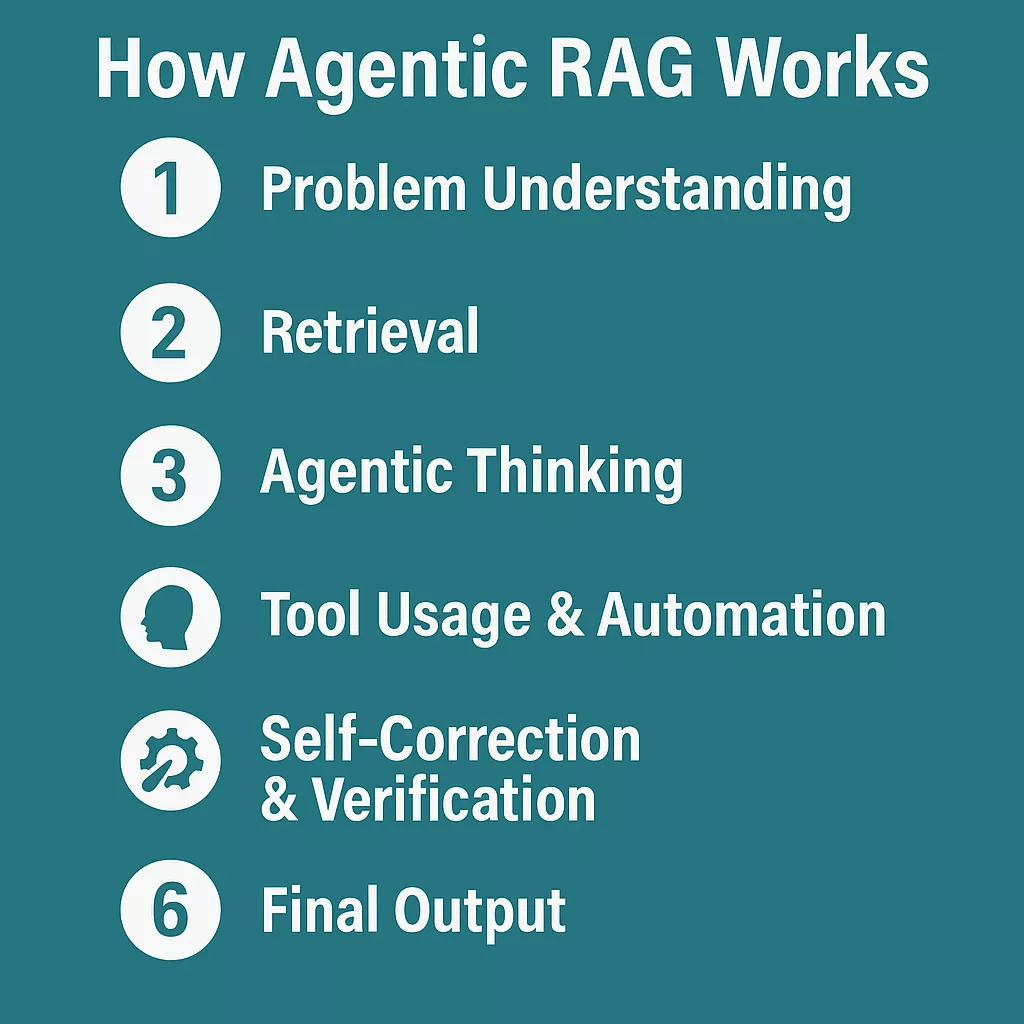
To understand the true power of Agentic RAG, imagine you’re watching a highly skilled AI assistant work through a complex task—not just generating answers, but thinking, planning, checking, and acting. Here’s how the process unfolds step by step.
1. Problem Understanding: The AI Figures Out What You Really Need
The moment you submit a request, Agentic RAG doesn’t jump straight to answering.
Instead, it pauses to interpret your intent and map out a plan.
It asks itself:
- What information do I need to solve this?
- What tasks should I break this into?
- Do I need to search, calculate, analyze, or use external tools?
This is the AI’s reasoning and planning phase—the moment when it transforms from a passive model into an intelligent agent ready to take action.
2. Retrieval: Finding the Most Relevant and Reliable Knowledge
Once the plan is set, Agentic RAG starts gathering information from the most trustworthy sources available.
Instead of relying solely on its internal training data, it pulls fresh, verified information from:
- Internal company databases
- Organizational knowledge bases
- PDF reports and internal documents
- APIs and data services
- Real-time web search
- Vector stores and embeddings
This ensures the AI is working with accurate, current, and context-specific knowledge—a critical step for high-stakes use cases.
3. Agentic Thinking: The AI Breaks the Task Into Logical Steps
After retrieving the right data, the system moves into its multi-step reasoning phase.
Here, the AI behaves almost like a human analyst or researcher.
It might follow steps like:
- Search a database
- Read and filter the results
- Summarize key findings
- Cross-check for accuracy
- Prepare the final output
This structured, sequential thinking dramatically increases reliability.
Instead of producing a quick guess, the AI follows a reasoning chain—helping it stay factual, logical, and consistent.
4. Tool Usage & Automation: The AI Doesn’t Just Think—It Acts
This is where Agentic RAG becomes truly powerful.
When required, it can call tools and perform actions automatically, including:
- Running search APIs
- Opening browser tools
- Performing calculations
- Querying SQL databases
- Executing code snippets
- Pulling CRM or ERP records
- Sending emails or initiating workflows
At this point, the AI stops being “chat-only” and becomes fully action-capable, turning conversations into real outcomes.
5. Self-Correction & Verification: The AI Checks Its Own Work
One of the biggest weaknesses of traditional AI models is that they don’t know when they’re wrong.
Agentic RAG solves this by actively verifying and correcting its own output.
It may:
- Re-run retrieval queries
- Compare multiple sources
- Identify contradictions
- Re-check calculations
- Add missing steps
- Rewrite incorrect portions
This built-in feedback loop makes the system far more trustworthy, especially for enterprise environments where accuracy is non-negotiable.
6. Final Output: Clear, Accurate, and Ready for Use
Once all reasoning, retrieval, verification, and tool actions are complete, Agentic RAG produces a final response that stands out for its:
- Accuracy – grounded in real data
- Citations – showing where the information came from
- Structure – logically organized and easy to understand
- Actionability – often backed by tools and tasks already executed
The result is not just an answer—it’s a high-quality, validated solution that aligns with enterprise standards.
Agentic RAG vs Traditional RAG vs LLMs
| Category | Agentic RAG | Traditional RAG | Standard LLMs |
|---|---|---|---|
| Core Concept | Combines retrieval with autonomous agents for reasoning, planning, and tool execution. | Enhances LLMs with retrieval of external documents before responding. | Large language models trained on vast data to generate text based on patterns. |
| Primary Strength | High accuracy with autonomous task execution and self-improvement. | Reduces hallucinations by grounding responses in retrieved documents. | Fast, creative text generation without external retrieval. |
| How It Works | Retrieves data → reasons multi-step → uses tools → verifies output → delivers action-backed results. | Retrieves relevant documents → feeds them into the LLM → produces a single-shot answer. | Generates responses based only on training data and user prompt. |
| Autonomy Level | High – can plan tasks, call tools, and act independently. | Low – retrieval-only, passive after data is fetched. | None – purely reactive, no retrieval or planning. |
| Reasoning Capability | Advanced multi-step reasoning with chain-of-thought and validation loops. | Moderate reasoning based on retrieved inputs. | Basic pattern-based reasoning; prone to hallucinations. |
| Tool Usage | Yes – APIs, databases, browsers, SQL, calculators, workflows, etc. | No – cannot interact with tools. | No – limited to text generation only. |
| Self-Correction | Strong – verifies sources, re-runs queries, refines output. | Weak – depends on retrieval quality and LLM output. | None – does not validate or correct mistakes. |
| Accuracy | Highest – retrieval + reasoning + verification. | Good – grounded with external knowledge. | Moderate – based on training data; hallucinations possible. |
| Use of Real-Time Data | Full – can call tools/API for live updates. | Limited – depends on retrieval setup. | None – cannot access live data. |
| Complex Task Handling | Excellent – can break tasks into steps and complete them end-to-end. | Moderate – provides information but cannot execute tasks. | Poor – limited to simple Q&A and text generation. |
| Enterprise Use Cases | Workflows, automation, analytics, customer ops, compliance, multi-agent systems. | Customer support search, Q&A assistants, knowledge retrieval. | Blog writing, brainstorming, drafting, general conversation. |
| Reliability | Very High – verified, contextual, and outcome-driven. | Medium – depends on retrieval accuracy. | Low to Medium – may fabricate facts. |
| Interpretation of User Intent | Advanced – plans based on intent and context. | Basic – focuses on retrieving relevant documents. | Basic – relies purely on training patterns. |
| Scalability for Business | High – supports automation, workflows, and agent ecosystems. | Medium – good for knowledge-heavy tasks. | Low – requires human oversight. |
| Infrastructure Needs | Higher – requires orchestration, tools, vector stores, agents. | Moderate – vector database + LLM. | Low – only the LLM model. |
| Ideal For | Enterprises needing accuracy, automation, real-time decision-making. | Businesses needing reliable Q&A and search-augmented chat. | Creative writing, casual use, or early ideation. |
| Limitations | Complex to build and requires robust engineering. | Retrieval quality can limit effectiveness. | Prone to hallucinations; lacks real-time knowledge. |
Real-World Use Cases of Agentic RAG
Agentic RAG is no longer an experimental concept—it’s quickly becoming the backbone of next-generation AI systems across nearly every industry. By blending retrieval, reasoning, and autonomous action, it empowers organizations to automate complex workflows, improve accuracy, and deliver intelligence at scale. Below are some of the most impactful real-world applications reshaping how businesses operate.
1. Autonomous Customer Support
Traditional chatbots can only provide scripted answers, but Agentic RAG transforms customer support into a fully automated, context-aware experience.
With agentic capabilities, the AI can:
- Pull customer profile data
- Check past orders and current order status
- Process refunds or replacements
- Update CRM records
- Trigger emails, alerts, or tickets
- Follow up automatically
The result is customer support that feels personalized, quick, and accurate, reducing workload on human teams while improving customer satisfaction.
2. Enterprise Knowledge Assistants
Large enterprises often struggle with scattered information spread across documents, systems, and departments.
Agentic RAG functions like a supercharged internal knowledge employee—one that never gets tired, forgets, or misplaces information.
It can:
- Search internal databases and wikis
- Read and interpret PDFs, policies, and technical documents
- Query CRMs and ERPs in real time
- Apply compliance and regulatory rules
- Summarize complex information in seconds
This makes it invaluable for training, onboarding, decision-making, and ensuring consistency across large teams.
3. Financial & Legal Research
The finance and legal sectors depend heavily on precise, verifiable information. Agentic RAG excels here because it retrieves, analyzes, and validates data before producing answers.
Professionals can use it to:
- Extract legal clauses from contracts
- Review and compare court rulings
- Analyze financial statements
- Check regulatory compliance
- Identify anomalies or risks
- Draft detailed summaries or briefs
Because the system verifies its sources and cross-checks facts, it delivers far more reliable results than a traditional LLM that generates text based on memory alone.
4. Business Process Automation
Agentic RAG is revolutionizing business operations by acting as a self-sufficient automation engine.
It can independently perform tasks such as:
- Creating detailed performance reports
- Pulling live data from internal systems
- Generating dashboards and visualizations
- Sending automated email updates
- Scheduling or triggering workflows
- Preparing meeting notes or summaries
By eliminating repetitive manual processes, it allows teams to focus on strategy and innovation rather than tedious operations.
5. Coding Assistants & DevOps Automation
In engineering environments, Agentic RAG becomes far more than a code generator—it becomes a true developer assistant and automation partner.
It can:
- Search documentation and codebases
- Debug errors with step-by-step reasoning
- Run automated tests
- Retrieve system logs
- Suggest optimized code improvements
- Execute deployment tasks or run scripts
This drastically accelerates development cycles and reduces errors, making it a powerful tool for software teams aiming for high velocity.
6. Data Analysis & Decision-Making
Leaders and analysts often need insights quickly, and Agentic RAG delivers them with high accuracy by combining retrieval with logical reasoning.
Executives can ask questions like:
- “Why did customer churn increase this quarter?”
- “What caused the sales dip in Q3?”
- “Which transactions look suspicious?”
Agentic RAG will:
- Retrieve data from analytics platforms
- Analyze patterns
- Identify anomalies
- Cross-check insights
- Deliver concise, decision-ready summaries
This makes it a powerful decision-support system for executives, analysts, and operations teams.
Benefits of Agentic RAG
Agentic RAG introduces a new level of intelligence, control, and reliability to AI systems. By combining retrieval, reasoning, autonomy, and verification, it offers powerful advantages that traditional RAG and standard LLMs simply cannot match. Below are the key benefits explained in a more detailed and engaging way.
i. Higher Accuracy
Agentic RAG significantly boosts accuracy by blending retrieval with multi-step reasoning.
Instead of relying on generic training data, it:
- Searches for real, verified information
- Cross-checks multiple sources
- Uses reasoning steps to validate facts
- Reduces or eliminates hallucinations
This makes the system highly dependable, especially for industries where precision is critical—such as finance, healthcare, research, and legal operations.
ii. Autonomy
One of the biggest strengths of Agentic RAG is its ability to act independently.
The system behaves like a digital worker that can:
- Execute tasks without human intervention
- Call APIs and external tools
- Run calculations, queries, and workflows
- Perform end-to-end processes
This autonomy helps businesses save time, reduce manual labor, and speed up operations across teams.
iii. Context-Aware Responses
Agentic RAG doesn’t just retrieve information; it understands the environment the user is working in.
It can adjust its output based on:
- User intent
- Company data
- Previous interactions
- Domain-specific rules
- Real-time context
As a result, its responses feel smarter, more personalized, and truly aligned with the user’s needs.
iv. Scalable to Complex Tasks
While traditional AI systems struggle with multi-step operations, Agentic RAG is designed for complexity.
It can manage tasks such as:
- Troubleshooting issues
- Research and analysis
- Multi-step workflows
- Enterprise processes
- Cross-system automation
This scalability makes it ideal for large organizations with evolving workflows and sophisticated requirements.
v. Real-Time Decision-Making
In fast-moving environments, speed matters.
Agentic RAG enables immediate reasoning and action, allowing it to:
- Search databases instantly
- Analyze patterns and anomalies
- Generate quick insights
- Execute high-speed decisions
This real-time intelligence is extremely valuable in sectors like cybersecurity, operations, logistics, and finance.
vi. Better Alignment & Safety
Agentic RAG is built with strong self-validation capabilities, making it far safer than traditional LLMs.
It improves safety by:
- Re-checking its own outputs
- Identifying contradictions
- Correcting mistakes
- Avoiding unsupported claims
- Maintaining regulatory and compliance alignment
This results in more trustworthy and reliable outputs, which reduces operational risks for organizations.
Challenges of Agentic RAG
1. High Engineering Complexity
- What it is: Designing agentic Retrieval-Augmented Generation (RAG) systems means orchestrating multiple components—retrieval pipelines, reasoning agents, tool integrations, and state management—so they work together reliably.
- Why it matters: Each component introduces its own failure modes and integration points. Engineers must handle asynchronous tool calls, design robust prompts and control flows, manage context windows, and ensure agents make safe, coherent decisions across multi-step tasks.
- Consequences: Without deep expertise, projects stall on brittle prototypes, debugging becomes time-consuming, and scaling from research demos to production-grade systems often requires substantial reengineering.
2. Cost and Infrastructure Requirements
- What it is: Agentic RAG frequently invokes external tools, runs multiple model calls per user request, and maintains indexing and caching layers—each of which consumes compute, storage, and network resources.
- Why it matters: Multi-step reasoning and tool chaining multiply inference costs and increase latency. High-throughput deployments need autoscaling, observability, and failover strategies, which raise operational expenses and complexity.
- Consequences: Teams face trade-offs between responsiveness, accuracy, and budget; small organizations may find the required infrastructure prohibitive, and cost overruns can undermine long-term viability.
3. Retrieval Quality Depends on Data
- What it is: The effectiveness of RAG hinges on the relevance and accessibility of the underlying knowledge store—how documents are indexed, annotated, and updated.
- Why it matters: Messy, poorly structured, or stale data leads to weak retrieval signals, which in turn produce hallucinations, irrelevant answers, or inconsistent agent behavior. Even sophisticated reasoning cannot fully compensate for low-quality inputs.
- Consequences: Organizations must invest in data curation, metadata standards, and continuous indexing pipelines; otherwise, user trust erodes as agents return incorrect or outdated information.
4. Difficult to Evaluate
- What it is: Agentic systems produce dynamic, multi-step outputs that depend on intermediate tool calls, external state, and non-deterministic model behavior.
- Why it matters: Traditional evaluation metrics and static test sets struggle to capture correctness, safety, and usefulness across entire agent workflows. Human review is costly and slow, while automated scoring often misses contextual failures or subtle errors.
- Consequences: Measuring progress, comparing models, and enforcing quality gates become challenging; teams must design new evaluation frameworks that combine scenario-based testing, instrumentation of agent decisions, and targeted human-in-the-loop audits.
The Future of Agentic RAG (2025–2030)
The next five years will mark a dramatic shift in how AI is designed, deployed, and experienced. Agentic RAG will not merely enhance existing systems—it will become the core foundation of a new, interconnected AI ecosystem. This era will be defined by autonomous agents, intelligent workflows, and AI systems that can think, act, and evolve independently. Here’s what the future looks like.
1. Fully Autonomous AI Agents
By 2030, AI agents will operate with a level of independence that feels revolutionary. These systems will be able to:
- Browse the web on their own
- Execute software tasks end-to-end
- Manage operations across tools and platforms
- Make rational, evidence-based decisions
- Identify and fix errors without human help
- Collaborate seamlessly with other AI agents
This evolution will fundamentally reshape workflows. Instead of humans micromanaging AI, companies will rely on autonomous agents that act like digital employees—handling research, operations, analysis, and decision-making with little to no oversight.
2. AI Operating Systems Become the New Backbone
Organizations will begin running centralized AI Operating Systems (AI OS layers)—platforms that allow:
- Retrieval mechanisms
- Tool integrations
- Autonomous agents
- Multiple models
to operate together in a unified environment.
These AI OS layers will coordinate:
- Workflows
- Knowledge retrieval
- Decision pipelines
- Multi-agent collaboration
- Enterprise-wide automation
In many ways, they will become the new nervous system for modern organizations.
3. Real-Time Multi-Agent Systems
Companies will deploy teams of AI agents, each specializing in different functions, working together in real time. For example:
- Sales agents analyzing leads
- Finance agents monitoring budgets
- Support agents handling tickets
- Data analysis agents identifying trends
These agents will communicate with each other, share insights, delegate tasks, and produce results faster than any human team could.
Autonomous collaboration will become the standard, enabling businesses to run operations around the clock with near-zero latency and maximum precision.
4. The End of Traditional Chatbots
Static, scripted, or rule-based chatbots will disappear entirely. They will be replaced by intelligent, adaptive systems such as:
- Reasoning agents that think through problems
- Planning agents that create multi-step strategies
- Workflow agents that execute business processes
- Research agents that gather and validate information
Chat itself will become just one interface among many.
Behind the scenes, these agents will handle complex tasks that were once impossible for chatbots—transforming AI from conversational helpers into true digital workforce systems.
5. The Rise of Self-Improving AI Systems
Future Agentic RAG systems won’t just perform tasks—they will learn from every action they take.
They will have the ability to:
- Analyze their own mistakes
- Improve retrieval strategies
- Refine reasoning steps
- Adapt workflows based on outcomes
- Continuously enhance accuracy and speed
This creates an AI ecosystem that becomes smarter day by day, evolving in real time without requiring constant human retraining.
Why Agentic RAG Matters for Modern Businesses
Today’s businesses operate in fast-changing environments where decisions must be accurate, fast, and data-driven. For this, companies need AI systems that are:
- Accurate, delivering dependable, fact-checked answers
- Flexible, able to adapt to different tasks and workflows
- Secure, protecting sensitive data and operating within compliance frameworks
- Scalable, capable of supporting teams, departments, and entire enterprises
- Domain-specific, understanding industry rules, terminology, and internal knowledge
Agentic RAG solves all of these challenges simultaneously.
Its blend of retrieval, autonomous reasoning, tool execution, and self-correction makes it the most reliable architecture for enterprise-grade AI.
Because of this, Agentic RAG is quickly becoming the gold standard for:
- Enterprise AI systems
- Knowledge management assistants
- Workflow and process automation
- Data-driven decision support tools
- Enhanced customer experience platforms
- Productivity and operational efficiency solutions
Organizations that adopt Agentic RAG early will gain a significant competitive advantage, leading the next wave of AI-powered business transformation.
Check Also: Agentic AI Pindrop Anonybit: Shaping the Future of Digital Trust
Conclusion
Agentic RAG marks a major leap forward in AI evolution. By merging retrieval, multi-step reasoning, autonomous agents, verification, and tool automation, it goes far beyond traditional chat models—enabling AI systems that can act, optimize, and deliver real results.
Agentic RAG-powered systems can:
- Reason through complex, multi-step problems
- Verify information before responding
- Use tools and APIs to execute tasks
- Self-correct and refine outputs
- Solve real-world challenges with high reliability
As businesses shift toward fully AI-driven operations, Agentic RAG becomes the backbone behind customer support, automation, research, financial analysis, and developer workflows. We’ve entered a new era where AI doesn’t just answer—it plans, collaborates, and improves continuously.
In essence, Agentic RAG isn’t just an upgrade – it’s the beginning of truly autonomous AI systems that will redefine how work happens in the future.