

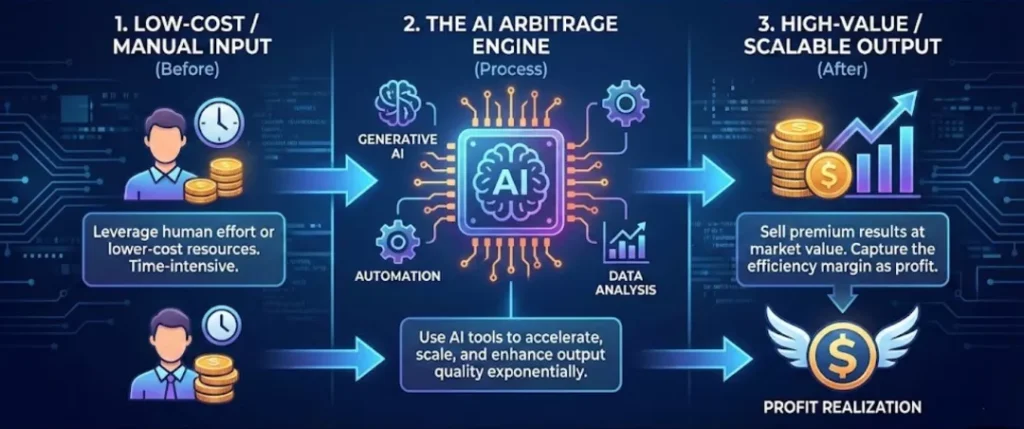
AI Arbitrage is the practice of leveraging the massive efficiency gap between the low cost of AI-generated output and the high market value of human-verified results. In simple terms, it involves using artificial intelligence tools to perform high-value digital tasks—such as coding, copywriting, graphic design, or data analysis—at a fraction of the time and cost it would take a human, while selling the final result at current market rates. The “arbitrage” profit comes from the difference between the minimal expense of running the AI (often just a monthly subscription) and the premium price clients are willing to pay for the finished product.
The Mechanics of the “Efficiency Gap”
To truly understand how people are profiting, you have to look at the unit economics of digital work. For decades, the “price” of a service was inextricably linked to the time it took to produce. If a lawyer charged $500 for a contract, it was because it took them three hours to draft it.
AI breaks this link.
In an AI Arbitrage model, the value is decoupled from time. If an AI tool can draft that same contract in 30 seconds, but the client still perceives the value of the legal document as $500, the provider captures nearly 100% of that value as profit. This is not just about doing things faster; it is about exploiting a temporary market inefficiency where the world has not yet adjusted its pricing expectations to match the new speed of production.
The Three Pillars of AI Arbitrage
While there are countless ways to apply this, successful AI arbitrage usually falls into one of three distinct categories.
1. Service Arbitrage (The “Drop-Servicing” Evolution)
This is the most common form of AI arbitrage for freelancers and agencies. It involves offering services on platforms like Upwork, Fiverr, or direct-to-client, where the deliverable is digital.
- The Workflow: A freelancer accepts a job to write a 2,000-word SEO article for $150.
- The Arbitrage: Instead of writing it from scratch (taking 4-5 hours), they use an advanced LLM (Large Language Model) like Claude 3.5 or GPT-4 to generate a high-quality draft in minutes.
- The Value Add: The human then spends 30 minutes fact-checking, adding personal anecdotes, and refining the tone.
- The Profit: They earn $150 for roughly 40 minutes of work, effectively raising their hourly rate from $30/hr to over $200/hr.
2. Content Asset Arbitrage
This involves building assets that generate passive income. Historically, building a niche website with 500 articles required hiring a team of writers (costing $20,000+) or years of personal effort.
- The Workflow: An entrepreneur identifies a high-traffic, low-competition niche (e.g., “indoor gardening for apartments”).
- The Arbitrage: They use programmatic SEO and AI writing tools to generate thousands of helpful, answer-based articles.
- The Profit: The site attracts traffic via Google, generating ad revenue. The cost to produce the content was pennies per article, but the ad revenue is paid out based on human viewership rates.
3. Financial & Data Arbitrage
This is a more technical form, often used in crypto or stock trading.
- The Workflow: Traders use custom AI scripts to monitor news sentiment or price discrepancies across different exchanges.
- The Arbitrage: An AI agent spots that Bitcoin is trading for $10 less on Exchange A than Exchange B. It executes a buy and sell order simultaneously, faster than any human could click a mouse.
- The Profit: The profit per trade is small, but the AI executes this thousands of times per day, accumulating significant gains.
Real-World Business Models: How People Are Cashing In
Let’s look at specific “playbooks” that are currently working in the market.
The “AI Agency” Model
Traditional marketing agencies sell hours. “We will dedicate 10 hours a month to your social media.” The AI Agency sells outcomes.
- Offer: “We will generate 50 qualified leads per month.”
- Execution: The agency uses AI tools to scrape leads, personalize cold emails, and even use AI voice agents to make initial calls.
- Why it works: The client doesn’t care how the leads are found, only that they are qualified. The agency uses tools that cost $100/month to do work that used to require a $60,000/year employee.
The Translation & Localization Flip
Global businesses need content in multiple languages.
- Old Way: Hire a translator for $0.15 per word.
- AI Arbitrage Way: Use DeepL or specialized translation AIs to do 90% of the work. Hire a native speaker only for the final “cultural check.”
- Profit: You can charge slightly below market rates to win volume, while your costs are 80% lower than competitors.
Code Conversion & Refactoring
Many companies have old code (COBOL, older Python versions) that needs updating.
- The Hustle: Developers offer “legacy code modernization” services.
- The Tool: AI coding assistants (like GitHub Copilot or Cursor) are incredibly good at translating code from one language to another.
- The Profit: A project estimated to take a month of manual coding can often be done in a few days, but the billing reflects the complexity of the task, not the ease of the tool.
Recent Statistics: The State of AI Adoption (2025-2026)
To understand the scale of this opportunity, we must look at the data. As of early 2026, the gap between AI capabilities and small business adoption remains the “sweet spot” for arbitrageurs.
| Metric | Traditional Workflow | AI Arbitrage Workflow | Improvement Factor |
| Blog Post Creation | 4 hours / $100 cost | 20 mins / $2 cost | 12x Faster / 50x Cheaper |
| Logo Design Concepts | 3 days / $300 cost | 10 mins / $0.50 cost | 400x Faster / 600x Cheaper |
| Social Media Calendar | 5 hours planning | 15 mins planning | 20x Faster |
| Customer Support | $20/hr per agent | $0.10 per resolution | 200x Cheaper |
Key Market Stats:
- Adoption Lag: While 90% of Fortune 500 companies use AI, only 22% of small businesses have fully integrated AI into their daily workflows. This 78% gap is where the arbitrage opportunity lies—serving small businesses who don’t know how to use the tools themselves.
- Freelance Shift: A 2025 survey of Upwork top-earners revealed that 64% admit to using AI tools to assist with their deliverables, yet only 15% explicitly market themselves as “AI-powered.”
- Productivity Boom: Goldman Sachs estimates that AI tools have increased the productivity of the average knowledge worker by 40%, yet hourly wages have not dropped, effectively increasing the profit margin for the worker.
The “Human in the Loop”: Why Pure AI Fails
It is critical to note that AI Arbitrage is not about copy-pasting raw AI output. That is a recipe for failure. The market is already flooded with low-quality, “slop” content that is obviously written by bots.
The “Cyborg” Approach The most profitable arbitrageurs operate as “Cyborgs”—part machine, part human.
- The Machine does the heavy lifting: research, drafting, coding basics, pattern recognition.
- The Human provides the high-value touch: strategy, empathy, emotional intelligence, complex problem solving, and quality assurance.
If you simply send a client a raw ChatGPT article, they will fire you. If you send them an article that was researched by Perplexity, drafted by Claude, and then edited for voice and flow by you, they will love it—and they won’t care how it was made.
Ethical Considerations and Risks
Is this ethical? This is the most debated question in the industry.
1. The Transparency Issue If a client pays you for a “hand-crafted” logo, and you generate it in Midjourney, are you scamming them? Most ethical guidelines suggest that the outcome is what matters, but transparency is safer.
- Ethical Approach: “I use advanced tools to speed up my workflow, allowing me to deliver high-quality results faster than competitors.”
- Unethical Approach: Lying and claiming you spent 20 hours drawing something that took 20 seconds.
2. Copyright and Ownership AI-generated images and text currently sit in a legal grey area regarding copyright. In the US, purely AI-generated works cannot be copyrighted. This poses a risk for clients who need to own the IP (Intellectual Property) of their assets. Arbitrageurs must understand these laws to avoid selling “un-ownable” work to clients.
3. The “Race to the Bottom” Eventually, AI arbitrage will normalize. As more people do it, prices will drop. The $150 article will eventually become a $20 article as the market corrects itself. Arbitrage is, by definition, a temporary window of opportunity. The long-term winners will be those who use AI to offer better services, not just cheaper ones.
A Step-by-Step Guide to Starting Your First Arbitrage
If you want to test this concept, here is a simple, low-risk path to your first dollar.
Step 1: Choose a High-Volume, Low-Creativity Niche Avoid high-art poetry or complex strategy. Look for repetitive digital tasks.
- Examples: Transcribing YouTube videos into blog posts, writing real estate listing descriptions, creating Pinterest pin variations.
Step 2: Build Your “Stack” Don’t just use ChatGPT. Build a workflow.
- Example Workflow for Real Estate: Use Zillow (for data) + Claude 3 (for writing descriptions) + Canva AI (for enhancing photos).
Step 3: The “Sample” Strategy Don’t ask for work; show it.
- Go to a YouTuber who has great videos but no blog.
- Use AI to turn their latest video into a formatted, SEO-optimized blog post.
- Email them: “Hey, I loved your video. I took the liberty of turning it into a blog post for you. Here it is for free. If you like it, I can do this for every video you upload for $X.”
Step 4: Scale with SOPs (Standard Operating Procedures) Once you have 3 clients, you will be busy. Record your screen while you do the AI workflow. Hire a virtual assistant, give them the recording and the AI subscription, and have them execute the work. You are now the manager, not the worker.
Conclusion
AI Arbitrage is the defining economic opportunity of this decade for freelancers and solopreneurs. It represents a shift from “selling time” to “selling solutions.” While the easy money of simply reselling raw AI output is vanishing, the opportunity to build sophisticated, AI-enhanced businesses is just beginning. The key is to stop viewing AI as a cheat code, and start viewing it as an exoskeleton—one that allows you to carry the workload of ten people, while delivering the quality of a master.
Frequently Asked Questions (FAQs)
1. Is AI Arbitrage a scam or illegal?
No, it is not illegal, nor is it a scam, provided you deliver what was promised. If a client hires you to deliver a “high-quality logo” and you deliver one that they love, the tools used to create it are generally secondary. However, it becomes unethical (and potentially a breach of contract) if you explicitly lie about your process when asked, or if a contract specifically forbids the use of AI. Always read the terms of service of the freelance platforms you use, as some require you to disclose AI usage.
2. How much money do I need to start?
This is one of the lowest-barrier business models in existence. You can start with $0 by using free versions of tools like ChatGPT or Bing Image Creator. However, for professional-grade results, you should budget around $40–$60 per month. This typically covers a premium LLM subscription (like ChatGPT Plus or Claude Pro) and a specialized tool for your niche (like Midjourney for art or specialized SEO tools).
3. Will clients be able to tell I’m using AI?
If you are lazy, yes. “Raw” AI output often has a specific, robotic tone—it overuses certain words (like “delve,” “tapestry,” or “game-changer”) and can lack nuance. However, if you follow the “Cyborg” model—where you use AI for the structure and rough draft, but use your human brain to edit, add voice, and fact-check—it is virtually impossible for clients to distinguish the work from manually created content.
4. Which niches are the most profitable right now?
Currently, the highest margins are in technical and B2B services. While writing blog posts is easy, it is also crowded. High-value arbitrage exists in code refactoring (updating old code), data analysis (turning spreadsheets into executive summaries), and video repurposing (turning long podcasts into short, captioned clips for TikTok/Reels). These tasks are tedious for humans but instant for AI, creating a massive value gap.
5. Won’t AI eventually replace the “Arbitrageur” too?
Yes, eventually. As AI becomes integrated directly into software (like Microsoft Office Copilot or Google Workspace), clients will learn to do these tasks themselves. That is why AI Arbitrage should be viewed as a stepping stone, not a forever career. The goal is to use the easy profits now to build a reputable agency or brand that offers high-level strategy and consulting—things AI still cannot do on its own.