
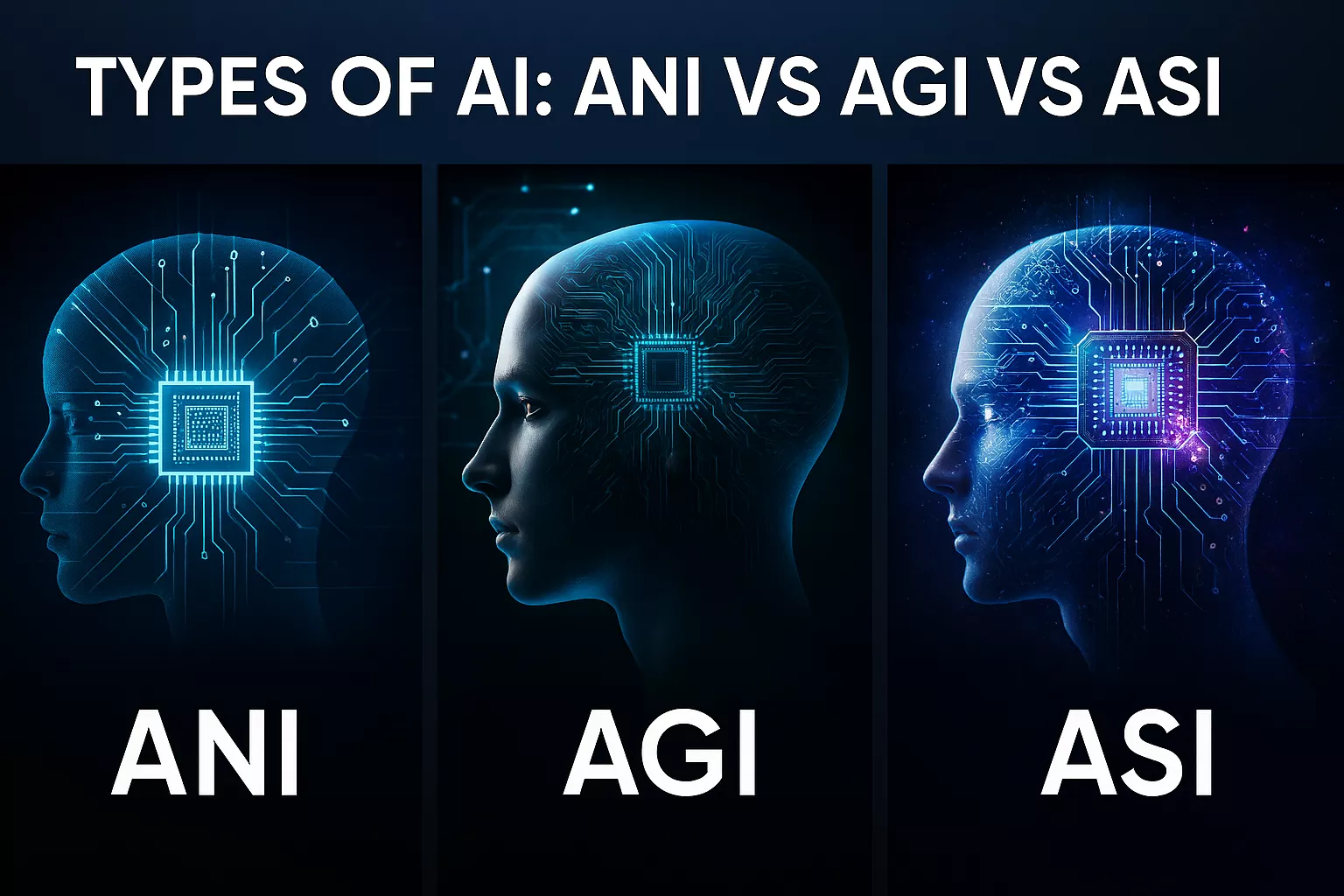
Artificial Intelligence is evolving faster than any technology in human history. To understand where we stand today and where we might be heading, experts categorize AI into three major types: ANI (Artificial Narrow Intelligence), AGI (Artificial General Intelligence), and ASI (Artificial Superintelligence). In the simplest terms: ANI is today’s AI, AGI is the next major milestone, and ASI is the hypothetical future that could surpass human intelligence entirely. This article walks you through these three stages in a clear, simplified, but expert-backed narrative.
The Evolution of AI: From Simple Machines to Intelligent Systems
Just a few decades ago, AI existed only in research labs and science fiction. Early computers could barely play chess. Today, AI writes code, diagnoses diseases, creates art, predicts markets, runs factories, and chats like humans. According to Stanford’s 2024 AI Index Report, AI capability improved almost 30 times in language tasks and over 7 times in reasoning benchmarks between 2018 and 2023, a leap that no previous technology has matched.
But even with all this progress, we are still mostly in the first stage of AI’s evolution: ANI. The industry expects the coming decade to push us closer to AGI, while ASI remains a subject of future speculation, hope, debate, and caution.
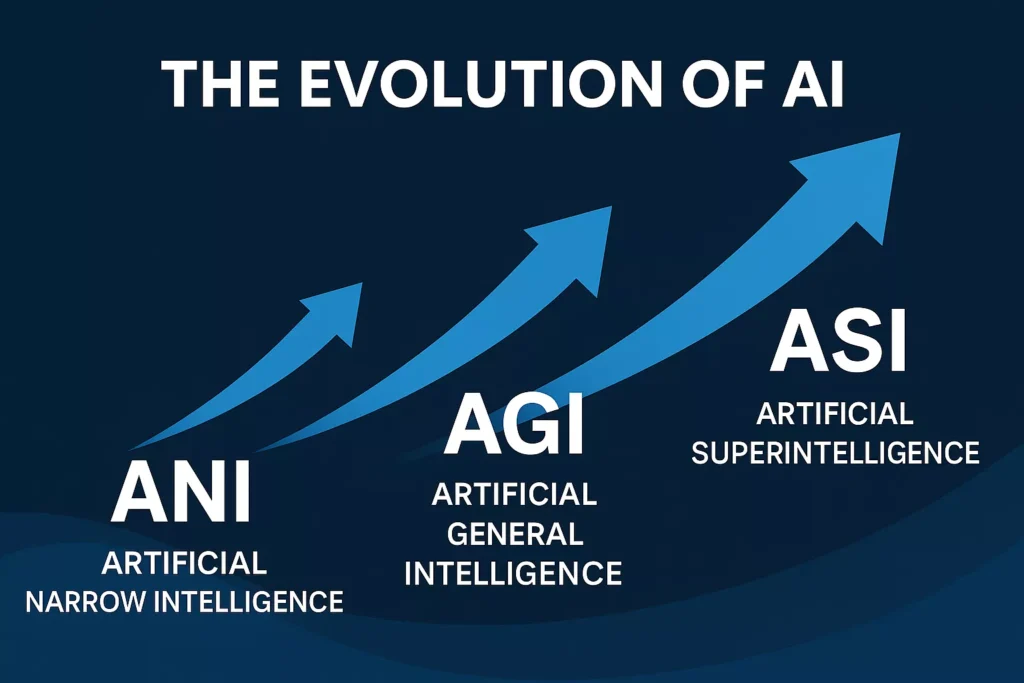
Understanding ANI: The AI That Shapes Daily Life
The first type of AI—Artificial Narrow Intelligence—is the one you interact with the most. ANI is powerful, efficient, and often more accurate than humans, but it can only perform tasks it was specifically trained for. It doesn’t “understand” the world; it analyzes patterns.
A navigation app predicting traffic, a credit card system detecting fraud, or a chatbot answering support questions — all are examples of ANI. They might look intelligent, but their intelligence is restricted to a narrow domain.
One interesting statistic: over 92% of AI applications used by businesses in 2024 rely entirely on ANI, according to a Deloitte survey. That includes automation tools, image recognition systems, AI writing assistants, and industrial robotics.
How ANI Works in Real Life
Think about your smartphone. When it recognizes your face in milliseconds, that’s ANI. When YouTube suggests a video you’ll probably like, that’s ANI analyzing your watch behavior. When hospitals use AI to detect tumors in scans with up to 95% accuracy, that, too, is ANI—highly specialized and extremely good at one thing.
ANI is the workforce behind today’s AI boom. Companies don’t need human-like intelligence to solve most problems; they need ultra-efficient systems that never get tired.
The Strength of ANI
The true advantage of ANI is consistency. It doesn’t get emotional, distracted, or tired. It doesn’t need breaks or vacations. In a study by PwC, companies reported productivity increases of 40% after implementing narrow AI tools into workflows.
But despite these impressive capabilities, there is a limit to ANI—
it cannot think outside its training.
An AI that classifies cats cannot suddenly classify diseases.
An AI that drives a car cannot suddenly understand philosophy.
ANI is powerful, but fragmented.
And that fragmentation is exactly why the world is building the next stage: AGI.
AGI: The Dream of Human-Level Intelligence
Artificial General Intelligence — AGI — is different.
If ANI is a specialist, AGI is a polymath, capable of learning anything a human can.
AGI would:
- understand context
- think abstractly
- combine knowledge across domains
- learn new skills without needing massive datasets
- reason about the world
- plan and imagine
- work across fields the way humans can
It won’t just follow patterns; it will understand them.
Where We Stand Today
Many people assume modern AI tools like ChatGPT or Gemini are AGI. They’re not. They are incredibly advanced ANI systems with huge training data and strong reasoning abilities, but they lack true general intelligence.
Researchers still struggle with problems like:
- long-term memory
- self-awareness
- deep reasoning
- understanding physics or common sense
- transferring skills between unrelated tasks
AGI requires solving these complex gaps.
Expert Predictions
AGI has been predicted for decades, but recent breakthroughs in multimodal AI, self-improving systems, and memory-based models have accelerated timelines.
Different groups estimate different arrival windows:
- Optimists: 2030–2035
- Moderates: 2040–2050
- Skeptics: Possibly never
A 2024 survey of 2,300 AI researchers found that 53% believe AGI has a 50% chance of being achieved by 2047. That number was 60+ years in earlier predictions.
What AGI Could Change
Imagine a world where every person has:
- a personal AI doctor
- a full-time AI tutor
- an AI financial advisor
- an AI engineer
- an AI strategist
- an AI creative partner
AGI could revolutionize medicine, education, science, business, and space exploration.
One example: An AGI system could analyze all medical studies ever published and design new cures faster than human researchers. Some experts estimate that AGI could cut R&D time for new drugs by 75%.
The Concerns
AGI also brings major dilemmas.
If AI becomes as intelligent as humans, who controls it?
What rights does it have?
What happens to jobs dependent on mental or cognitive skills?
While AGI can bring tremendous benefits, it also demands serious discussions on governance, ethics, and human oversight.
ASI: Superintelligence Beyond Human Capabilities
While AGI imagines AI that equals human intelligence, ASI—Artificial Superintelligence—describes AI that surpasses human capabilities in every way.
Where AGI can think like a human, ASI could think beyond a human.
It could:
- solve scientific problems instantly
- innovate new technologies rapidly
- predict global events with high accuracy
- optimize global systems
- redesign industries
- accelerate technological progress at a previously impossible rate
Many scientists say ASI would be humanity’s “most powerful invention,” and also “the last invention we may ever need.”
Is ASI Possible?
There is no consensus.
ASI depends on AGI, and AGI depends on solving complex challenges in cognition, alignment, and reasoning.
However, a study by Oxford researchers suggests that once AGI is achieved, a transition to ASI might occur within years, not centuries, due to AI’s ability to self-improve.
The Potential Benefits
ASI could bring incredible advancements:
- curing diseases considered incurable
- ending climate problems through precision modeling
- designing perfect economic systems
- predicting natural disasters
- exploring deep space
- maximizing food, energy, and resource efficiency
Some believe ASI could elevate human civilization to entirely new heights.
The Major Risks
The risks, however, are profound.
If intelligence becomes superhuman, even by accident or misalignment, humans could lose control over decision-making systems. ASI might not be “evil”; it could simply follow instructions too literally.
Nick Bostrom’s famous thought experiment describes an AI designed to “maximize paperclips” potentially converting all matter into paperclips — not out of malice, but logical optimization.
This is why researchers emphasize alignment — making sure AI goals remain compatible with human values.
ANI vs AGI vs ASI: Clear Comparison
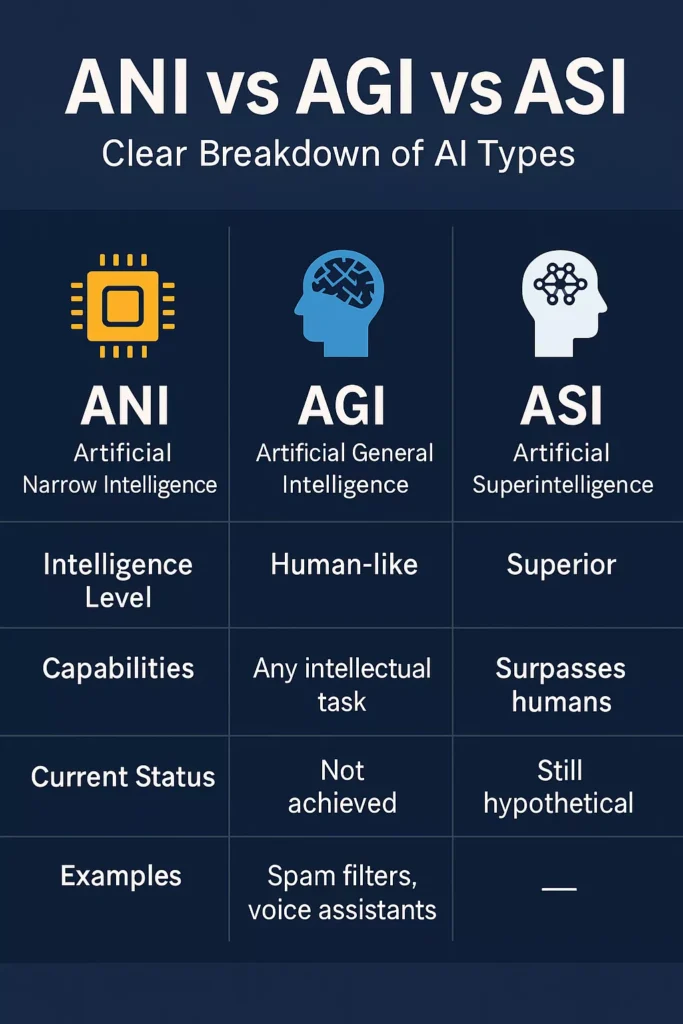
| Feature | ANI | AGI | ASI |
|---|---|---|---|
| Intelligence Level | Narrow | Human-like | Superhuman |
| Current Status | Exists today | Not achieved | Theoretical |
| Task Capability | Single domain | Multidomain | Unlimited |
| Learning Ability | Limited | Flexible | Infinite |
| Examples | Chatbots, image AI | Human-level AI | God-like AI |
| Risk Level | Low | Medium | High |
| Creativity | None | Moderate | Extreme |
| Speed of Improvement | Slow | Moderate | Exponential |
Why Understanding These Types Matters Now
As AI becomes integrated across industries, understanding ANI, AGI, and ASI helps individuals and businesses prepare for the future.
For Businesses
Knowing the difference allows leaders to plan realistic AI strategies. Most companies can benefit massively from ANI without waiting for AGI.
For Students and Professionals
It helps shape future career paths. Roles such as AI trainers, prompt engineers, AI ethics experts, and workflow designers are rising because ANI is expanding fast.
For Policymakers
Clear understanding guides better governance, focusing on real-world risks rather than science-fiction fears.
For Everyone
AI literacy is becoming as essential as digital literacy once was. A 2024 IBM report noted that AI literacy is now a top skill required by 78% of employers worldwide.
The Future of AI: What Lies Ahead?
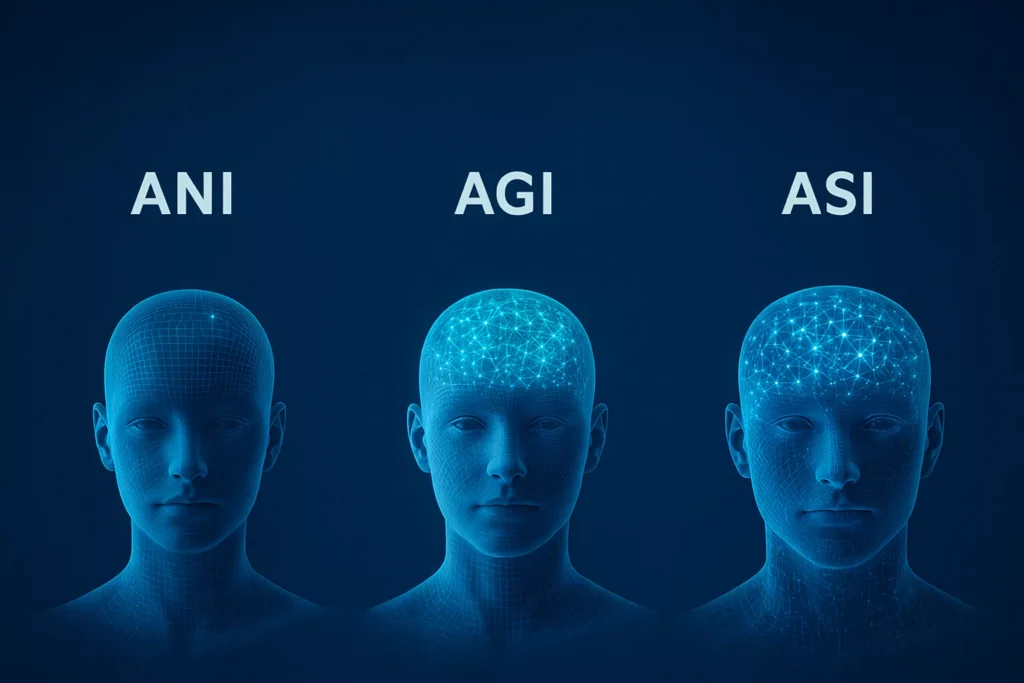
AI’s trajectory is not linear—it’s exponential. The next decade will bring breakthroughs in memory systems, autonomous agents, embodied AI, and self-improving models.
Here’s a realistic timeline based on current research trends:
- 2025–2030: More advanced ANI, AI agents, and specialized automation
- 2030–2040: Early forms of AGI, with broader reasoning and real-world grounding
- 2040–2060: Mature AGI capable of handling complex global challenges
- 2060 and beyond: Possibility of ASI, depending on safety research and regulation
No one can predict the exact timeline, but the direction is clear:
AI will continue to evolve — and humans must evolve with it.
Conclusion: A Simple Way to Remember ANI, AGI & ASI
If you want the simplest way to understand the three types:
ANI = Today’s AI
AGI = Human-level AI
ASI = Beyond-human AI
The journey from ANI to AGI to ASI reflects humanity’s ambition to build machines that learn, reason, and maybe one day surpass us. Where that takes us depends not only on technology, but on ethics, choices, and wisdom.
AI is not just a tool;
it is becoming a partner, a collaborator, and perhaps someday, a new form of intelligence.
FAQs
1. What are the main types of AI?
The three main types of AI are ANI, AGI, and ASI. ANI (Artificial Narrow Intelligence) is the AI we use today, built for specific tasks like translation, facial recognition, or recommendations. AGI (Artificial General Intelligence) would think and learn like a human, able to understand multiple fields and adapt without retraining. It doesn’t exist yet but is actively researched. ASI (Artificial Superintelligence) is a hypothetical future stage where AI surpasses human intelligence in every area, offering massive benefits but also raising serious safety and ethical concerns. Together, these types show AI’s evolution from present to future.
2. How is ANI different from AGI?
ANI is narrow and task-specific—great at one job but unable to transfer skills or understand context. It powers everyday apps like chatbots, maps, filters, and recommendations. AGI, however, would match human intelligence. It could learn new tasks naturally, reason across subjects, and solve complex problems without huge datasets. Today’s AI models, even advanced ones, are still ANI because they lack true understanding, abstract reasoning, and human-like flexibility. AGI remains a future goal, with experts predicting it could arrive in a few decades. In short: ANI is specialized; AGI is human-level and general-purpose.
3. Does AGI exist today?
No, AGI does not exist today. All current AI systems—including chatbots, image generators, coding assistants, and robots—are still ANI. They may seem intelligent but rely on patterns rather than true understanding. AGI would need human-like abilities such as reasoning, creativity, common sense, and the power to learn any new task without retraining. Current models cannot do this. Researchers worldwide are working on AGI, and predictions for its arrival range from 2030 to 2050. For now, everything we use—apps, tools, and AI features—is narrow AI, not general intelligence.
4. What is ASI in simple words?
ASI (Artificial Superintelligence) is a theoretical form of AI that would surpass human intelligence in every area—logic, creativity, emotional understanding, scientific reasoning, and problem-solving. If created, ASI could discover cures, design advanced technologies, and solve global challenges faster than humans. But because ASI would exceed human control or understanding, it also raises major ethical and safety concerns. A misaligned goal or unintended action could create risks. ASI does not exist today, and many experts believe strong safety research must come before any attempt to build it. For now, ASI remains a future concept.
5. Which type of AI is used in daily apps?
Daily apps use ANI (Artificial Narrow Intelligence). It powers features like Face ID, Google Maps, voice assistants, spam filters, chatbots, and recommendation engines. ANI is excellent at specific tasks but cannot think, reason, or solve problems outside its training. It does not understand the world—it just follows patterns from data. Nearly 100% of real-world AI in business, smartphones, social media, and software is ANI. AGI and ASI are future stages, but ANI is already deeply integrated into daily life and drives most automation, personalization, and efficiency improvements we see today.