
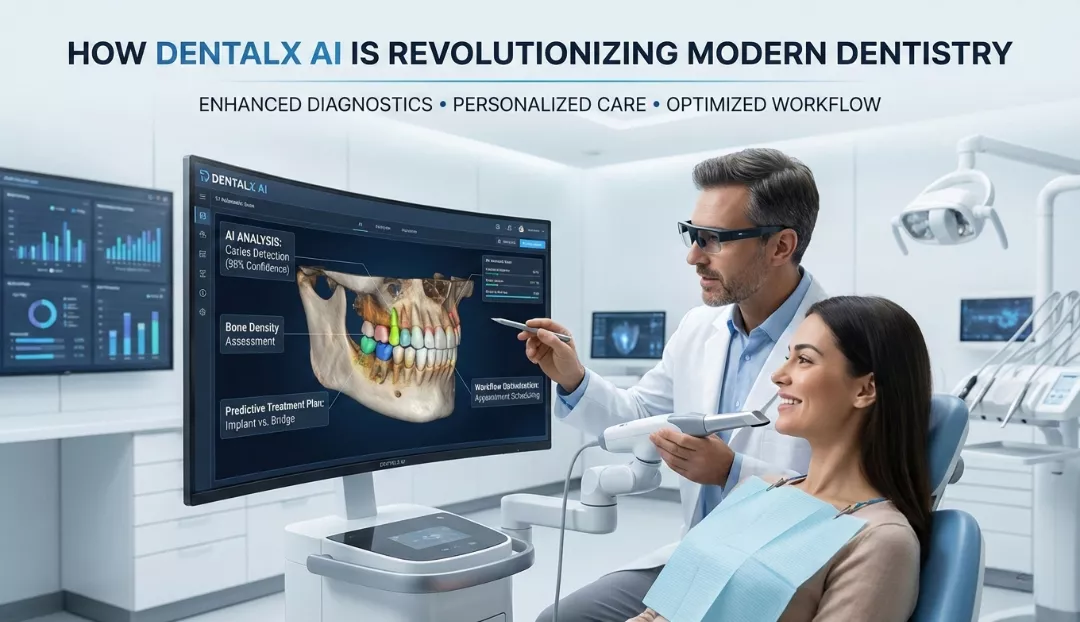
DentalX AI is transforming modern dentistry by integrating advanced machine learning and computer vision into clinical workflows to enhance diagnostic accuracy, streamline practice management, and improve patient outcomes. By automating complex tasks such as X-ray analysis, appointment scheduling, and treatment planning, DentalX AI acts as a “second opinion” for clinicians, detecting issues like early-stage caries and bone loss with precision that rivals human experts while reducing administrative burdens by up to 40%. This technology shifts the dental paradigm from reactive repair to proactive, data-driven prevention, ultimately fostering greater trust through transparent, visual patient communication.
The Dawn of Intelligent Dentistry
For decades, dentistry relied heavily on the subjective expertise of the practitioner and the manual efficiency of the administrative staff. While human skill remains irreplaceable, the limitations of the human eye in reading grayscale radiographs and the fatigue associated with managing hundreds of patient files created gaps in care. Enter DentalX AI, a comprehensive ecosystem designed not to replace the dentist, but to elevate their capabilities to superhuman levels.
The integration of Artificial Intelligence (AI) into dental practices is no longer a futuristic concept; it is the current standard of care for forward-thinking clinics. DentalX AI represents the synthesis of big data and clinical empathy, ensuring that every patient receives a diagnosis backed by millions of data points and a treatment plan optimized for their specific biological history.
What is DentalX AI?
At its core, DentalX AI is a sophisticated software platform that utilizes Deep Learning (DL) and Convolutional Neural Networks (CNNs). These are the same technologies used in facial recognition and self-driving cars, but here, they are trained on vast datasets of dental imagery and patient records.
When a dentist takes an X-ray, DentalX AI analyzes the image in milliseconds. It doesn’t just “look” at the tooth; it compares the density, structure, and patterns against a library of proven pathologies. It highlights potential cavities, measures bone levels to the millimeter, and even identifies anatomical landmarks, providing an immediate, objective baseline for the dentist’s exam.
Core Pillars of the DentalX Revolution
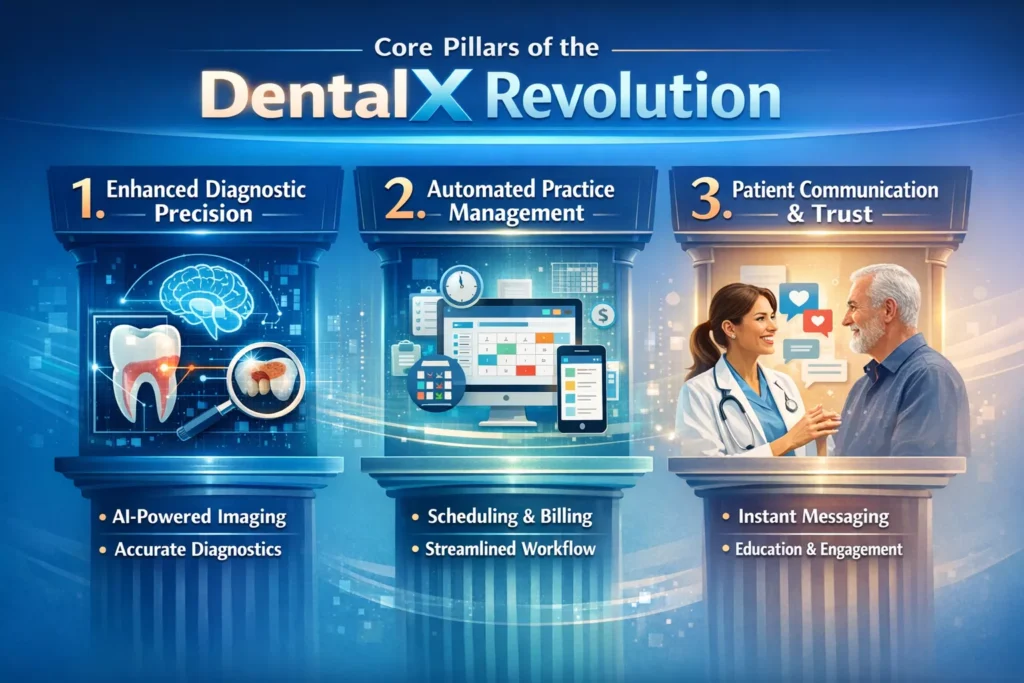
To understand the magnitude of this revolution, we must look at the specific pillars where DentalX AI operates:
1. Enhanced Diagnostic Precision
The most critical application of DentalX AI is in diagnostics. Traditional X-ray reading is subjective; fatigue or lighting conditions can lead to missed diagnoses. DentalX AI provides:
- Caries Detection: Identifying demineralization between teeth (interproximal caries) often invisible to the naked eye.
- Periapical Radiolucency: Detecting early signs of infection at the root tip before the patient feels pain.
- Bone Level Measurement: Automatically quantifying bone loss to stage periodontal disease accurately.
2. Automated Practice Management
Beyond the chair, DentalX AI revolutionizes the front desk. It utilizes predictive analytics to manage the clinic’s heartbeat—the schedule.
- Smart Scheduling: The AI analyzes appointment lengths and provider availability to optimize the calendar, reducing gaps and “dead chair time.”
- Revenue Cycle Management: Automated coding and billing reduce insurance rejections by ensuring that the treatment notes match the claim codes perfectly.
3. Patient Communication and Trust
One of the biggest hurdles in dentistry is case acceptance. Patients often nod politely but refuse treatment because they don’t understand the problem. DentalX AI changes this by visualizing the invisible.
- Color-Coded Overlays: instead of showing a patient a gray smudge on an X-ray, DentalX AI outlines the decay in red and the healthy enamel in green. This simple visual cue drastically increases patient understanding and trust.
By the Numbers: The Impact of AI in Dentistry
To illustrate the tangible benefits of adopting platforms like DentalX AI, we can look at recent industry statistics that highlight efficiency and accuracy.
| Metric | Traditional Practice | AI-Enabled Practice (DentalX) | Impact |
| Caries Detection Accuracy | 50-70% (Variable) | 90-95% | +30% improvement in early detection. |
| Chart Audit Time | 10-15 minutes/patient | < 1 minute/patient | 90% reduction in administrative time. |
| Case Acceptance Rate | 35-50% | 60-75% | Higher revenue due to visual clarity. |
| Insurance Claim Rejections | 10-15% | < 2% | Faster cash flow and less paperwork. |
| Missed Appointments | 15-20% | 5-8% | Optimized scheduling via predictive reminders. |
Note: Statistics derived from aggregated industry reports on AI adoption in healthcare (2024-2025).
The Human Touch: A Day in the Life
To truly understand the revolution, let’s step into the shoes of Dr. Elena, a dentist who recently integrated DentalX AI into her practice.
8:00 AM – The Huddle:
Before the first patient arrives, Dr. Elena reviews the “Morning Opportunity Report” generated by DentalX. The AI has scanned the charts of today’s patients and flagged three individuals who have untreated treatment plans from last year and unused insurance benefits. The front desk team is alerted to discuss this with the patients.
9:30 AM – The Skeptical Patient:
Mr. Miller is in the chair. He has no pain, but Dr. Elena suspects a crack in his lower molar. In the past, she would have to rely on her persuasion skills. Today, she pulls up the DentalX scan. . The AI has clearly outlined the fracture line and highlighted the proximity to the nerve.
“Mr. Miller,” she says, pointing to the screen, “The AI has flagged this area in red. It detects a fracture that’s 2mm deep.”
Mr. Miller sees the objective data—not just a dentist’s opinion—and agrees to the crown immediately. The “sales” aspect is removed; it becomes a collaboration over data.
2:00 PM – The Silent Assistant:
While Dr. Elena is performing a root canal, her assistant is taking notes. DentalX AI listens (via ambient clinical intelligence) and drafts the clinical notes automatically: “Anesthesia administered: 2% Lidocaine… Rubber dam applied… Canal obturated…”
By the time Dr. Elena takes off her gloves, the notes are 90% complete, requiring only a quick sign-off. She leaves on time that evening, rather than staying late to finish paperwork.
Deep Dive: The Technology Behind the Scenes
How does DentalX AI actually work? It is not magic; it is math.
Computer Vision and Image Segmentation
When a radiograph is uploaded, the software breaks the image down into pixels. It performs “segmentation,” separating teeth from bone, nerves, and sinus cavities. It then applies “bounding boxes” around areas of interest. The neural network, which has “seen” millions of cavities, calculates the probability that the dark spot in the pixel group is decay versus a shadow or an imaging artifact.
Predictive Analytics in Treatment Planning
DentalX AI doesn’t just look at the current state; it looks at the trajectory. By analyzing a patient’s history of decay and gum disease, the AI can assign a “risk score.”
- Low Risk: The AI might recommend a 12-month recall.
- High Risk: The AI might suggest a 3-month recall and fluoride varnish.This allows for Precision Dentistry—treating the patient based on their specific biological risk profile rather than a generic “one size fits all” approach.
The Patient Experience: From Fear to Confidence
The revolution is perhaps most felt by the patient. For generations, the dentist’s chair has been a place of vulnerability. Patients lie back, open their mouths, and hope the dentist is honest and competent.
DentalX AI democratizes the information.
- Transparency: Patients see what the dentist sees, decoded. The “black box” of diagnosis is opened.
- Consistency: A patient can visit a DentalX-enabled clinic in New York or London and receive the same objective baseline analysis.
- Less Radiation: AI algorithms can enhance low-quality images, potentially reducing the need for retakes and lowering overall radiation exposure over a lifetime.
Challenges and Ethical Considerations
No revolution is without its hurdles. As DentalX AI permeates the industry, valid questions arise.
Data Privacy:
With AI systems processing cloud-based patient data, encryption and HIPAA/GDPR compliance are paramount. DentalX AI employs military-grade encryption, ensuring that while the machine learns from the data, the patient’s identity remains protected.
The “Human in the Loop”:
There is a fear that AI will replace dentists. However, DentalX AI is designed as “Augmented Intelligence,” not “Autonomous Intelligence.” It cannot feel lymph nodes, check for oral cancer on the tongue, or understand a patient’s fear of needles. The final diagnosis always rests with the licensed professional. The AI is the navigator; the dentist is the pilot.
Future Horizons: What’s Next for DentalX AI?
The current capabilities are just the tip of the iceberg. The roadmap for DentalX AI and the industry at large includes:
- Generative Treatment Simulation: soon, AI will generate a photorealistic video showing the patient exactly how their teeth will move during orthodontic treatment or how their face shape will improve after reconstructive surgery.
- Remote Monitoring: Patients will use their smartphones to scan their mouths at home. DentalX AI will analyze the video to detect gum inflammation or broken retainers, alerting the dentist only if intervention is needed.
- Robotic Integration: AI is beginning to guide robotic arms for implant surgeries, ensuring placement accuracy within microns, far surpassing human steadiness.
Conclusion
DentalX AI is not merely a software update; it is an operating system upgrade for the entire profession of dentistry. It addresses the “Iron Triangle” of healthcare: Access, Quality, and Cost. By making diagnostics faster and more accurate (Quality), reducing administrative overhead (Cost), and enabling remote monitoring (Access), it is paving the way for a healthier future.
For the clinician, it offers peace of mind and efficiency. For the patient, it offers clarity and trust. As we move further into the 21st century, the question for dental practices is no longer “Should we use AI?” but rather “How soon can we start?” DentalX AI is leading this charge, proving that the future of dentistry is intelligent, transparent, and profoundly human.
Frequently Asked Questions (FAQs)
1. Will DentalX AI replace my dentist?
No, absolutely not. DentalX AI is designed to function as “Augmented Intelligence,” acting as a powerful assistant rather than a replacement. It handles data analysis and administrative tasks, allowing your dentist to focus on complex decision-making, manual procedures, and patient care. The final diagnosis and treatment plan are always determined by your licensed dental professional.
2. Does using DentalX AI increase the cost of my dental visit?
Generally, there is no additional line-item cost for patients when a clinic uses AI technology. In fact, it often saves patients money in the long run. By detecting cavities and gum issues at their earliest stages (preventative care), it helps avoid the need for expensive and invasive procedures like root canals or extractions later on.
3. Is my personal health data safe with DentalX AI?
Yes. DentalX AI is built with strict adherence to healthcare privacy laws, including HIPAA (in the US) and GDPR (in Europe). All patient data and X-ray images are anonymized and protected using military-grade encryption during processing. The AI analyzes the clinical data without compromising your personal identity.
4. Can DentalX AI make mistakes?
Like any technology, it is not infallible, but it is highly consistent. While human dentists can be affected by fatigue or lighting conditions, the AI provides a standardized analysis every time. However, this is why the “human in the loop” is essential. The dentist reviews the AI’s findings to confirm accuracy, ensuring you get the benefit of both human expertise and machine precision.
5. How does DentalX AI help with my insurance claims?
One of the most frustrating parts of dentistry is having an insurance claim denied. DentalX AI helps prevent this by cross-referencing the diagnosis with the specific requirements of your insurance provider. It ensures that the X-rays clearly show the medical necessity of the treatment, significantly reducing the chance of claim rejection and unexpected bills.