

Prompt engineering is the art and science of crafting precise inputs (prompts) to guide generative AI models, like ChatGPT or Gemini, toward optimal outputs. It acts as a bridge between human intent and machine execution, transforming vague requests into structured instructions that Large Language Models (LLMs) can understand and execute accurately. By strategically refining wording, adding context, and structuring queries, prompt engineers can significantly enhance an AI’s reasoning capabilities, reduce errors (hallucinations), and unlock complex problem-solving skills without writing a single line of traditional code.
Introduction: Speaking the Language of AI
Imagine walking into a high-end restaurant and simply telling the chef, “Make me food.” You might get a steak, a salad, or a bowl of soup—but rarely exactly what you wanted. However, if you say, “I want a medium-rare ribeye steak, seasoned with garlic butter, served with a side of roasted asparagus,” the chef knows precisely what to do.
AI models work the same way. They are incredibly powerful “chefs” trained on the internet’s vast knowledge, but they lack telepathy. Prompt engineering is the skill of writing that specific order. It is rapidly becoming the “new coding language,” where syntax is replaced by natural language, and logic is structured through clear communication. Whether you are a developer, a marketer, or a student, mastering this skill turns you from a passive user into an AI conductor.
The Anatomy of a Perfect Prompt
To move beyond basic questions, you must understand the four pillars of a high-quality prompt. A “lazy” prompt yields a generic answer, but a structured prompt yields a solution.
| Component | Description | Example |
| Instruction | The specific task you want the model to perform. | “Summarize,” “Translate,” “Write code,” “Analyze.” |
| Context | Background info to help the AI understand the whyand who. | “You are a senior fitness coach helping a beginner…” |
| Input Data | The specific content or data the AI needs to process. | “Here is the list of ingredients: [List]…” |
| Output Indicator | How you want the answer to look. | “Format as a Markdown table,” “Limit to 3 bullet points.” |
Example: Transforming a Prompt
- Basic Prompt: “Write an email about the project delay.”
- Engineered Prompt: “Act as a project manager. Write a polite but firm email to the client explaining that the ‘Alpha Project’ will be delayed by one week due to server migrations. Propose a new delivery date of March 12th. Use a professional tone and keep it under 150 words.”
The Process: How to Engineer a Prompt

Prompt engineering isn’t a “one-and-done” action; it is an iterative cycle.
Step 1: Define the Goal
Be ruthlessly specific. Instead of “I want a blog post,” ask “I want a 1,000-word SEO-optimized blog post about sustainable gardening for millennials.”
Step 2: Draft and Constrain
Write your initial prompt using the “Anatomy” structure above. Add constraints to prevent the AI from rambling.Constraints are your guardrails—they force the model to focus.
- Constraint Examples: “Do not use jargon,” “Answer in JSON format,” “Use analogies.”
Step 3: Test and Evaluate
Run the prompt. Did the AI hallucinate? Was the tone too robotic? Did it miss a key detail?
Step 4: Iterate and Refine
If the output was too long, add “Be concise.” If it was too complex, add “Explain like I’m 5.” This is where the “engineering” happens—tweaking the variables until the output is consistent.
Core Techniques: From Zero-Shot to Chain-of-Thought
You don’t need to be a computer scientist to use advanced logic. These techniques are force-multipliers for accuracy.
1. Zero-Shot vs. Few-Shot Prompting
- Zero-Shot: Asking the AI to do something without examples.
- Prompt: “Classify this tweet: ‘I loved the movie!’ as positive or negative.”
- Few-Shot: Providing examples (shots) to guide the model. This is the single most effective way to fix formatting issues or style inconsistencies.
- Prompt:“Classify the sentiment of these reviews: ‘The food was cold.’ -> Negative ‘The service was okay.’ -> Neutral ‘Best night ever!’ -> Positive ‘I waited 20 minutes for a table.’ -> [AI fills in: Negative]“
2. Chain-of-Thought (CoT)
This technique forces the AI to “show its work.” When you ask a complex math or logic question, LLMs often guess the answer immediately and get it wrong. By asking it to think step-by-step, accuracy improves dramatically.
- Standard Prompt: “If I have 5 apples, eat 2, and buy 3 more, how many do I have?”
- CoT Prompt: “If I have 5 apples, eat 2, and buy 3 more, how many do I have? Let’s think step by step.“
3. Role-Playing (Persona)
Assigning a persona sets the tone and expertise level.
- Prompt: “Act as a grumpy 19th-century lighthouse keeper. Describe the incoming storm.”
- Result: The AI will use archaic language, metaphors of the sea, and a somber tone, completely changing the output style compared to a standard request.
Real-World Use Cases
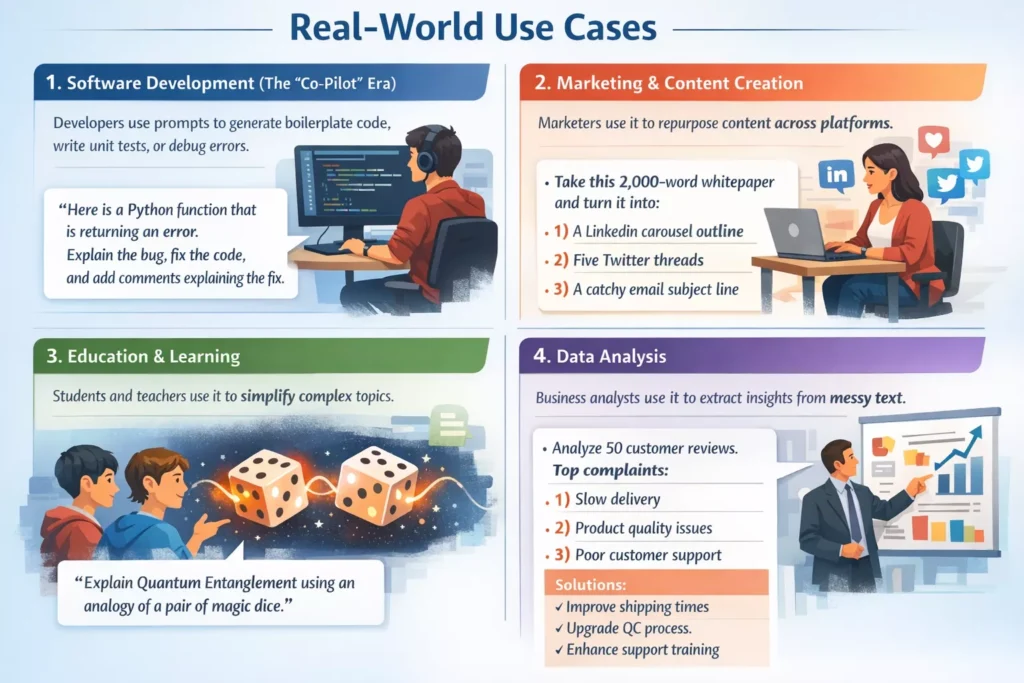
Prompt engineering is industry-agnostic. Here is how it is being applied today:
1. Software Development (The “Co-Pilot” Era)
Developers use prompts to generate boilerplate code, write unit tests, or debug errors.
- Use Case: “Here is a Python function that is returning an error. Explain the bug, fix the code, and add comments explaining the fix.”
2. Marketing & Content Creation
Marketers use it to repurpose content across platforms.
- Use Case: “Take this 2,000-word whitepaper and turn it into: 1) A LinkedIn carousel outline, 2) Five Twitter threads, and 3) A catchy email subject line.”
3. Education & Learning
Students and teachers use it to simplify complex topics.
- Use Case: “Explain Quantum Entanglement using an analogy of a pair of magic dice.”
4. Data Analysis
Business analysts use it to extract insights from messy text.
- Use Case: “Analyze the following 50 customer reviews. List the top 3 recurring complaints and suggest one actionable solution for each.”
Best Practices: The Dos and Don’ts
To ensure your prompts are “Google Indexable” (high quality) and effective, follow this cheat sheet.
| Feature | DO This | DON’T Do This |
| Clarity | “Write a 5-sentence summary.” | “Write a short summary.” |
| Context | “You are an expert in tax law.” | “You are a helper.” |
| Structure | Use ### Headings and bullet points. | Write a giant wall of text. |
| Negatives | Tell the AI what to do (“Use formal language”). | Tell the AI what not to do (“Don’t be slangy”). Positive constraints work better. |
| Iteration | “Refine that, make it punchier.” | Giving up after one bad result. |
Advanced Concepts: Temperature and Hallucinations
For those looking to go deeper, understanding hyperparameters can give you an edge.
- Temperature: This controls the “creativity” of the model (usually a scale of 0 to 1).
- Low Temperature (0.1 – 0.3): Precise, factual, deterministic. Use this for coding, math, or factual data extraction.
- High Temperature (0.7 – 1.0): Creative, random, diverse. Use this for brainstorming, poetry, or fiction writing.
- Hallucinations: AI models sometimes confidently state false information. To mitigate this:
- Ask the model to cite sources (even if it can’t browse, it mimics the style).
- Use the instruction: “If you do not know the answer, state that you do not know. Do not make up facts.”
Conclusion: The Future of Prompting
We are currently in the “manual transmission” era of AI, where we must carefully shift gears (write prompts) to get the best performance. As we move forward, Automated Prompt Engineering (where AI writes its own prompts) will become more common. However, the core skill of problem decomposition—breaking a vague desire into logical steps—will remain a uniquely human necessity.
Prompt engineering is not just about tricking a robot into doing homework; it is about learning how to structure thought itself. By mastering this, you future-proof your career and unlock a level of productivity that was previously impossible.
Frequently Asked Questions (FAQs)
1. Do I need to know how to code to be a prompt engineer?
No, you do not need traditional coding skills (like Python or Java) to get started. The primary “language” of prompt engineering is natural human language (e.g., English), combined with strong logic and critical thinking. However, understanding basic coding concepts can be a major advantage when working with APIs or instructing the AI to generate code.
2. Can prompt engineering fix AI “hallucinations”?
It can significantly reduce them, but rarely eliminates them 100%. Techniques like “Chain-of-Thought” prompting, explicitly asking for citations, or setting a low “temperature” (creativity level) help keep the AI grounded in fact. Users should always verify critical data, as even the best prompts can sometimes yield confident but incorrect answers.
3. What is the difference between a “system prompt” and a “user prompt”?
A System Prompt (or system message) is the high-level instruction given to the AI before the conversation starts, usually by developers (e.g., “You are a helpful assistant who is concise”). A User Prompt is the actual request you type into the chat box (e.g., “Summarize this article”). The system prompt defines the AI’s behavior; the user prompt defines the specific task.
4. Will AI eventually make prompt engineering obsolete?
In its current manual form, likely yes. As AI models become smarter at inferring intent from vague instructions (intent recognition), the need for hyper-specific “hacks” will decrease. However, the core skill of problem decomposition—breaking a complex goal into logical steps for a machine to execute—will remain a highly valuable human skill.
5. Which AI model is best for learning prompt engineering?
ChatGPT (OpenAI) is generally the best starting point due to its wide accessibility and responsiveness to logic. Claude (Anthropic) is excellent for practicing with large amounts of text (context), while Midjourney is the gold standard for learning the unique syntax of image generation prompts. Practicing on different models helps you understand the universal principles of AI interaction.