
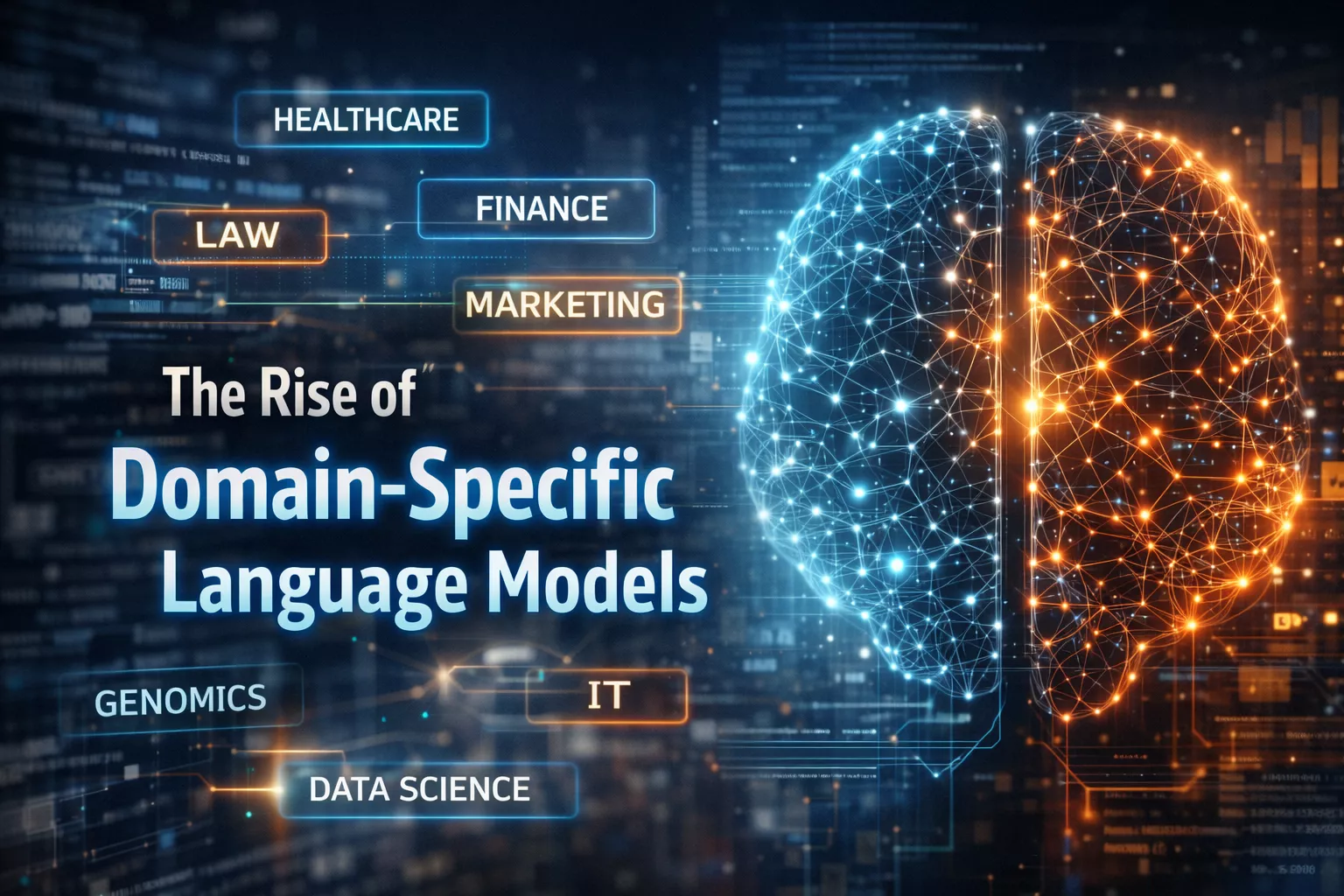
Domain-Specific Language Models (DSLMs) are the next evolution in artificial intelligence, marking a shift from “generic” jack-of-all-trades models to highly specialized, industry-focused expert systems. Unlike general-purpose Large Language Models (LLMs) trained on the entire internet to answer broad questions, DSLMs are fine-tuned on curated, high-quality datasets specific to fields like medicine, law, finance, and engineering. This specialization allows them to deliver significantly higher accuracy, reduce “hallucinations” (factual errors), ensure stricter data privacy, and operate with greater computational efficiency. As businesses move past the initial hype of general AI, DSLMs are emerging as the practical infrastructure that will power the true automation of complex, high-stakes professional workflows.
The “Jack of All Trades” Problem
For the last few years, the world has been mesmerized by the magic of generic technology. We marveled when a chatbot could write a poem about a toaster in the style of Shakespeare, debug a snippet of Python code, and then suggest a recipe for dinner—all in the same conversation window. This was the era of the General Purpose LLM (Large Language Model). These models were designed to be the ultimate generalists, educated on a diet of the entire public internet.
But as the “honeymoon phase” with generic AI fades, a stark reality is setting in for enterprises and professionals: Generalists are great at dinner parties, but you don’t want them performing your heart surgery.
We are currently witnessing the end of “Generic” Tech. The novelty of an AI that knows a little bit about everything is being replaced by the necessity of AI that knows everything about one thing. This is the dawn of the DSLM (Domain-Specific Language Model).
What Are DSLMs? The Rise of the Specialist
To understand DSLMs, think of the difference between a high school trivia champion and a neurosurgeon. The trivia champion (the Generic LLM) has a vast breadth of knowledge. They know the capital of Peru, the plot of War and Peace, and basic biology. But if you have a specific, complex brain aneurysm, their broad knowledge is useless—and potentially dangerous.
A DSLM is the neurosurgeon. It might not know (or care) who won the 1998 World Cup, but it has “read” every medical journal, case study, and clinical trial related to neurology published in the last 50 years.
Technically, DSLMs are often smaller, more efficient models that have been “fine-tuned” or trained from scratch on highly specific data corpora. Because they don’t need to waste neural pathways remembering how to write haikus or bake cakes, they can dedicate their entire parameter count to understanding the nuances of legal statutes, protein folding sequences, or financial compliance regulations.
The Three Pillars of the DSLM Revolution
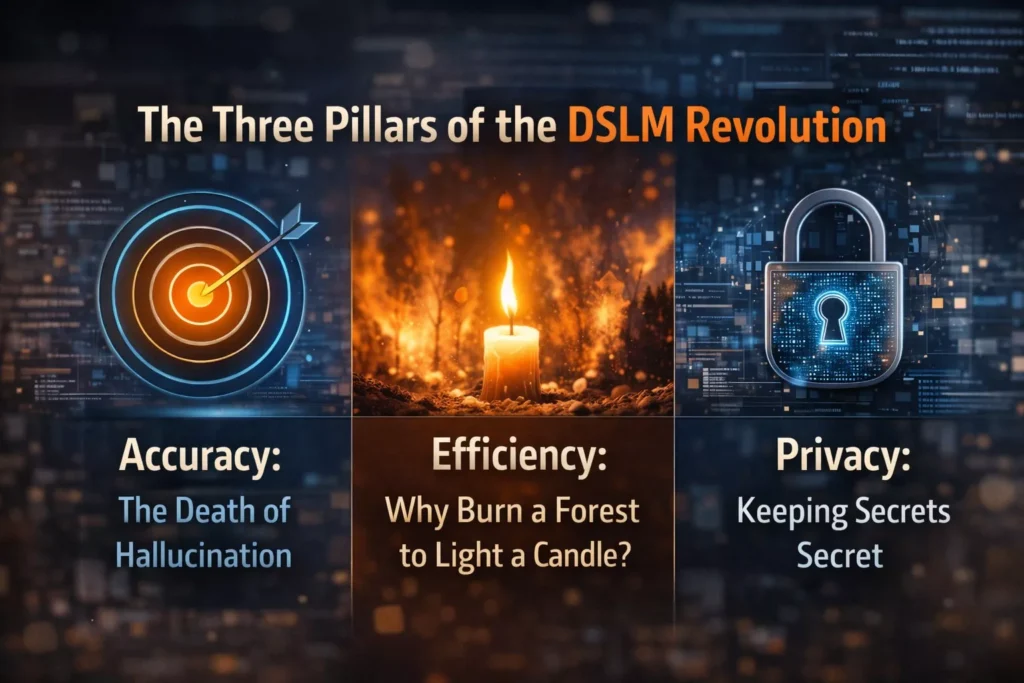
Why is the tech world pivoting so hard toward specialization? It comes down to three critical factors that generic models simply cannot solve: Accuracy, Efficiency, and Privacy.
1. Accuracy: The Death of Hallucination
The biggest dirty secret of generic AI is “hallucination”—confidently making things up. For a creative writer, an AI inventing a fact is a feature; for a lawyer or an engineer, it’s a liability lawsuit waiting to happen.
Generic models hallucinate because they predict the next statistically likely word based on the entire internet, which contains as much misinformation as it does fact. DSLMs, however, are fenced in. A legal DSLM trained only on Supreme Court rulings and verified case law has a much narrower “search space” for its answers. It effectively removes the noise. When you ask a generic model about a complex tax code, it guesses based on forums and blogs it read. When you ask a Tax-DSLM, it cites the specific regulation.
2. Efficiency: Why Burn a Forest to Light a Candle?
Running a massive model like GPT-4 or Claude 3 Opus requires an astronomical amount of energy. Every time you ask a generic giant to summarize a simple internal memo, thousands of GPUs spin up, consuming water and electricity. It’s overkill.
DSLMs are often “Small Language Models” (SLMs) disguised as experts. Because they only need to know the vocabulary of their specific domain, they can be 1/10th or even 1/100th the size of generic models. This means:
- Lower Latency: Answers are instant.
- Lower Cost: Running them costs pennies compared to dollars.
- Edge Deployment: A specialized DSLM for automotive repair could theoretically run directly on a mechanic’s diagnostic tablet, without needing an internet connection to a massive data center.
3. Privacy: Keeping Secrets Secret
Corporations are terrified of sending their proprietary data into the “black box” of a public AI model. Samsung, Apple, and banks have notoriously restricted employee use of generic ChatGPT due to data leakage fears.
DSLMs solve this by being deployable strictly within a company’s private cloud or on-premise servers. A pharmaceutical company can train a “DrugDiscovery-Bot” on its own 20 years of secret research data. Since the model is domain-specific and local, that competitive advantage never leaves the building.
Industry Deep Dives: The Real-World Impact
The theoretical benefits are clear, but what does the “End of Generic Tech” look like on the ground? It looks like a fragmented landscape of highly capable tools that don’t just “chat,” but actually work.
Healthcare: From WebMD to Dr. AI
In healthcare, the stakes for “generic” errors are life and death. We are seeing the rise of models like BioBERT and ClinicalBERT, but the next generation is even more granular.
- Radiology DSLMs: These don’t just “look at images”; they are trained on millions of X-rays and MRI scans specifically to detect micro-fractures or early-stage tumors that generic vision models miss.
- Patient Intake Specialists: Instead of a generic receptionist, hospitals are deploying voice-enabled DSLMs trained on medical triage protocols. They understand the difference between “my chest hurts” (indigestion) and “my chest feels like an elephant is sitting on it” (cardiac arrest) because they’ve been trained on millions of triage transcripts.
Law: The End of the Billable Hour?
The legal profession relies on precision. One misplaced comma can cost millions.
- Contract Review Bots: Generic AI can summarize a contract. A Legal DSLM can redline it. It can spot that a specific “Force Majeure” clause is non-compliant with New York State law because it has been trained specifically on NY commercial codes.
- Litigation Prediction: specialized models are analyzing decades of rulings from specific judges to predict how they are likely to rule on a specific motion, giving lawyers a strategic edge that “gut feeling” can’t match.
Finance: The Crystal Ball Gets Clearer
In finance, “generic” advice is usually bad advice.
- Sentiment Analysis DSLMs: Hedge funds are using models trained not just on “news,” but specifically on “Central Bank Speak.” These models can detect subtle shifts in the tone of a Federal Reserve meeting minutes document that imply a 0.25% rate hike, triggering trades milliseconds before the market reacts.
- Fraud Detection: A generic model might flag a large transaction as weird. A Banking DSLM knows your specific spending habits, the typical fraud patterns of your geographic region, and the merchant codes of the store you are at, reducing false positives significantly.
Coding and Engineering: The 10x Developer
General models can write Python scripts, but they struggle with massive, legacy codebases.
- Legacy Code DSLMs: Companies with 30-year-old mainframe code (COBOL) are training DSLMs specifically to understand their internal spaghetti code. These models act as translators, helping modern developers update systems that no human fully understands anymore.
The New Architecture: “Agentic” Orchestrators
If we have thousands of specialized models, how do we use them? Do we need 50 different apps? No. The future user interface is the “Orchestrator” or “Agentic AI.”
Imagine you ask your computer: “Plan a business trip to Tokyo, book the flights, and prepare a briefing on Japanese IP law for my meeting.”
In the DSLM era, a lightweight “Manager AI” receives this request and delegates:
- It calls the Travel-DSLM to book flights (optimized for airline APIs).
- It calls the Finance-DSLM to handle the expense reporting (optimized for company policy).
- It calls the Legal-DSLM to generate the IP law briefing (optimized for Japanese statutes).
The user sees one smooth interaction, but under the hood, a team of experts is collaborating. This “Society of Minds” approach is far more robust than a single brain trying to do it all.
The Business Shift: Data is the New Moat
For the last decade, “Big Data” was a buzzword. Now, it is the only asset that matters. In the era of Generic Tech, the company with the best algorithm won (e.g., Google, OpenAI). In the era of DSLMs, the company with the best data wins.
- The Law Firm with 100 years of case files now has a competitive advantage over a tech giant, because the tech giant doesn’t have the legal data to train the model.
- The Hospital with millions of patient records holds the keys to the best diagnostic AI.
This shifts power away from pure tech companies and toward legacy industries. If you have unique, proprietary data, you can build a DSLM that no one else can copy.
Challenges: The Tower of Babel
Of course, this fragmented future has its own risks. If every company and industry builds its own DSLM, we risk creating a “Tower of Babel” scenario where these models cannot talk to each other.
- Interoperability: How does the “Legal DSLM” talk to the “Accounting DSLM” when they use different vocabularies?
- Data Silos: As companies realize their data is gold for training DSLMs, they will stop sharing it. The “Open Web” might shrink as data becomes hoarded behind corporate firewalls to train proprietary models.
Conclusion: A Human-Centric Future
The end of “Generic” Tech is actually good news for humans. Generic AI often felt like it was trying to replace us—to be a human-like generalist. DSLMs, by contrast, feel more like tools. They are power drills, not robot butlers.
A doctor doesn’t feel threatened by an MRI machine; they feel empowered by it. Similarly, a lawyer won’t be replaced by a generic “Robot Lawyer,” but they will be supercharged by a “Contract Analysis DSLM.”
We are entering an era of deep collaboration between human experts and machine experts. The “Jack of All Trades” era of AI was a fun experiment, but the “Master of One” era is where the real work begins.
FAQs
1. What is the fundamental difference between a Generic LLM and a DSLM?
Answer: Think of a Generic LLM (like standard ChatGPT or Claude) as a university librarian—they know a little bit about everything, from history to coding to poetry, because they’ve read the entire library (the internet). A DSLM (Domain-Specific Language Model) is like a specialized heart surgeon. It doesn’t know poetry or history, but it has memorized every medical textbook and case study in existence. While Generic LLMs are trained on broad, unfiltered internet data, DSLMs are trained (or fine-tuned) exclusively on high-quality, curated data specific to one industry, making them far more accurate within that narrow field.
2. Why would a company choose a “smaller” DSLM over a massive model like GPT-4?
Answer: Bigger isn’t always better; sometimes it’s just more expensive and distracting. Companies prefer DSLMs for three main reasons:
- Accuracy: Generic models “hallucinate” (make things up) because they try to please the user with any likely answer. DSLMs are restricted to factual, industry-specific data, drastically reducing errors.
- Cost & Speed: Running a massive generic model requires huge amounts of computing power and energy. DSLMs are often lighter and faster, saving companies millions in server costs.
- Privacy: Companies can host smaller DSLMs on their own private servers, ensuring sensitive data (like patient records or legal strategy) never leaves the building.
3. Will DSLMs replace general-purpose chatbots for everyday users?
Answer: Unlikely. The “End of Generic Tech” refers mostly to enterprise and professional workflows, not casual consumer use. For brainstorming dinner ideas, writing emails, or planning a vacation, a generic “Jack-of-all-trades” model is still superior. DSLMs will likely work in the background of professional software—powering the tools your doctor uses, the software your lawyer consults, or the dashboard your bank manages—rather than being a chatbot you talk to about the weather.
4. How do DSLMs handle the “Hallucination” problem better than generic AI?
Answer: Hallucination often occurs when a model forces a connection between unrelated concepts it learned from the open internet. A DSLM operates within a “fenced” environment. For example, a Legal DSLM hasn’t read fantasy novels or Reddit conspiracy threads; it has only read case law. Because its “vocabulary” is strictly limited to verified professional content, the statistical probability of it generating a nonsensical or fictional answer is significantly lower.
5. Does the rise of DSLMs mean specialized human jobs (like coding or law) are in danger?
Answer: It actually suggests the opposite. Generic AI threatened to replace humans because it acted like a “human-like” generalist. DSLMs are designed as expert tools that require a skilled human pilot. A “Surgical DSLM” cannot operate on a patient; it needs a surgeon to interpret its findings. A “Coding DSLM” needs a senior architect to guide the system design. The rise of DSLMs shifts the workflow from “AI doing the job for you” to “AI acting as a super-powered assistant that makes the expert 10x more efficient.”